
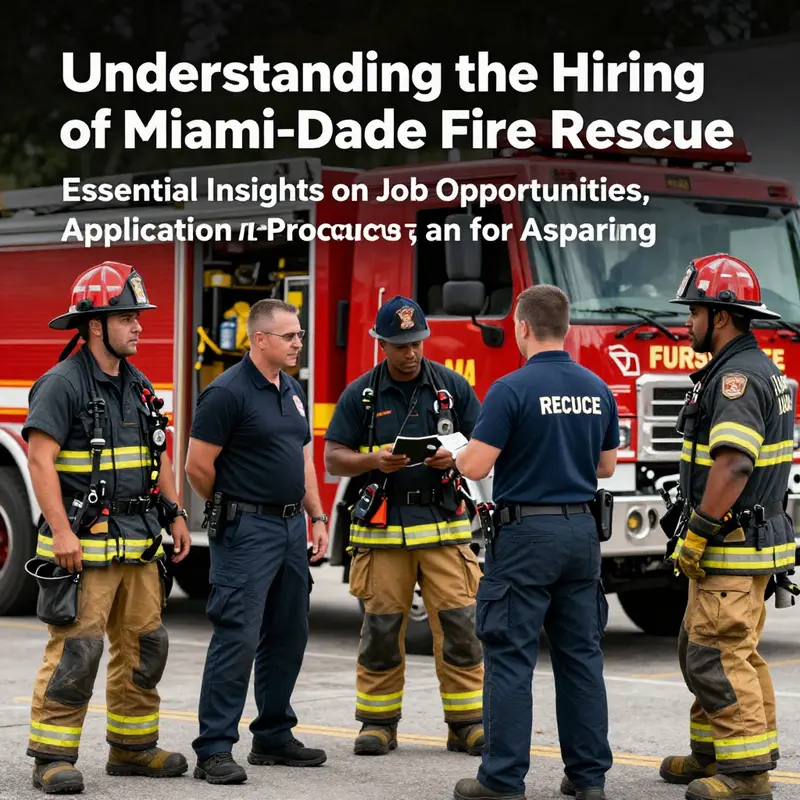
The Miami-Dade Fire Rescue is a pivotal emergency service within the community, dedicated to saving lives and ensuring public safety. As such, understanding when this vital organization is hiring is crucial for aspiring firefighters, emergency personnel, educators, and community residents. Given the dynamic nature of public service recruitment, this article dissects the current hiring status, job descriptions, application processes, testing procedures, and available resources for prospective applicants. By addressing these specifics, we aim to empower candidates with the knowledge they need to pursue a fulfilling career serving their communities.
Navigating the Hiring Horizon: Understanding When Miami-Dade Fire Rescue Recruits and What Prospects Look Like in 2026
The question of when Miami-Dade Fire Rescue will hire is not a simple calendar query. In large urban counties like Miami-Dade, recruitment tends to unfold as a lived cycle rather than a fixed annual event. The department operates within a web of constraints that include personnel needs, budget approvals, retirement rates, training capacity, and evolving public-safety demands. As of February 3, 2026, there is no publicly announced, standing recruitment window posted by the department. That absence on the official channels is itself a signal: openings are typically triggered by concrete vacancies and the ability to fund new positions, rather than by a pre-scheduled hiring season. For job seekers, this means a different rhythm than you might expect from private-sector hiring or even from some other public agencies with set annual timing. The prudent approach is to stay continuously aligned with the department’s official avenues, because those are the sources that will publish the exact roles, deadlines, and testing timelines when the next round begins.
The most reliable beacon for future opportunities remains the Miami-Dade Fire Rescue Careers page. There, the department consolidates current openings and outlines the path from application to appointment. The nature of the roles typically spans firefighting positions, emergency medical technician and paramedic tracks, and administrative or support staff who enable frontline services. Even when no positions are posted, the page is the best place to confirm whether a requisition is in play, what the qualifications are, and what the department expects in terms of experience, certifications, or educational prerequisites. Applicants who want to be prepared should note that the recruitment process in this field commonly includes several well-defined stages: a written examination to assess baseline knowledge, a physical ability test to determine readiness for the demands of the job, and an interview to evaluate judgment, communication, and cultural fit within the team. The sequence may also incorporate background checks, medical clearance, and drug screening, all of which are standard in public-safety recruitment. While the specifics can vary from one recruitment cycle to the next, the core framework—application, testing, interview, and evaluation—remains a consistent map for aspirants.
Given the unpredictability of openings, a proactive plan helps maintain momentum. First, keep an eye on the official careers page for Miami-Dade Fire Rescue. Even when there is no vacancy, the site often provides guidance on eligibility, required certifications, and the general timeline for when recruiting activities begin. Second, recognize that hiring is inherently tied to the county’s broader human resources strategy. The Miami-Dade County HR Department publishes a broader set of government job opportunities, and its portal can surface postings that influence when fire-rescue positions might become available, particularly for administrative or support roles that can complement frontline crews. For anyone considering a long view, subscribing to email notifications or regularly revisiting both the fire-rescue careers page and the county HR site helps ensure early awareness of openings and any changes to the application process.
Preparation, then, becomes a function of two parallel tracks: credentialing and fitness readiness, aligned with the official recruitment signals. For firefighter, EMT, or paramedic tracks, candidates should anticipate that certifications matter. EMTs and paramedics bring critical value; for firefighters, the standard path often requires or highly values basic emergency medical certification, fire science education, and a demonstrable commitment to public safety. Although the published materials do not enumerate every prerequisite in every cycle, they consistently emphasize that candidates must meet the department’s professional standards and pass the multi-stage assessment that follows a formal application. Prospective applicants should plan to document their certifications, gather letters of recommendation if requested, and be prepared to present a clean professional record as part of the background review. The physical element—whether framed as a structured physical abilities test or a job-specific assessment—should be anticipated early. Building endurance, strength, agility, and stamina ahead of application improves performance during the actual testing phase and reduces the risk of failing a crucial hurdle.
The timing of openings also hinges on the broader operational calculus of the county. Fire services are capital-intensive and staffing-sensitive, with budget deliberations and strategic planning cycles shaping how many personnel can be funded in a given year. When a vacancy arises, the department’s ability to fill it quickly depends on whether there is a sanctioned budget amendment, a new line item, or a reallocation that frees up funds for recruitment and training. In such cases, the department will typically launch an official recruitment push, publish the list of open positions, provide application instructions, and outline the schedule for examinations and interviews. Given the variability, candidates who intend to apply should not rely on a fixed timetable. Instead, they should maintain readiness across all the essential steps: the online application, the written assessment format, the physical test protocol, and the interview stage. Keeping a personal calendar ready to mark exam windows, fitness testing dates, and interview slots as soon as they are announced will reduce the friction that often accompanies the transition from dream to application to appointment.
An important facet of the process is the alignment of personal goals with the county’s public safety mission. Miami-Dade Fire Rescue, like many large departments, seeks individuals who bring not only physical capability but also teamwork, communication, and composure under pressure. The interview might probe scenarios common in fire-ground operations and emergency medical response, challenging candidates to articulate decision-making under stress. The right mindset is as critical as the right set of physical skills. For many applicants, success hinges on the ability to demonstrate a commitment to serving a diverse community, understanding the complex realities of emergency medical care, and showing a willingness to engage in ongoing training that sharpens both technical and interpersonal abilities. Training academies, once a candidate advances past the screening phase, further cement these competencies. The pathway from recruit to competent professional is structured, with a sequence of training assignments, ride-alongs, and supervised field work that shapes a new cohort of responders into a cohesive unit.
Beyond the mechanics of applying, the current landscape invites attention to the broader ecosystem of job opportunities in public service. The county’s careers portal is not limited to fire-related postings; it provides visibility into other departments, aiding candidates who might wish to explore cross-department opportunities or seek roles that leverage their skills in different contexts. Even if your ultimate goal remains a frontline firefighting position, understanding how other public safety and administrative roles fit into the county’s workforce strategy broadens the candidate’s perspective and can offer alternative pathways should direct openings be delayed. In practical terms, this means candidates should consider continuing education, maintaining certifications, and engaging with community programs or volunteer opportunities that align with public safety values. Such engagements not only strengthen a résumé but also deepen familiarity with the realities of service, which can be advantageous during interviews.
The caution against relying on rumor or unverified sources is particularly important in this space. As always, official channels are the trustworthy ground. The department’s own recruitment page is the definitive source for current openings, deadlines, and testing details. The Miami-Dade County HR site can also surface relevant postings that influence the broader hiring ecosystem. Prospective applicants should treat non-official messages with skepticism and prioritize government portals for accurate timelines and requirements. In the current climate of information sharing, this distinction matters as much as any physical test or written exam. The integrity of the process rests on transparency and verifiable information published by the agency itself.
To synthesize, the hiring rhythm for Miami-Dade Fire Rescue remains responsive to real-world needs rather than fixed calendars. The absence of an announced recruitment window on February 3, 2026, indicates that openings occur when vacancies materialize and funding is secured. The best strategy for potential applicants is to stay connected to the official careers page and, when possible, to monitor the county HR portal for related postings. Prepare along two axes: credentialing and physical readiness, and cultivate a resilient, service-oriented mindset that aligns with the department’s mission and the diverse community it serves. When the next opportunity appears, the pathway will be visible—clear in the posted job description, the listed steps of testing, and the schedule for interviews. Until then, readiness is the foremost asset, and proactive engagement with the right channels is the surest route to turning aspiration into appointment.
For readers seeking broader context on how these processes fit into the evolving landscape of public safety, a related exploration of fire-rescue systems’ innovation and station design can provide helpful perspective on what agencies value in the long term. The internal link below directs to content on a topic that complements the current discussion of hiring by situating recruitment within a broader conversation about how modern fire services adapt to changing communities and technologies: The Green Firehouse: Creating Sustainable Spaces for Community and Health https://tpbhrescue.org/the-green-firehouse-creating-sustainable-spaces-for-community-and-health/. This resource helps illuminate the environment in which future hires will operate, from station design to community engagement efforts, underscoring that recruitment is only one part of a continuous journey toward resilient, effective emergency response.
External resources for further information include the official Miami-Dade Fire Rescue careers portal, which provides the latest openings, testing timelines, and application steps, alongside the county’s general job opportunities page. These sources are essential for anyone plotting a practical course toward a firefighting career in this region. As you prepare, keep in mind that information can change rapidly; a vigilant, proactive approach ensures you do not miss the moment when an opportunity becomes available. The pursuit is not merely about meeting a qualification checklist—it is about committing to a mission, maintaining the fitness and readiness to serve, and aligning with a department that operates at the intersection of life-saving urgency and community stewardship. For continued updates and official postings, refer to the Miami-Dade Fire Rescue careers page and the county HR site. External reference: https://www.miamidade.gov/firerescue
null
null
Chasing the Call: Navigating When Miami-Dade Fire Rescue Is Hiring and What Applicants Need to Know
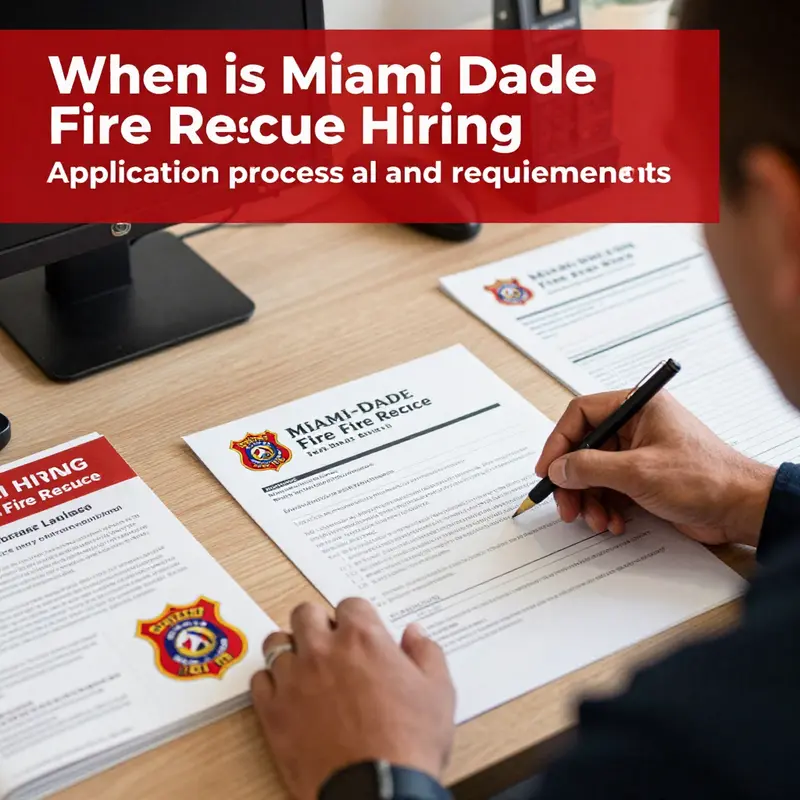
When a community relies on the steady hand of its firefighters, the timing of recruitment becomes more than a calendar entry. It is a hinge on which the safety of countless residents rests. In the case of Miami-Dade Fire Rescue, hiring windows are not fixed on a predictable schedule. The department tends to recruit in waves driven by personnel needs, budget cycles, and vacancy patterns rather than a standing, year-round posting. For anyone contemplating a career in this department, the most reliable compass is found on official channels rather than rumor or assumed timelines. The current guidance is straightforward: check the department’s official website for formal announcements, and if the timing is unclear, monitor the site and its linked resources regularly. This is not simply a matter of curiosity; it is about aligning preparation with opportunity and understanding that becoming a Miami-Dade firefighter requires both readiness and patience in equal measure.
The practical reality for prospective applicants is that the hiring process unfolds in stages that reflect the gravity of the role. First comes notification of open positions, which may include several tracks such as firefighter, emergency medical technician, and administrative support. Each track carries its own eligibility criteria, testing sequence, and documentation requirements. Because openings are not issued on a fixed cadence, it’s essential to cultivate a cadence of check-ins with the official channels. The department’s announcements arrive with details about the specific postings, application deadlines, and the testing timeline. Applicants should pay close attention to these particulars, as missing a deadline can mean waiting for the next recruitment cycle to open. The most trustworthy source of this information remains the department’s own platforms, where updates are posted in real time and where notifications can be pushed to interested candidates through digital channels.
Beyond the immediate announcements, there is another enduring truth: preparation cannot wait for a posting. A strong applicant pool collects many who bring varied life experiences, yet the core requirements tend to be consistent. Eligibility criteria typically cover age, educational background, physical fitness readiness, and a background that is compatible with a demanding public-service role. The physical demands, in particular, measure not only strength but endurance, speed, agility, and rhythm under stress. This makes early, consistent training valuable even before a formal invitation to apply lands in your inbox. In practice, a thoughtful preparation routine—balanced between cardiovascular conditioning, strength work, and recovering practices—helps ensure that when a window does open, a candidate’s performance will reflect genuine readiness rather than last-minute improvisation. The pathway to a successful application is not a sprint; it is a disciplined journey that aligns personal fitness, cognitive preparation, and a clear understanding of the job’s responsibilities.
The application process itself is a sequence of well-defined steps designed to verify an applicant’s fitness for service while ensuring fairness and transparency. While the exact order can vary by recruitment cycle, the typical flow includes an online application, a written examination, a physical ability test, an interview, and a comprehensive background and medical review. Each stage serves a distinct purpose. The written exam assesses foundational knowledge relevant to firefighting and emergency response, while the physical ability test simulates the real-world tasks firefighters perform, such as carrying equipment, climber work, and obstacle navigation. Interviews explore situational judgment, decision-making under pressure, and the personal characteristics that contribute to team cohesion and community trust. Finally, the background investigation and medical evaluations confirm suitability for a role that places the public’s welfare at the center of every shift.
As a baseline, prospective applicants should routinely consult the Miami-Dade Fire Rescue official site for the official application portal and guidelines. The site will specify required documents, such as proof of education, certifications, and any state or national licensure prerequisites. It can also outline the exact testing windows, including the timeframes for written tests and the locations and dates of physical assessments. Because these pieces of information are subject to change, relying on the official announcements ensures compliance with current expectations and avoids missing critical steps. In addition to the department’s site, there is value in consulting the Miami-Dade County HR Department page for broader government job postings that can intersect with the fire service, particularly for administrative or support roles that still require the same level of integrity and public service orientation as frontline firefighting.
Preparation for the process is as important as understanding the process itself. A disciplined approach to study—covering fire science fundamentals, emergency medical protocols, and situational judgment—can markedly improve performance in the written and oral components. For those who want a structured, accessible resource, the official app offers a practical companion. It provides real-time updates on job openings, application status, and study guides that align with the testing framework used by the department. This can be a particularly valuable tool because it consolidates timely announcements and preparation materials in one place, reducing the need to chase multiple sources. Engaging with these resources early in the cycle increases the odds that a candidate will arrive at each step confident and prepared rather than reactive. The blend of formal posting information and proactive study is where preparation meets opportunity in a very tangible way.
In thinking about the conditions that shape a successful candidacy, it’s useful to reflect on the broader environment of modern fire service in a busy urban county. Miami-Dade County’s demographics and geography demand a workforce that can operate across a wide spectrum of emergencies—from high-rise incidents and coastal rescues to everyday medical emergencies and community risk reduction. That breadth of responsibility places a premium on mental agility, teamwork, and a readiness to adapt. The hiring process mirrors this by evaluating not only technical capability but the social and ethical dimensions of service: accountability, communication under pressure, and a steadfast commitment to public safety. The recruitment cycle, therefore, is as much about selecting individuals who will be reliable teammates under stress as it is about measuring raw physical prowess. In this sense, the process serves a dual purpose: it safeguards the public while fostering a culture of resilience, continuous learning, and mutual trust among those who wear the badge.
For candidates who wish to visualize their place in this continuum, a practical approach is to map out a personal timeline that aligns their training milestones with anticipated posting patterns. This means identifying the minimum standards and the ideal week-by-week plan for fitness, cognitive drills, and study sessions. It also means building a network within the firefighting community—mentors, current or past applicants, and professionals who have navigated the process successfully. Such connections can offer insights into the nuances of each testing phase, the pacing of interviews, and the practical realities of the background screening. While this guidance comes from observed patterns and shared experiences, the official postings remain the ultimate authority. The channel between preparation and opportunity is narrow but navigable when one remains informed, disciplined, and patient.
The horizon of a career in Miami-Dade Fire Rescue is bright for those who pursue it with steady intent. It is a path that rewards persistence and a clear alignment between personal readiness and the demands of the job. The department’s commitment to safeguarding the community is matched by its expectation that new recruits will approach their responsibilities with integrity, humility, and teamwork. To those preparing for a future role, the message is simple but meaningful: stay engaged with official channels, prepare consistently, and approach each stage with an understanding of the department’s mission and the realities of public service. The recruitment cycle may not announce itself with a fixed date, but the opportunity is real and accessible to those who are prepared when the moment arrives. In the evolving landscape of urban firefighting, readiness remains the most reliable form of readiness—a state of preparation that translates directly into effective, life-saving action when it matters most.
This emphasis on a prepared, patient, and informed approach sits in conversation with broader discussions about how fire departments evolve to meet contemporary needs. As infrastructure, health considerations, and community expectations shift, the environments in which firefighters operate also transform. Contemporary design and sustainable practices within fire stations, for instance, influence recruitment by shaping the culture and daily routines of the workforce. For readers curious about how these broader ideas connect to personnel decisions, the concept of a healthier, more sustainable fire service is explored in depth in a related discussion titled The Green Firehouse, which examines how the physical and operational spaces of fire departments can support better health, efficiency, and community outcomes. The linked piece provides context for understanding how the environments in which firefighters train and work intersect with the kinds of people a department seeks to recruit and retain. The Green Firehouse offers a perspective on design and culture that complements the practical focus on timelines, testing, and preparation described here.
In all of this, the central takeaway is clarity and consistency. Miami-Dade Fire Rescue does not publish fixed hiring dates in advance; instead, it communicates opportunities through official channels and relies on a multi-stage process to assess candidates comprehensively. Prospective applicants should keep a steady watch on the official site, consider enrolling in the app for immediate updates, and build a long-term plan that blends fitness, study, and professional networking. The journey may have uncertain intervals between announcements, but the path to eligibility remains well-defined, and the steps to participate—when a window opens—are straightforward for those who have prepared in advance.
For those who want to engage more directly with the ongoing conversation about readiness, the official app stands out as a practical touchpoint. It aggregates job postings, status updates, and exam preparation resources in one accessible interface, reducing the friction that can derail a candidate at the last minute. Access to study guides and testing information through the app can help align study priorities with the actual testing framework used by the department, ensuring that effort translates into measurable performance on exam days. The app is a reliable companion for anyone pursuing a role with Miami-Dade Fire Rescue, especially when combined with disciplined personal training and a strategic approach to the application timeline. Real-time updates, clear instructions, and sustained attention to the department’s announcements are the elements that turn potential into participation, and participation into a successful career that serves a diverse and dynamic community.
Internal link reference: The Green Firehouse article provides additional context about how the physical and cultural environments of fire stations influence the work of the department and its people. You can explore that discussion here: The Green Firehouse.
External resource: For ongoing updates and study resources tied to the firefighter exam, consult the official Miami-Dade Fire Rescue app, which provides real-time postings and preparation materials. https://apps.apple.com/us/app/miami-dade-fire-rescue/id1502469738
Timing the Call: Inside Miami-Dade Fire Rescue Hiring, Exam Schedules, and Testing Pathways
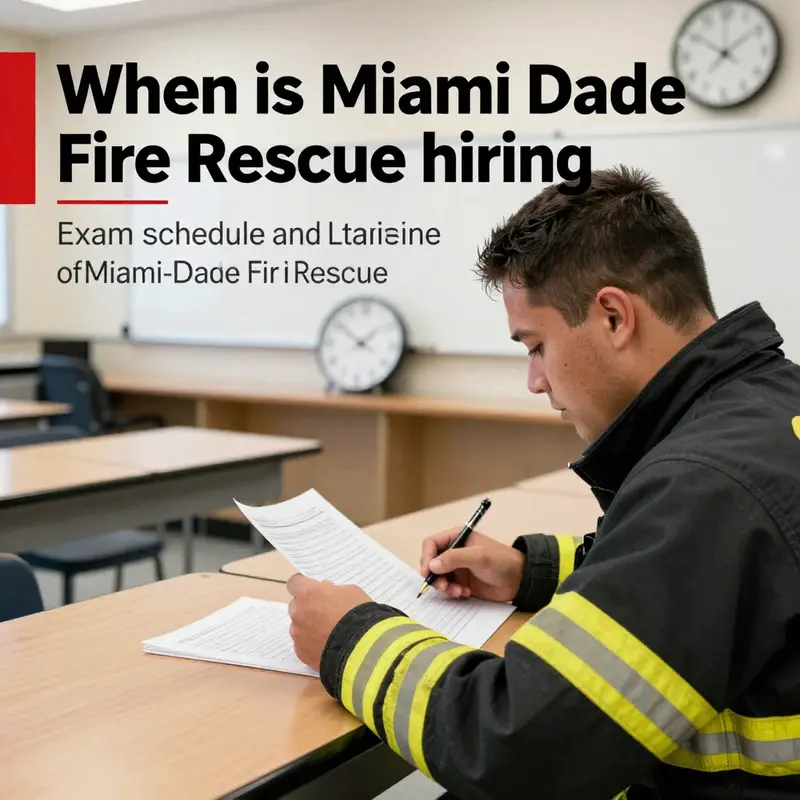
When a city’s fire rescue service invites new recruits, it is rarely a simple, single-day event. For Miami-Dade Fire Rescue, hiring cycles arise from the ebb and flow of vacancies, budget realities, and the department’s immediate staffing needs. The department does not publish fixed annual recruitment calendars; instead, announcements surface whenever positions open. This means a candidate’s best strategy is steady vigilance: check the official site for career opportunities, and subscribe to notifications if the option exists. It is a process built on transparency, but also one that rewards preparation, patience, and timely action. As you map your path toward joining the Miami-Dade Fire Rescue team, you enter a sequence that begins with a formal online application and proceeds through several evaluative steps designed to vet candidates against the department’s standards for knowledge, physical capability, judgment, and resilience. The sequence is not merely a test of memory or strength; it is a structured expedition through a set of qualifications that together determine whether a candidate can meet the demands of real-world emergency response. The recruitment cycle may shift as vacancies emerge, or as the county’s finances and priorities shift. This variability underscores the importance of monitoring the official recruitment pages closely. The Miami-Dade Fire Rescue site is the most authoritative source for posting dates, job titles, and the specific steps candidates must complete. A core reality for prospective applicants is that there is no guaranteed timetable; yet there is a clear, repeatable pipeline that, when followed, positions a candidate to respond quickly to each new opportunity. The first known constant in this process is the online application. All candidates must submit their information electronically through the County’s official recruitment portal. This portal serves as the gateway to eligibility screening, which will determine whether a candidate advances to the test phases. The screening itself is not a mere formality; it is an initial filter that checks for baseline qualifications and essential documentation. Those who clear this screening are ushered into a written exam, which is the first major hurdle in the evaluation of aptitude and readiness for service. The written exam is designed to assess a blend of fire knowledge, logical reasoning, numerical ability, and reading comprehension. It is not a memory test alone, but a measure of how well a candidate can apply information under pressure, interpret complex information, and solve problems that arise in routine and emergency contexts alike. Preparation for this stage should be deliberate and targeted. While the exact content can vary with each recruitment cycle, the categories—fire knowledge, reasoning, mathematics, and comprehension—tend to recur with enough consistency to allow for meaningful study plans. A second pivotal component of the process is the Physical Ability Test, or PAT. The PAT is intentionally demanding, mirroring tasks firefighters perform in the field. It commonly includes activities such as running or brisk movement under time constraints, weighted walks to simulate the endurance required to carry equipment, ladder climbs to test grip and upper-body strength, and other tasks that approximate real firefighting scenarios. Training to excel at the PAT should begin well ahead of any announced test date, with a focus on endurance, functional strength, and technique for efficient movement under fatigue. The PAT, by its nature, is as much a test of consistency and approach as it is of peak performance. After the written exam and PAT, candidates may be invited to participate in a structured interview. The interview is designed to gauge communication skills, situational awareness, and the capacity to respond with clarity and professionalism in high-stress situations. A well-rounded performance in the interview often reflects a candidate’s potential to work within a team, to listen actively, and to articulate decisions in a manner that commands trust in urgent moments. The interview, while subjective in its judgment, is standardized through a framework that helps ensure fairness and reliability across applicants. Following these stages, the final steps typically involve a background check and a health examination. The background check is comprehensive, covering criminal history, driving records, employment history, and other factors that bear on public safety responsibilities. The health examination ensures that a candidate meets the medical standards necessary to perform the physically demanding duties of a firefighter. Taken together, the sequence from online application through background and health confirmation constitutes the end-to-end hiring path. While it can be lengthy, each stage has a clear purpose: to ensure only those who demonstrate the requisite knowledge, physical fitness, judgment, and integrity move forward. The department emphasizes that the schedule for each phase is published on its official pages, and it is common for the written exam and PAT dates to be posted separately from job postings. This split approach allows the agency to manage testing logistics more effectively while giving candidates time to prepare for each phase in sequence. Practically, a candidate who wants to succeed should plan for a multi-step journey rather than a single assessment day. The timing of those steps matters as well. Since openings are not announced on a fixed cadence, candidates should anticipate a cycle that can unfold over weeks or months from initial posting to final selection. Staying in contact with the recruitment portal—checking for new postings, reviewing eligibility notes, and noting deadlines for each stage—helps prevent missed opportunities. In practice, applicants often discover that the most reliable way to stay informed is to set routine checks on the department’s site and to register for any available notifications. The human resources arm of the county, Miami-Dade County Human Resources Department, also offers public postings for government jobs, which can accompany Fire Rescue recruitment in visibility and reach. While the Fire Rescue site remains the primary source for firefighting positions, cross-referencing HR postings can yield additional context about timelines, required documents, and the preparation resources available to candidates. For those who are serious about pursuing a career in firefighting within the county, the process is a disciplined blend of ongoing preparation, precise attention to published schedules, and a readiness to advance quickly when openings appear. Beyond the mechanics of the tests, prospective applicants should consider the broader competencies that undergird successful performance in fire-rescue roles. These roles demand situational judgment, effective communication with diverse teams, and the composure to operate under life-or-death pressure. The structured interview, for many, is the area where these capabilities are most clearly demonstrated. Practicing responses to scenario-based questions can help applicants articulate thoughtful decisions, demonstrate teamwork, and reveal the professional demeanor that the department values. There is a known resource for developing these soft skills, one that, while not specific to firefighting, is relevant to mastering high-stakes conversations and interactions. For those seeking to strengthen conversational clarity under pressure, resources such as Becoming a Great Conversationalist offer transferable insights that can benefit interview performance. The link to that kind of guidance can be found at this resource: Becoming a Great Conversationalist. While it does not replace formal interview prep, it complements the preparation by sharpening the ability to listen, respond, and project calm confidence in demanding exchanges. In practical terms, preparing for Miami-Dade Fire Rescue recruitment should be a holistic effort. Build a plan that aligns with the official testing sequence, allocate time for each stage, and set milestones that mirror the posted schedules. Start early with the online application, ensuring all supporting documents are accurate and complete. If you reach the eligibility review stage, be prepared to provide clarifications or additional materials promptly, as delays in document submission can stall the process. When the written exam dates are announced, tailor a study plan that covers the core topics while building test-taking stamina. As the PAT date approaches, shift the focus to functional strength and cardiovascular conditioning, integrating practice runs and simulated rescue moves into a weekly routine. As interviews approach, enter with a clear narrative about your motivation, your understanding of the firefighting role, and your teamwork philosophy. Finally, anticipate the sequence that follows, including background verification and a medical evaluation, and organize your personal and professional references, medical history, and any required documentation accordingly. The entire process hinges on two pillars: timely information and disciplined preparation. The department’s practice of posting schedules and requirements publicly means that an applicant who remains engaged and prepared can move with confidence when an opportunity arises. It is, in effect, a test of consistency as much as a test of capability. In this light, the question “When is Miami-Dade Fire Rescue hiring?” translates into a strategic posture: stay informed, prepare comprehensively, and respond decisively when a vacancy opens. The practical takeaway for readers is straightforward. Regularly visit the Miami-Dade Fire Rescue official site for current postings and testing timelines. Do not rely on rumors or sporadic notices; rely on the formal channels that govern county employment. If you need support during the process, the Miami-Dade County Human Resources Department provides a help line at (305) 375-4700 to answer questions about eligibility and application procedures. In sum, the hiring landscape is dynamic, but the pathway through it is clear. A candidate who is attentive to published schedules, prepared across cognitive and physical dimensions, and ready to engage in a structured interview can navigate the process with confidence. The result is not just a successful test score, but a credible demonstration of the readiness to contribute meaningfully to a team charged with protecting lives and property. The blend of online preparation, physical readiness, and interpersonal skill forms the core of what Miami-Dade Fire Rescue seeks in its new firefighters, emergency medical technicians, and support staff. As you chart your own journey, remember that the timeline may shift, but the steps remain stable. A well-timed application, coupled with focused effort across each stage, can place you in a favorable position when the next cycle opens. This is the rhythm of public safety recruitment: alert, assess, apply, prove, and join. External resource: Miami-Dade Fire Rescue official site. https://www.miamidade.gov/fire
When the Bell Rings Again: Navigating Miami-Dade Fire Rescue Hiring Windows and Preparing for the Next Test
The idea that a fire department operates on a fixed hiring calendar is a practical illusion. In practice, recruitment for Miami-Dade Fire Rescue unfolds in response to real world needs—budget realities, staffing gaps, and shifting service demands. As of early 2026, there is no publicly published year long schedule for openings. Instead, positions appear when vacancies emerge, and the department communicates forthcoming opportunities through its official channels. For anyone plotting a path to join the team, this means staying vigilant rather than waiting for a single inevitable application window. The official Miami-Dade County Fire Rescue site remains the primary touchpoint for postings, descriptions, eligibility criteria, and application instructions. A related but broader source is the county HR site, which hosts government wide postings and policy updates that can affect eligibility and the timing of hiring cycles across agencies. The upshot is simple: readiness matters as much as timing, and the path to employment hinges on access to timely information and disciplined preparation.
Within Miami-Dade Fire Rescue there are several roles that commonly attract applicants. The backbone of the department’s field operations rests with firefighters, the core role most people envision when they imagine a fire rescue career. Beyond that, the department periodically seeks Fire Rescue Officers or other support positions that keep the system running—from dispatch or administrative roles to technical or logistical support that ensures a fast coordinated response in emergencies. The market for these roles can ebb and flow with budget cycles and project based needs, but the underlying prerequisites professionalism, physical fitness, and a clear sense of public service remain constant through every hiring wave. The ongoing nature of recruitment where openings arise and disappear, sometimes within weeks, drives a pragmatic approach for candidates. Instead of chasing a single deadline, aspiring applicants should cultivate a steady cadence of monitoring the official announcements and preparing in parallel for the full spectrum of assessments that the department typically employs.
Applicants should anchor their efforts on the official sources. The Miami-Dade Fire Rescue page is the go to for current openings, with each listing including job descriptions, eligibility requirements, and explicit application instructions. In addition, the Miami-Dade County HR site offers a broader view of government postings and helps candidates understand how county wide processes might impact the timing or sequencing of Miami-Dade Fire Rescue opportunities. These channels work best when used in tandem: monitor postings, review the descriptions carefully, and prepare document packets in advance so you can act quickly when a position aligns with your qualifications. The reality is simple but essential: on time applications often correlate with better odds, particularly in agencies where testing slots or interview panels fill quickly.
From a strategic standpoint, prospective applicants should orient themselves toward the multi stage nature of the hiring process. A typical cycle begins with submitting an online application through the official platform. If your profile aligns with the posted requirements, you may advance to the examination phase, which commonly includes a written test designed to assess reading comprehension, mathematical problem solving, and situational judgment that reflects the job realities. Following the written assessment, many departments including this one, incorporate a physical ability test to evaluate stamina, upper body strength, and endurance—factors critical to the demands of firefighting and rescue operations. The process often culminates in an interview or a panel discussion, where candidates are evaluated on communication skills, teamwork, problem solving approach, and composure under pressure. Throughout, a background check and medical clearance steps ensure not only capability but safety and reliability in a role that involves high risk life critical tasks.
With that framework in mind, preparation becomes the best form of near certainty. Candidates should begin by curating a robust set of qualifications and credentials. For many fire rescue tracks, foundational certifications such as EMT Basic or Firefighter I II certifications mark eligibility or significantly strengthen an application. Even for administrative or support roles, relevant professional credentials and demonstrated experience in public service, emergency management, or operations can tilt the scales in a candidate’s favor. It is equally important to assemble a compelling resume and a concise narrative that connects your experience to the job’s core demands: rapid decision making, teamwork under pressure, and a commitment to public safety. Beyond credentials, physical preparation remains crucial. The physical aptitude portion of the process tests endurance, strength, and agility under standardized conditions, so a well structured fitness regimen should be part of a candidate’s routine well before any posting appears. Planning ahead to meet medical and legal prerequisites such as background checks and any required medical clearances can save valuable time when a window opens.
In this environment of intermittent postings, information literacy becomes a practical skill. Track official notifications not just for openings but for related scheduling events: upcoming exams, physical tests, and interview timelines. The department site typically publishes these events, sometimes with limited notice, and reservation in a timely manner can affect your ability to participate. Similarly, the county HR site can provide broader context for how vacancies are processed, what forms to prepare, and how to manage parallel applications if you are considering multiple government positions. A well prepared candidate will also map a personal timeline that aligns with these cycles setting quarterly goals to acquire credentials, maintain fitness, and refine interview skills. The result is not a single moment of opportunity but a sustained rhythm of readiness that increases the likelihood of catching the right opening when it appears.
For those who want a practical compass while they monitor official channels, a few concrete steps can help. First, build a folder with all essential documents proof of certifications, your resume, references, and any required background information. Second, review the job descriptions carefully; even within the same department, roles can demand different combinations of experience and skills. Third, invest time in test preparation resources that mirror the department’s assessment style. Practice questions that assess judgment under pressure, review firefighting terminology, and ensure you can articulate clear concise responses in interviews. Finally, stay aware of the broader labor market context. While the department primarily fills its own openings, job boards and recruitment aggregators often surface positions within the county that share related qualifications, providing a broader signal about the competitiveness of the field and the pace of hiring across the region.
As you plan, you might consider how contemporary recruitment philosophies align with the broader mission of public safety. The idea of a sustainable community focused fire service resonates with a broader literature on effective recruitment and retention. The concept of a green firehouse, for instance, symbolizes a forward thinking approach to resources, health, and community well being in fire stations. Reading about such perspectives can enrich a candidate’s understanding of the profession beyond the uniform and the badge. The green firehouse concept offers a mental model for how a department can balance operational readiness with long term health and environmental stewardship, a reminder that the role you seek is part of a larger system committed to resilience.
The practical path remains grounded in reliable information and steady readiness. Regularly visiting the official Miami-Dade Fire Rescue site ensures you don’t miss a posting, an eligibility update, or a change in application instructions. Checking the county HR site adds a macro perspective that can illuminate how city and county processes interact with departmental timelines. In parallel, monitoring external job boards like Indeed can help you gauge the market dynamics: you may see a pulse of activity that hints at when openings are more likely to appear and how many candidates are applying for similar roles. For those who want a benchmark, current listings on Indeed show a substantial number of opportunities within the Fire Rescue field in the Miami-Dade area, offering a window into the level of competition and the types of qualifications that employers are prioritizing at the moment. While these listings are not substitutes for official postings, they can help you calibrate your preparation and expectations.
The journey toward becoming a member of Miami-Dade Fire Rescue is thus a blend of disciplined readiness, proactive information gathering, and a willingness to engage the process over time. There is no single date to circle on a calendar; there are instead recurring moments when the department invites qualified applicants to move forward. Your best strategy is to maintain a state of readiness: keep your certifications up to date, refine your physical conditioning, tailor your resume to firefighting and emergency response roles, and practice the interview format you are likely to encounter. When a posting does appear, you will be poised to move quickly submitting a complete, accurate application, meeting any deadlines, and preparing for the multi stage assessment that will determine your fit for the team. In recognizing the layered nature of this pursuit, it is also worth acknowledging how the hiring process reflects the department’s broader mission: reliability, courage, and service under pressure. The tests and interviews are not just gatekeeping steps; they are designed to identify candidates who can think clearly in crisis, communicate effectively with teammates, and maintain composure when lives are on the line. Those who approach the process with honesty, perseverance, and a genuine commitment to helping others tend to navigate the rigorous stages with confidence. The experience of preparing for and participating in these assessments can itself be transformative, revealing strengths, gaps, and opportunities for growth that extend far beyond a single job opportunity.
For seekers who want to stay anchored in practical steps while also absorbing the larger culture of the department, the balance between preparation and timing is essential. Expect occasional shifts in timelines and be ready to adapt your plan accordingly. If you find yourself awaiting a posting, use that interval to deepen your qualifications, broaden your network within the emergency services community, and sharpen your ability to articulate how your experience aligns with the department’s needs. By treating each potential window as a chance to demonstrate readiness rather than a one off chance to land a role you increase your chances of turning a tentative opportunity into a lasting career. And when the bell finally rings for a new opening, you will be ready to respond with the calm capable and capable performance that Miami-Dade Fire Rescue and the community rely on.
Final thoughts
Staying informed about Miami-Dade Fire Rescue’s hiring status is imperative for those aspiring to join this esteemed organization. Each aspect of this process—from understanding job availability and descriptions to navigating the application details—plays a crucial role in a candidate’s journey. Engaging with available resources and keeping abreast of updates can significantly enhance your chances of successfully entering this demanding yet rewarding profession. The dedication of Miami-Dade Fire Rescue to serving the community continues to inspire new generations of emergency service personnel.