
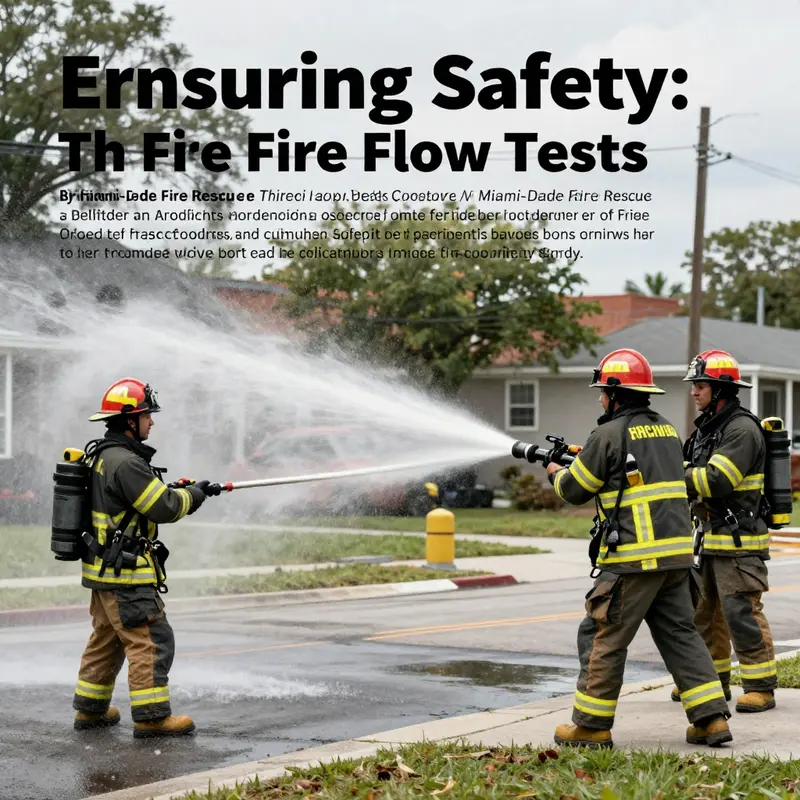
Fire safety is an essential aspect of community well-being, particularly in urban environments where rapid responses to emergencies can save lives. The Miami-Dade Fire Rescue Department plays a pivotal role in maintaining fire safety standards in the county. One critical component of their fire protection strategy is the fire flow test, a systematic approach to evaluating the adequacy of the water supply. This article will explore the importance of fire flow tests, the procedures involved, their impact on the fire safety infrastructure within Miami-Dade County, the analysis of results, and future developments anticipated in this area. Each chapter will build on the previous one to provide a holistic understanding of how these tests contribute to the overall safety and security of the community.
Flow, Pressure, and Protection: How Miami-Dade Fire Rescue Tests the City’s Water Supply for Firefighting
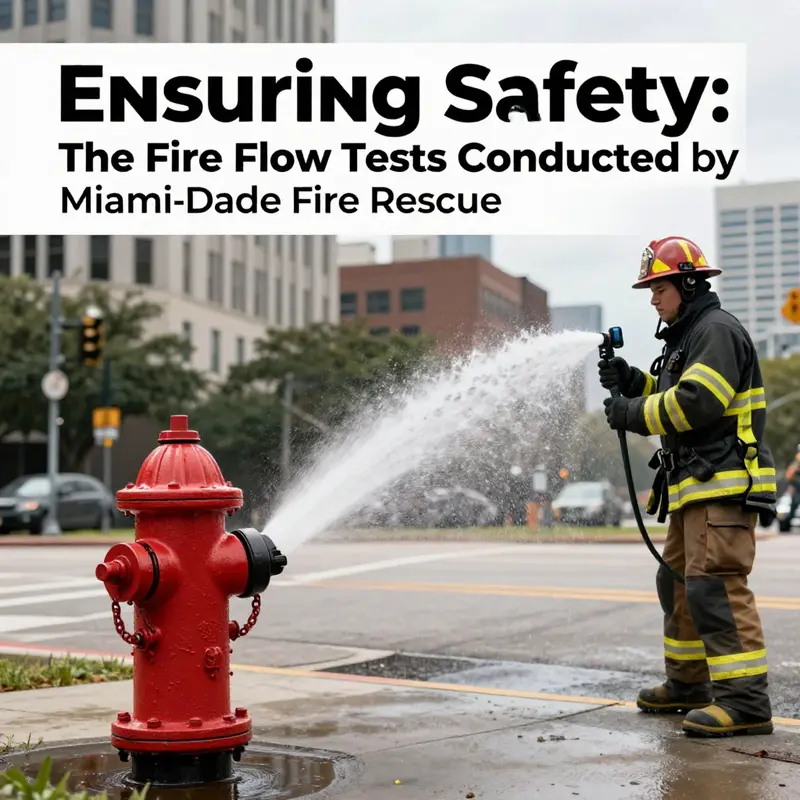
In the practical theater of urban danger, water is both instrument and shield. For Miami-Dade County, where the climate presses in from the coast and the skyline is a jagged chorus of apartment towers, the reliability of water supply under pressure becomes a defining metric of public safety. Miami-Dade Fire Rescue treats fire flow testing not as a ceremonial checkbox but as a deliberate, ongoing discipline that translates geographical complexity into actionable resilience. The tests probe a fundamental question: can the county’s hydrants, mains, and storage facilities deliver enough water quickly enough to sustain a coordinated fire attack, even when the scene is at once crowded, dynamic, and imperfect? The answer determines not just whether a ladder truck can reach a high rise or a pumper can sustain a long line, but whether every resident and worker has a predictable, dependable line of defense when seconds matter.
Fire flow testing unfolds as a careful, staged inquiry into the hydraulic truth of a living city. Technically, the process centers on measuring how much water a hydrant can deliver under pressure while the system is loaded as it would be during a fire. This involves opening hydrants in a controlled sequence, capturing pressure readings at multiple points in the network, and directing the flow through calibrated measurement devices that quantify gallons per minute with precision. The tests are designed to reflect realistic firefighting conditions: water is drawn at steady rates, pressure is allowed to dip, and the performance of the entire distribution network is observed under stress. In practice, a field team will select hydrants that represent diverse network conditions—locations near high-density developments, corridors with aging or undersized pipes, and nodes at the intersection of multiple mains. Each test not only answers “how much water can be delivered” but also reveals how pressure changes as demand rises, which routes heat and friction introduce, and where losses erode the firefighter’s ability to achieve an effective fire attack. This combination of measurement, observation, and interpretation creates a map of capability that is both granular and strategic, a map that informs day-to-day operations and long-range planning alike.
The reality of a coastal, urban county introduces hydraulic complications that can tax even well-designed systems. High-rise districts present a particular challenge because vertical lift imposes additional energy requirements on pumps and a greater need for adequate pressure at the point of use. Commercial districts with dense occupancy can demand rapid, high-volume water delivery to multiple points of attack, while residential neighborhoods with aging infrastructure risk friction losses that accumulate across long mains and dead-end lines. Fire flow tests surface these vulnerabilities with clarity. They reveal pressure pockets where resilience is thin, pipes that constrict flow, and hydrants that underperform compared to their neighbors. They also validate strengths: in some zones, the distribution network can sustain robust flows even under simultaneous demand from several hydrants, illustrating a high degree of redundancy and a capacity to adapt to evolving emergency scenarios. The knowledge gained is not theoretical. It informs where to prioritize upgrades, which segments of the system require valve realignments, and where new mains or booster facilities would most effectively elevate performance without destabilizing surrounding networks. In this sense, fire flow testing becomes a strategic instrument for infrastructure stewardship, aligning firefighting readiness with the broader goals of utility reliability and public service.
Beyond the physical measurements, the tests are deeply bound to the department’s risk assessment and incident response frameworks. The data feed into risk maps that guide pre-planning for responses in high-risk neighborhoods and commercial districts. They shape training curricula, too. Firefighters rehearse tactics that align with the known capabilities of the water supply, practicing scenario-based commands that assume certain pressures and volumes at strategic points in the system. When a hydrant is found to underperform, the implications cascade through command decisions, from initial size-up to water shuttle strategies and the choice of alternate water sources. This is not merely about pumping more water; it is about preserving safety margins for crews operating under high heat, thick smoke, and complex terrains. It also fosters a culture of continuous improvement, where engineers and frontline responders dialogue about what the flow numbers imply for protection plans, building codes, and even future street layouts that might better accommodate emergency water distribution.
The methodology of Miami-Dade’s fire flow testing embodies a practical synthesis of hydraulic science and field prudence. A technician monitors residual pressures while flow is introduced through hydrants, capturing simultaneous data streams that illuminate how pressure decays with rising demand. The team evaluates the performance across different hydrant configurations, including standpipes and interconnected mains, to understand how the network behaves when a single hydrant is fully engaged versus when several are activated in a coordinated effort. This approach acknowledges that fires rarely unfold in isolation; they often involve multiple fronts, variable fuel loads, and shifting water needs as crews advance, ventilate, and apply suppression tactics. The resulting pictures of pressure and flow become the backbone of risk-informed planning. They support decisions about pipe sizing, valve placement, and the allocation of capital resources to upgrade aging segments or integrate new transmission mains that distribute pressure more evenly across a canyon of streets and neighborhoods. The end product is a data-rich narrative that translates abstract hydraulic capacity into tangible protection for residents.
To chronicle and contextualize progress, Miami-Dade Fire Rescue maintains a public-facing channel for fire safety initiatives, including fire flow testing updates. The cadence of notifications informs property owners, developers, and neighborhood associations about planned tests, potential temporary traffic impacts, and the general purposes of the exercise. This transparency helps cultivate trust and fosters community understanding of the essential work that keeps a dense urban area resilient. Within the broader ecosystem of safety, the testing program also serves as a catalyst for cross-disciplinary collaboration. Utilities engineers, city planners, and emergency managers converge to interpret results, explore what-if scenarios, and align water system improvements with land-use planning and climate resilience goals. In an era when heat waves and droughts stress municipal water resources, the ability to anticipate shortages and re-prioritize flows during an incident becomes not just prudent but indispensable.
The narrative of fire flow testing in Miami-Dade would be incomplete without acknowledging the impulse toward innovation that threads through contemporary fire service culture. The discipline is not static; it evolves with new insights about urban design, climate risk, and the frontiers of hydraulic modeling. For readers who want to glimpse how contemporary ideas shape practice, consider the broader conversations happening in related spaces—where innovation museums and forward-looking exhibitions explore how data, sensors, and systems thinking reshape public safety. One such thread is captured in an exploration of how museums and institutions are reimagining the knowledge ecosystem around firefighting—an idea that helps illuminate why Miami-Dade Fire Rescue treats flow testing as part of a larger mission to anticipate, adapt, and improve. Innovation Museum Transforming Fire Services offers a compact lens into how emerging concepts can inform field operations, training, and policy in meaningful, leadership-driven ways.
The practical implications of fire flow testing extend beyond the immediate test day. When a report identifies a region with chronically low pressure, the department prioritizes a set of corrective actions: upgrading undersized pipes, installing additional storage or pumping capacity, reconfiguring valve arrangements to reduce friction losses, and coordinating with water utilities to ensure that peak demand does not overwhelm availability during critical periods. These decisions ripple through construction codes and development plans, guiding engineers and builders to design new structures with water supply considerations that anticipate the realities of a high-density urban fabric. They also shape the ongoing education of firefighters who, together with incident commanders, rely on predictable water delivery to choreograph suppression efforts, establish safe withdrawal points, and protect both responders and the public in dangerous environments. In this way, the fire flow tests knit together the threads of engineering, governance, and human response into a coherent fabric of protection.
The cadence of testing and reporting, the cadence of maintenance and upgrades, the cadence of training and real-world application—all of these cohere into a single narrative: a city that cannot be complacent about its water supply cannot claim true readiness for emergencies. Miami-Dade’s experience demonstrates that the value of a fire flow test lies not only in the numbers produced on a gauge but in the disciplined, cross-functional work they unleash. It is a reminder that fire protection is rarely a solitary act by a single team. It is a choreography that requires hydrants and mains to speak with pumps, valves, and meters, and for those conversations to be understood by engineers, planners, and incident commanders who must translate data into decisive action under pressure. As the county continues to grow and evolve, the fire flow testing program remains a critical instrument for safeguarding lives, preserving property, and sustaining the city’s capacity to respond when the alarm sounds.
External resource: https://www.miamidade.gov/fire/
Flow Under Pressure: How Miami-Dade Fire Rescue Tests Water Flow to Protect the County
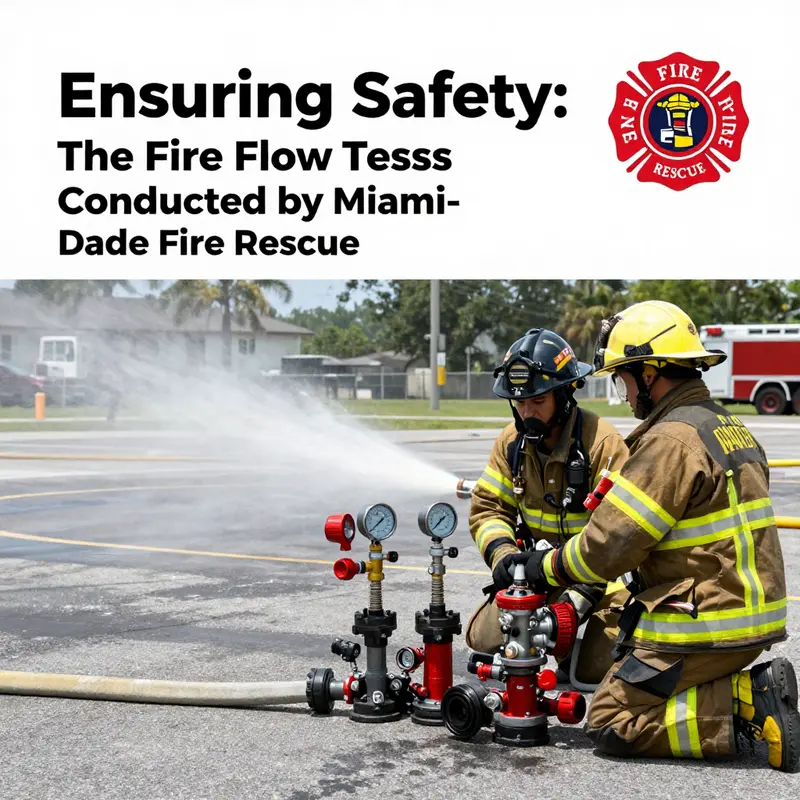
Flow tests sit at the intersection of engineering, emergency readiness, and public safety. In Miami-Dade County, where neighborhoods span dense urban cores and flood-prone coastal corridors, the ability to move water reliably from the supply system to a fire scene can determine whether a small blaze remains contained or becomes a community-wide crisis. Fire flow testing, at its core, asks a practical question: can the water system deliver enough volume and enough pressure to sustain suppression efforts when every hydrant, main, and pump is called into duty? Fire departments and water agencies historically share a common interest in ensuring that hydrants deliver predictable performance, not just under ideal weather and ordinary conditions, but under the most demanding, stress-tested scenarios that real fires impose. The Miami-Dade Fire Rescue Department undertakes these investigations to verify that the county’s water supply network remains capable of supporting life safety and property protection during emergencies that stress both the system and the responders who rely on it.
The purpose of fire flow tests, as practiced in many large metropolitan regions, extends beyond checking a single hydrant’s output. They map the distribution network’s hydrant density, valve configurations, and the capacity of pumps and upstream sources to sustain a given flow rate across multiple hydrants simultaneously. They reveal how a high-demand event in one part of the system interacts with pressures in far-flung neighborhoods. If a test shows that a zone struggles to reach a target flow without excessive pressure loss, engineers can identify which segments of the network require reinforcement or reconfiguration. The tests also help prioritize investments—where to replace aging mains, where to add relief valves, and how to optimize the operation of pump stations to balance supply against fluctuating demand. In effect, the tests translate raw water science into actionable protection strategies for both new developments and aging communities.
The project of fire flow testing unfolds within a climate of transparency and accountability. The research literature makes clear that while procedures and methodologies are often standardized, the precise methods and sequences used by a specific department may be tailored to local topography, supply sources, and the size of the service area. In the case of Miami-Dade, the official and most dependable source for up-to-date information about schedules, notifications, and procedural changes remains the department’s own portal. What we know from the available research materials is that the evidence-base for Miami-Dade’s particular approach to fire flow testing is not included in the provided knowledge base content. What is documented, however, is the broader concept: fire flow testing is a systematic examination of how water moves through a system under controlled demand. It is a diagnostic tool as much as a compliance exercise, designed to yield data that informs ongoing improvements rather than merely confirm the status quo.
To understand what a fire flow test attempts to measure, imagine a scenario in which several hydrants in a neighborhood are opened in a controlled sequence, while a fire department pump operates at a designated rate. Observers monitor static pressure before any water leaves the system, residual pressure once flow begins, and the actual flow rate delivered by the hydrants. The goal is to determine whether the network can sustain the required flow for the duration and intensity anticipated in a real fire event. Pressure drops are not simply numbers; they translate into practical realities on the ground: if pressure dips too low, hose teams may be unable to maintain adequate spray patterns, streams may become less effective, and foam and fuel control operations could be compromised. In this sense, a fire flow test is as much about the behavior of water under pressure as it is about understanding how an urban network behaves when a fire interrupts normal service patterns.
The acoustics of a test are telling as well. Noise from pumps and measurement devices is the background hum of a living infrastructure, a reminder that a city’s water system is not a static asset but a vibrant, interconnected organism. Engineers use metering points along the distribution grid to capture data that feed into hydraulic models, which in turn estimate performance under numerous scenarios—different times of day, varying demand from residential sectors, and the influence of elevation or corridor geometry. The output is a map of the county’s hydraulic resilience: which zones meet the desired flow thresholds, where the margins are tight, and where contingency planning must be more assertive. When the data are combined with meteorological and usage patterns, they yield a narrative about risk—what could happen if a large fire coincides with an ongoing municipal demand, a heatwave, or a period of drought that reduces available supply.
A broader takeaway is that fire flow testing is inseparable from asset management. Hydrants are not mere hydrants; they are distributed, aging pieces of a larger puzzle that includes mains, valves, storage facilities, and pumping infrastructure. Each component exerts a bearing on how the system behaves during a crisis. A test can reveal a valve that sticks, a main that exhibits unexpected friction losses, or a hydrant that underperforms due to debris, corrosion, or improper maintenance. The resulting insights feed into a continuous improvement loop: inspection cycles, replacement schedules, and targeted upgrades that increase reliability across the county. In this sense, fire flow testing is a forward-looking discipline. It informs capital planning, emergency response readiness, and even the layout of future development, since new neighborhoods carry new demand profiles and new risk maps that must be harmonized with existing supply networks.
The practical implications extend to the firefighters who rely on the system in the field. While the scene commander concentrates on fire suppression tactics, the support staff behind the scenes must ensure that the water supply can sustain those efforts. Here, the collaboration between the fire rescue department, the water management authority, and municipal engineers becomes critical. The tests become a shared language, a way to align expectations about what is achievable under pressure and to articulate what is not. That alignment is vital for minimizing delays during actual emergencies and for enabling rapid, informed decisions when circumstances deviate from the plan. It also clarifies public expectations. Communities benefit when residents understand that a robust and well-tested water system is part of a larger safety net, alongside early warning systems, building codes, and trained responders. The public communications that accompany fire flow testing—notifications, schedules, and results summaries when appropriate—sit at the crossroads of transparency and operational security, offering reassurance while protecting sensitive operational details.
It is within this framework that the chapter’s narrative turns to the realities of documentation and knowledge sharing. The available research materials acknowledge a gap: specific, procedure-level information about Miami-Dade Fire Rescue’s fire flow testing methodologies is not present in the supplied content. This omission is not unusual in specialized fields, where certain technical details are reserved for official manuals, standards, or internal protocols. Yet the absence of granular step-by-step procedures does not diminish the importance of the test’s outcomes, nor does it undermine the value of discussing the conceptual architecture that supports those outcomes. For readers who seek exact procedures, the prudent path remains consulting official documentation or contacting the Miami-Dade Fire Rescue department directly, alongside relevant local fire safety standards. In the meantime, the broader arc of fire flow testing can be described with a focus on purpose, design principles, and the way results translate into safer, more resilient communities.
Within the narrative of a county-scale program, there is room for a moment of practical connection. Readers who want a concrete touchpoint can explore related public-facing resources on fire safety and emergency preparedness that illustrate how information flows between agencies and communities. For a primer that frames how agencies communicate with the public about safety initiatives, including fire flow testing, a concise overview can be found in introductory posts such as Hello World. This link serves as a gentle invitation to explore the broader conversations around readiness and how information is curated for diverse audiences. Hello World offers a stepping stone for readers who wish to situate the topic within a wider discourse on safety culture and effective communication in public service.
As the county evolves, so too will the practice of fire flow testing. Population growth, urban infill, sea-level rise, and shifting climate patterns all influence how water systems are designed, operated, and upgraded. The tests become more than routine checks; they are ongoing experiments in resilience. They reveal where the system is resilient, where it is marginal, and where it is fragile. They enable planners to model future demand, identify bottlenecks before they become crises, and justify investments that strengthen the entire safety net. In the end, a fire flow test is not a single snapshot but a continuous conversation among engineers, firefighters, city officials, and residents about how to keep critical life-support systems working when the clock is ticking, when the pressure is on, and when every gallon counts.
The narrative across chapters in this article series aims to connect theory with practice, policy with street-level operations, and data with decisions. The chapter on procedure and methodology is intentionally framed not as a manual but as an interpretive lens—a way to understand why fire flow tests matter, what they seek to prove, and how their outcomes ripple outward to influence everything from hydrant maintenance cycles to emergency response tactics. The overarching theme is that public safety rests on complex, well-coordinated systems that only function when tested against reality, when variables are pushed and measured, and when the institutions entrusted with protection commit to learning from those tests and applying the lessons with speed and precision. In Miami-Dade, as in other major jurisdictions, this is how a fire department converts technical performance metrics into practical protections for communities, neighborhoods, and families across the county.
External resource: For official procedures and the latest updates, refer to the Miami-Dade Fire Rescue website: https://www.miamidade.gov/fire-rescue
Flowing Readiness: How Miami-Dade Fire Rescue Tests Safeguard the County’s Fire Safety Infrastructure
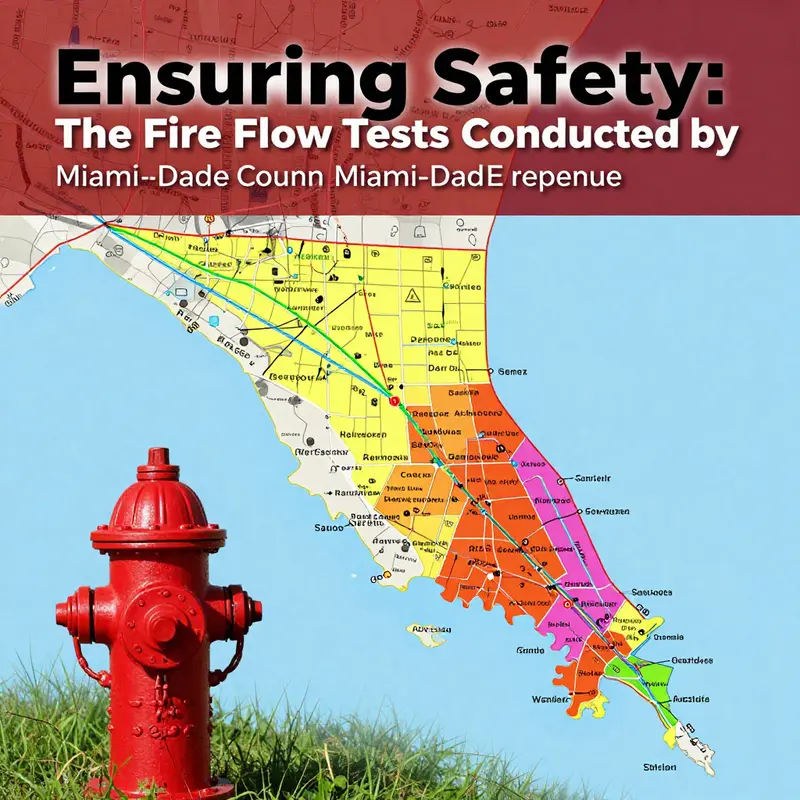
In the creaturely logic of a city’s thriving life, water is the quiet arterial system that can decide the difference between danger and safety in an instant. For Miami-Dade County, the fire flow test is a disciplined ritual that translates that belief into measurable data. It is not a spectacle of water spraying toward the sky but a precise, controlled probe of how much water the system can deliver under pressure when seconds matter most. Fire flow tests, conducted by Miami-Dade Fire Rescue and its partners, are the instruments that confirm the reliability of hydrants and the integrity of the broader fire protection network. The aim is simple in concept yet complex in execution: to verify that the municipal water supply can meet the demands of a real emergency, especially in dense urban cores, tall buildings, and areas with aging infrastructure. The value of these tests lies not in dramatic sprays but in the confidence they generate—the assurance that when a blaze erupts, responders will have sufficient water to suppress it, protect life, and limit property damage.
Where that confidence comes from is a blend of physics, discipline, and prudent prudence. Hydrants are not isolated devices; they are nodes in a city-wide network that includes pumping stations, transmission mains, service lines, valves, and telemetry systems that monitor pressure and flow. A typical fire flow test, conducted under standardized conditions, measures how much water can be pulled from a hydrant and at what pressure it can be sustained, all without compromising essential services to other customers. The maneuver is to simulate a demanding firefighting scenario—think of a high-rise or a residential block during peak usage—without creating an actual blaze. By doing so, engineers and fire service leaders can validate performance, identify bottlenecks, and schedule preventive maintenance before problems become emergencies. When the test is finished, the data become part of a feedback loop that informs upgrades, valve replacements, and hydrant refurbishment programs. The practice, in effect, keeps the fire protection system honest and current in the face of evolving demand.
To grasp why the tests matter, it helps to consider what they reveal beyond the numbers. Fire flow testing scrutinizes three core aspects: capacity, reliability, and timing. Capacity speaks to the volume of water a hydrant can deliver at a given pressure. Reliability concerns whether that performance can be reproduced across multiple tests and over time, even as the system ages or as seasonal demands fluctuate. Timing looks at how quickly a hydrant can reach its targeted pressure and how long that pressure can be sustained. All three dimensions intersect with one another, because a hydrant that delivers a high peak for a few seconds may not sustain a useful flow long enough to support an extended fire attack. Conversely, a hydrant that maintains steady pressure but cannot meet peak demand may still fail to meet the needs of a complex incident. The tests thus anchor a dynamic balance between capability and consistency, ensuring that responders can project a safe and effective firefighting posture in a wide range of conditions.
The general consensus in the broader field—and the practice in Miami-Dade as in many comparable jurisdictions—is that, when conducted according to established protocols, fire flow tests do not cause damage to pipes, valves, or hydrants. In fact, they are a form of proactive maintenance. They reveal weaknesses that would otherwise remain hidden until a crisis arrives. A loose valve, a corroded joint, a partially blocked line, or a pump issue can be detected because the test exposes anomalous readings that trigger targeted inspections. In this light, the testing program functions not as a disruption but as a safeguard—a routine, science-based health check for the county’s most critical fire protection assets. This perspective aligns with the broader trend in modern fire management toward risk-aware planning: you measure before you act, and you act to reduce risk before it becomes a catastrophe.
Even though there may be no single, published, independent assessment detailing the fiber of Miami-Dade’s fire flow impact, the logic of testing is consistent with what researchers and practitioners have observed elsewhere. Tests release water for short intervals, and the resulting data help quantify whether a network can sustain the demands of a worst-case scenario without compromising service to other customers or triggering unintended side effects. In practice, the utility of the test is measured in the clarity it provides for maintenance scheduling, capital planning, and emergency response readiness. If a test flags a pressure drop in a corridor of the county’s waterworks, crews can drill down to the source—whether it is a valve that needs calibration, a section of pipe with a blockage, or a pump that requires recalibration—and then craft a targeted remedy. The upshot is resilience: a more robust municipal system that supports rapid fire suppression, minimizes the chance of water-related setbacks during operations, and sustains public safety over the long arc of urban growth.
This resilience is particularly critical in a county characterized by a complex mix of neighborhoods, elevated structures, and variable water demand. Miami-Dade’s fire flow testing is thus not simply a routine exercise; it is a strategic element of an integrated safety framework. The data flow from these tests feed into maintenance cycles, capital improvement plans, and emergency readiness drills. In this sense, a fire flow test is a small, methodical contribution to a much larger conversation about reliability, equity, and service level expectations for all residents and businesses. Because the tests are designed to be minimally invasive, they also underscore a principle that sits at the heart of contemporary fire protection: testing should inform action without imposing unintended consequences on the community.
A broader lens helps place Miami-Dade’s practice within an evolving discipline of risk assessment and preemptive strategy. The idea that tools exist to forecast and mitigate the environmental footprint of firefighting actions has gained traction in recent years. The concept of a Fire Impact Tool, for instance, signals a shift toward evaluating the broader implications of operational decisions before they are executed. This mindset—assessing potential consequences in advance and balancing trade-offs—complements the direct objective of fire flow testing: to validate the adequacy of water supply while preserving the integrity of infrastructure and minimizing disruption. The county’s approach, therefore, embodies a dual aspiration: verify and protect. It seeks to confirm that hydrants and the water distribution system will perform when invoked, and it seeks to protect the built environment from unnecessary wear or damage that might accompany aggressive testing or overextended flows.
In the absence of a formal Miami-Dade-specific published dossier, case-by-case operational records and routine maintenance logs illustrate a consistent pattern. When tests are performed under careful protocol, the primary outcomes are actionable insights rather than dramatic changes. The county’s water and fire protection teams interpret the findings to schedule valve replacements, rehabilitate aging mains, and recalibrate pressure zones to maintain uniform performance across neighborhoods. The result is a system that continues to adapt to population growth, new construction, and shifting weather patterns while preserving its core mission: to deliver dependable water streams to the scene of a fire with speed and precision. In this sense, the fire flow test becomes a practical instrument of ongoing improvement, not a one-off audit. It is a living part of the county’s safety ecology, reinforcing readiness through measurement, iteration, and accountable action.
To appreciate how this work translates on the ground, imagine a cityscape where a large apartment complex sits on a busy corridor. The hydrant network in that area must deliver a sustained, high-volume flow under pressure while other water customers continue to receive service. The test isolates the hydrant’s performance, but the implications extend to pump station operations, valve sequencing, and the coordination of multiple firefighting resources. If the test reveals that the flow reaches the expected threshold and pressure holds steady, responders gain a reliable baseline for incident planning. If, instead, the data show a deficit, planners can accelerate maintenance, propose improvements, or adjust response tactics to compensate—perhaps by pre-positioning additional supply lines or coordinating with nearby facilities to stage hydrants for rapid access. In every scenario, the exercise translates into a more predictable, controllable emergency response, which is the core objective of public safety programs.
The narrative around innovation in fire services also provides a lens for understanding how testing practices evolve. New methodologies, data visualization tools, and collaborative training approaches can reshape how flow tests are conducted and interpreted. For readers curious about how ideas migrate from concept to field practice, one can explore the broader landscape of innovations that influence testing culture and operational readiness. For instance, a resource such as Innovation Museum transforming fire services offers a window into how contemporary thinking about safety, technology, and community service informs the way agencies approach testing, maintenance, and resilience. The link represents a broader ecosystem in which evidence-based testing informs policy, which in turn guides investment and daily practice. While the specifics may vary from place to place, the throughline remains: rigorous testing, paired with intelligent response, keeps communities safer by ensuring the invisible infrastructure performs when it matters most.
As the county continues to evolve, the practice of fire flow testing anchors a broader commitment to transparency and accountability in public safety. Public awareness about testing schedules, methodology, and the rationale behind maintenance decisions strengthens trust and reinforces the idea that safety is a shared responsibility. The data derived from these exercises do not sit in a silo; they circulate among engineers, fire service personnel, city planners, and the public alike. By turning complex hydraulics into actionable knowledge, the system becomes more legible to those who rely on it most—the residents who live, work, and travel through the county every day. Even in moments when the weather or development pressures push the network to its limits, the continuous cycle of testing and improvement sustains a level of preparedness that is rarely visible in ordinary times but clearly indispensable when danger emerges.
In sum, the fire flow tests conducted by Miami-Dade Fire Rescue are more than a procedural obligation. They are a daily act of stewardship that guards a vital resource—the water supply—whose reliability underpins every firefighting effort. They are a discipline that blends engineering, public health, urban planning, and community service into a coherent practice aimed at maximum safety with minimal disruption. The evidence gathered through testing, the disciplined maintenance that follows, and the culture of continuous improvement together forge a fire protection infrastructure that responds with steadiness and speed when communities need it most. While direct notes of impact may not always appear in public reports, the practical consequences of sound testing—the early detection of weakness, the protection of critical pipelines, and the assurance of firefighting capacity—are evident every time a hydrant is deployed, every time a testing cycle is completed, and every time maintenance crews return to a valve room with a plan for the next cycle of inspection. The county’s approach embodies a forward-looking ethic: test, learn, and fortify so that readiness endures, even as the city grows and demand evolves.
External Resource: For more official information on fire safety initiatives in the county, see the Miami-Dade Fire Rescue site at https://www.miamidade.gov/fire-rescue.
Pressure, Power, and Preparedness: Inside Miami-Dade Fire Rescue’s Fire Flow Tests
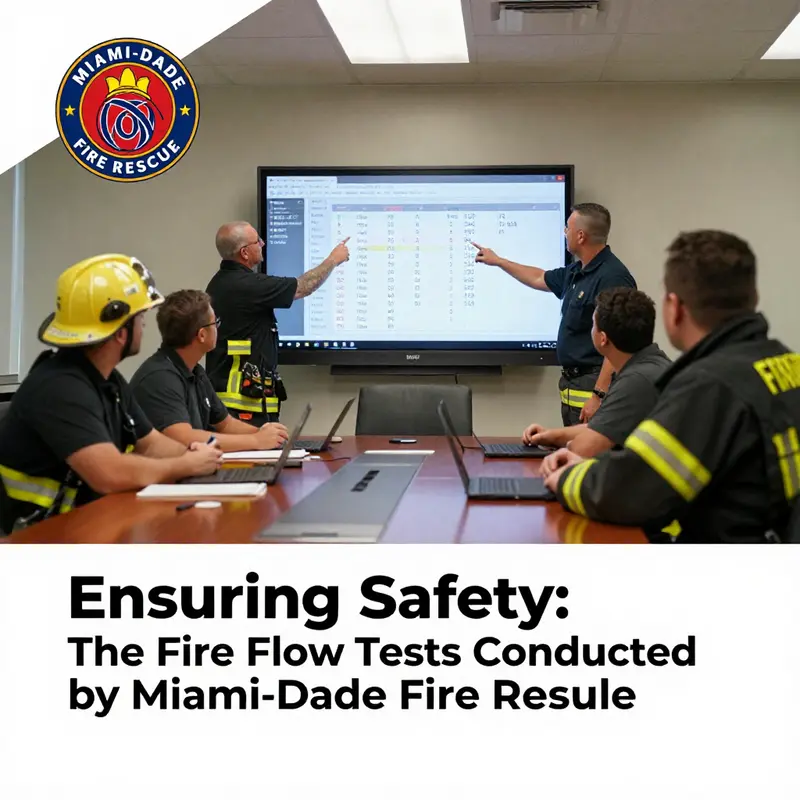
In the heat of a South Florida afternoon, when a siren shatters the cadence of traffic and palm trees bend in a quick tropical gust, the true measure of a fire department’s readiness rarely makes headlines. It lives in a quiet, relentless set of checks on the water system that feeds every hydrant, every engine, and every potential line of defense during a blaze. The fire flow test conducted by the Miami-Dade Fire Rescue (MDFR) is one such measure. It is not a dramatic spectacle but a disciplined, data-driven process that reveals whether the county’s water arteries can deliver the volume and pressure required to suppress a fire in dense urban corridors, along residential streets, or within coastal neighborhoods where terrain and tide conditions add complexity. The tests, performed across hydrants and along distribution networks, are the nervous system of a city’s emergency response. They translate the friction losses of piping, the elevation differences between valves and street level, and the unpredictable twists of weather into actionable intelligence for firefighters and planners alike.
To understand the significance of these tests, one must first travel into the mechanics of how a fire flow test is designed. A typical scenario simulates the conditions of an actual incident: a large-volume draw from a hydrant while a fire company drills a coordinated assault with pumping apparatus, hose lays, and elevated demand from multiple attack lines. On the ground, engineers and fire officers monitor parameters such as static pressure, residual pressure, and flow rate, usually expressed in pounds per square inch and gallons per minute. Static pressure represents the water pressure when no water is being drawn; residual pressure reflects what remains once water is actively flowing through the system. The gap between these measures reveals how the network responds to a sudden surge in demand. A successful test demonstrates that the residual pressure stays above a critical threshold while the flow meets or exceeds the target for the expected fire size and occupancy type. In practical terms, this becomes a decision matrix about how many engines should be positioned to support a given block, where the most effective hydrant locations lie, and how long it will take to reposition equipment if conditions shift during an incident.
Miami-Dade County presents a mosaic of environments. In the dense cores of metropolitan neighborhoods, hydrant spacing and distribution complexity test the resilience of the most intricate parts of the system. Suburban districts stretch the grid more broadly, but elevation and older piping can still impose hidden limits. Coastal zones add another layer of challenge: saltwater intrusion, corrosive wear, and floodplain dynamics can influence both valve operation and hydrant performance. MDFR’s fire flow testing account for these differences, producing results that inform not only immediate tactical decisions but long-range infrastructure planning. The knowledge gained from testing feeds into staffing models, deployment protocols, and the design criteria used when new facilities are integrated or existing ones are upgraded. It is a loop of feedback that connects the hydrant with the pump panel, the engine crew’s tactics, and the county’s capital improvement program. The objective is not merely to avoid a dry hydrant in a pinch but to ensure that, when the moment comes, the water arrives with predictable force at the point of need.
The data produced by MDFR’s tests is more than numbers on a page. It becomes a map of reliability for the county’s water supply system. Where hydrants perform robustly under high demand, responders gain confidence to stage fewer bottlenecks and to anticipate which neighborhoods will require additional preplanning during large incidents. Where weaknesses appear—perhaps in a corridor with a history of higher humidity, mineral buildup, or aging mains—the department can prioritize maintenance, valve exercising, or even hydrant replacement before a real event magnifies the risk. The county’s approach to fire flow testing integrates this granular understanding with a broader safety mission: to sustain the public’s trust that response times and water reliability will not falter when the city needs protection most.
Crucially, MDFR’s testing program also supports operational readiness in a practical sense. The results shape decisions about staffing levels and resource allocation. If a certain district demonstrates consistently robust flow characteristics, a department might allocate fewer engines to those blocks during routine checks, preserving units for high-demand events elsewhere. Conversely, zones with marginal residual pressures under peak flow conditions may trigger a more conservative posture, with additional engines or alternative water sources pre-positioned for large incidents. The tests therefore function as a forward-looking risk management tool, translating physical realities of the built environment into proactive, data-driven staffing and equipment strategies.
Modern fire flow testing in Miami-Dade is not conducted in isolation. The MDFR website serves as an authoritative portal for technical reports, data summaries, and interactive maps that render hydrant performance across the county in a digestible format for both professionals and the public. These resources enable cross-agency coordination, utility planning, and community planning efforts that depend on understanding how water supply behaves under stress. The county’s commitment to transparency in this arena—through accessible dashboards and clearly explained methodologies—helps demystify the process and fosters collaboration with engineers, elected officials, and neighborhood associations that have a stake in how fire protection infrastructure evolves over time.
In the spirit of resilience, some discussions around facility design and maintenance echo beyond the outright mechanics of testing. A forward-looking thread in fire service discourse emphasizes how the places where firefighters train and operate reflect broader commitments to health, sustainability, and community well-being. For instance, the concept of building sustainable, health-centered fire stations resonates with the idea that infrastructure should support a ready and capable workforce. A related line of thought, illustrated by initiatives such as the green firehouse project, explores how station design and operations can minimize environmental impact while maximizing readiness. This intersection of resilience in the built environment and reliability in the water supply underscores a holistic approach to fire protection. In conversations about readiness, it helps to consider not only the hydrants themselves but the rooms where crews prepare, the streets where they work, and the ways in which facilities embody a culture of safety and stewardship. The green firehouse concept—an invitation to imagine spaces that nurture community health alongside respondent readiness—offers a powerful lens through which to view MDFR’s testing programs and their broader implications. the-green-firehouse-creating-sustainable-spaces-for-community-and-health.
The chain of evidence behind MDFR’s fire flow results is as much about communication as it is about measurement. When the test results are compiled, they are not only filed for engineering review; they are translated into actionable, actionable briefs for field commanders who must translate data into on-the-ground choices. The information helps determine which hydrants have to be serviced, which mains require flushing, and where the system might benefit from valve upgrades or pressure-reducing strategies. It also informs the county’s risk-based planning framework, ensuring that high-risk neighborhoods—whether due to occupancy density, critical facilities, or vulnerable populations—receive attention commensurate with their potential demand during a fire. In a region where climate volatility and urban growth intersect, the ability to anticipate stress points before a blaze occurs is a defining feature of a mature fire protection apparatus. The capacity to preempt failures in the water delivery chain is as essential as rapid fire suppression once a call is received.
Interpreting fire flow data also demands a careful balance between fiscal prudence and public safety. The decisions that flow from test results must justify maintenance budgets, capital improvement projects, and routine operational costs. This balancing act is not about maximizing one number on a dashboard but about ensuring that every hydrant, every valve, and every pump contributes to a coherent system capable of sustaining life and property under duress. In Miami-Dade, where the urban core, suburban expanses, and coastal corridors converge, the diversity of conditions makes this balancing act more complex. The challenge lies in translating a county-wide dataset into tailored action at the neighborhood level, and MDFR meets that challenge by maintaining a continuous feedback loop between field performance, infrastructure condition, and the strategic priorities of public safety.
For readers looking to explore the practicalities and outcomes of these efforts, the official MDFR website remains the primary source of truth. It provides access to the most up-to-date technical reports, data summaries, and interactive maps that illuminate how hydrants perform across different times, weather conditions, and demand scenarios. These resources are invaluable for emergency planners, engineers, and the general public who want a clearer picture of how a modern fire protection system is engineered to respond under pressure. They also serve as a reminder that fire flow testing is not a one-off event but a sustained discipline embedded in daily operations, capital planning, and community safety.
In sum, the fire flow test program conducted by Miami-Dade Fire Rescue embodies a practical commitment to reliability, efficiency, and public trust. It translates the abstractions of pipe hydraulics into tangible capabilities on the streets: the confidence that a hydrant will deliver ample water, the assurance that a pump crew can muster gravity and force in tandem, and the foresight to allocate resources where the pressure of risk is greatest. It is a quiet, meticulous craft—one that underwrites every courageous action a firefighter takes and every calm decision a civilian relies on in moments of peril. The tests illuminate not just how water moves within a complex network, but how a city moves toward greater resilience in the face of fire.
External resource: https://www.miamidade.gov/fire-rescue
From Hydrants to Hyper-Real Insight: The Next Wave of Miami-Dade Fire Rescue Fire Flow Testing
On any given day, the waterworks behind a city’s streets appear quiet, yet during a blaze they become a vital artery. The Miami-Dade Fire Rescue’s fire flow testing program is a quiet but rigorous system that ensures those arteries are robust when pressure and volume are demanded most. The tests simulate the stress of a real fire, mapping how water travels from the source through pumps, mains, and hydrants to the nozzle in the hands of a firefighter. They are not only checks; they are diagnostic scans of a living, evolving network that must withstand surges, disruption, and climate-driven variability. The county’s water distribution isn’t simply a sheet of pipes but a dynamic ecosystem whose reliability hinges on precise alignment between supply, demand, and the unpredictable surges that emergencies can unleash. In this sense, fire flow testing is less a single event and more a continuous discipline—an ongoing conversation between infrastructure and the communities it serves, a conversation that must stay audible even as urban fabrics change and weather patterns shift.
Looking ahead, the chapter of practice distinct from the routine is being rewritten with an eye toward integration and immediacy. The first major shift lies in smart monitoring technologies. Sensors embedded along the distribution network continually measure flow rates, pressures, valve statuses, and even subtle temperature drift that might indicate aging infrastructure or partial blockages. In a fire event, these sensors don’t just glow; they feed a real-time stream of data to a centralized command view, where engineers and incident commanders can visualize the hydraulic picture at scale. This isn’t a distant fantasy; it is the next frontier for fire flow testing. The promise is not merely to confirm the system works on a particular day under controlled conditions, but to reveal how it behaves in the heat of an emergency—when every second matters and every psi counts. The practical value lies in turning what used to be episodic checks into a living monitoring regime that can alert decision-makers before a crisis reaches a critical threshold.
The second pillar is real-time data analytics. As data pours in from field sensors, advanced analytics transform raw numbers into actionable knowledge. Machine-assisted trend analysis can reveal subtle patterns that static tests might miss: pressure drops near critical junctions during high-demand periods, the cascading effect of a single failing valve across feeders, or the probability that a hydrant will underperform during peak demand. The analytics do not exist in isolation; they inform maintenance planning, capital improvement programs, and operational strategies for fire incidents. When the data indicate a vulnerability within a segment of the distribution network, planners can simulate various contingency options—altering pump operations, reconfiguring valve openings, or staging additional water supply sources—before a fire triggers those decisions in the field. In short, the test data become a predictive compass rather than a retrospective ledger, guiding budgets, construction timelines, and training priorities with a confidence earned from continuous observation rather than episodic measurement.
A critical thread in this evolution is standardization. The most accurate measurements are only as valuable as the methods by which they are obtained. Miami-Dade Fire Rescue envisions more uniform testing procedures across a wide range of infrastructure, from aging mains in dense urban corridors to newer developments on the suburban edge. Standardization does not erase local nuance; rather, it harmonizes the essential elements of testing—test duration, hydrant configuration, flow rates, pressure targets, and recording protocols—so results are comparable across neighborhoods and over time. With uniformity, a problem identified in one corridor can be reliably linked to similar patterns elsewhere, enabling a county-wide resilience roadmap. This consistency supports not only internal confidence but also external accountability, as residents and officials know that the same yardstick is being used whether the hydrant is near a school, a hospital, or a major transit corridor. The goal is not sameness for its own sake but a meaningful comparability that accelerates learning and sharpens response.
In the broader ecosystem of public safety, the shift toward real-time monitoring and analytics also amplifies the value of community trust. Residents benefit when the reliability of fire protection infrastructure becomes transparent, not opaque. Open dashboards, public briefings, and timely notifications are strengthened by data that are timely and well-documented. When a test reveals a potential weakness, the response can be engineered swiftly and with clarity, reducing uncertainty during crisis planning. The longer view is equally important: with each test cycle, the system becomes more adaptive, and the city learns to anticipate where stress will concentrate as climate patterns shift and urban density evolves. The goal is not a flawless system—perfection is elusive—but a system whose vulnerabilities are identified, prioritized, and addressed with measurable progress. In this way, continuity becomes a civic virtue rather than a bureaucratic aspiration, a signal that the public’s safety is a living, budgeted, and progressively improving undertaking.
Embedded within this forward-looking trajectory is a nod to the wider culture of innovation that characterizes modern emergency services. The idea of a smart, connected hydrant network resonates with a broader narrative about how emergency response increasingly blends field experience with digital rigor. In that sense, Miami-Dade’s path mirrors a wider movement toward intelligent infrastructure that supports decision-making at the speed of emergencies. A related thread emerges when considering the broader corpus of professional practice and public engagement. The notion that technology can extend human capacity without replacing it is central to sustainable progress. Fire flow testing, at its best, becomes a collaborative discipline where engineers, firefighters, and city planners converge around a common objective: ensuring rapid, reliable water supply to save lives and protect property when every moment is critical. This collaboration, enriched by data and guided by standardized methods, forms the backbone of a resilient public safety system that can adapt to new threats and new ways of operating.
When a reader imagines the practical implications, the benefits become tangible. Real-time monitoring can quickly flag potential issues that would not be evident in a traditional, once-a-year audit. Consider a scenario in which a minor pipe movement or a small valve leakage gradually lowers the pressure available to a critical hydrant cluster. The monitoring system would not wait for a scheduled test to discover this drift; it would trigger an alert during the heat of a blaze or during peak daily demand. The early warning enables preemptive maintenance or temporary operational adjustments, such as rebalancing the distribution network to preserve pressure where it matters most. The upshot is that communities experience fewer surprises during emergencies, which translates into more dependable water application and, ultimately, more effective firefighting. In practical terms, this means faster containment, less property loss, and a safer pace of life for residents who rely on a robust public utility network.
The chapter of transition also invites curiosity about how testing activities can be woven into everyday operations without becoming disruptive or unsafe. A future testing regime might integrate with routine inspections, capturing pertinent hydraulic data during standard maintenance work, or it could leverage off-peak periods to calibrate sensors and verify pressure targets. Such integration reduces redundant effort and leverages existing workflows, making the path to real-time insight smoother for frontline crews. The practical design of tests will continue to evolve, balancing safety, accuracy, and speed. Yet the underlying ethos remains consistent: information is only valuable if it informs action in real time, and action is only credible if it rests on rigorous, standardized methods. The result is a testing culture that treats data as a resource rather than a byproduct, a culture that values the clarity of numbers as much as the courage of the crews who respond to emergencies.
For those who wonder about the social and logistical dimensions, the story of fire flow testing is inseparable from the places it serves. Miami-Dade County presents a complex urban tapestry—dense central districts, sprawling suburban rings, and coastal communities with unique water supply challenges. The testing program must accommodate this diversity while maintaining coherence in its standards. The push toward uniform procedures across infrastructure serves both equity and reliability: all communities deserve the same assurance that hydrants will perform when needed, and the same confidence that the tested data reflect true capability rather than a localized anomaly. In practical terms, uniform protocols mean that a hydrant’s measured performance in one neighborhood can be meaningfully compared to another, enabling more precise risk assessments and more efficient allocation of scarce resources for upgrades and maintenance. This approach anchors progress in measurable outcomes rather than abstract intentions, a vital feature as the county grows and its resilience needs evolve.
A natural pause emerges, not as a farewell to older practice, but as a bridge to a more connected future. The integration of digital sensors and real-time analytics does not render traditional field expertise obsolete; it amplifies it. It empowers frontline responders to interpret flow data alongside on-scene observations, to triangulate information from various sources, and to act with greater precision under pressure. The synergy of human judgment and machine-generated insight holds the promise of better preparedness, faster containment, and more resilient neighborhoods. The chapter of development is, in effect, a narrative about confidence—confidence in the water supply system, confidence in the protective services that rely on it, and confidence in the civic structures that communicate risks and responses to the people they serve.
As the conversation around innovation evolves, it is useful to recall how such progress is framed within the community’s broader safety culture. The operational shift toward smarter fire flow testing aligns with a growing emphasis on preventive upkeep, proactive risk management, and proactive transparency. When a public safety agency commits to continuous improvement, residents appreciate that a system is being watched and refined, not merely maintained. The result is a durable relationship between service providers and the communities they defend, where residents understand the value of regular testing and the reasons behind the necessary investments. It is this mutual trust that sustains the long arc of modernization, guiding decisions about capital expenditures, future-proofing strategies, and public communication. The story is not a single invention but a continuum of improvements that accumulate over time, each step reinforcing the next and making the system sturdier against the uncertainties of urban life.
In closing this exploration of what lies ahead, it is helpful to carry a concrete image of how these developments might unfold over the next decade. Imagine a city where hydrants, valves, pumps, and pressure sensors form a coordinated network that responds to fires with almost preternatural alignment between supply and demand. The test results feed a learning loop that continuously refines both practice and policy—informing maintenance schedules, prioritizing upgrades, and shaping training for personnel. For readers interested in the broader context of how such transformations gather momentum, the linked discussion on innovation and transformation provides a broader lens on how institutions adapt to technology-enabled control and oversight. See the broader discussion here: Innovation Museum Transforming Fire Services.
Finally, for those who want to see the official doorway to the county’s ongoing safety work, including current fire flow testing news and public notifications, the Miami-Dade Fire Rescue site offers the most authoritative, up-to-date information: https://www.miamidade.gov/fire-rescue.
Final thoughts
The role of fire flow tests conducted by the Miami-Dade Fire Rescue Department is paramount in ensuring that fire safety measures are effective and reliable. As explored in this article, these tests are integral to assessing and enhancing the water supply capabilities essential for emergency responses. From the testing methodologies employed to the critical analysis of results, the commitment to maintaining robust fire safety infrastructure reflects Miami-Dade’s dedication to community welfare. Looking forward, advancements in testing procedures promise to further bolster this commitment, ensuring residents and first responders alike can rely on a well-prepared system in times of need.