
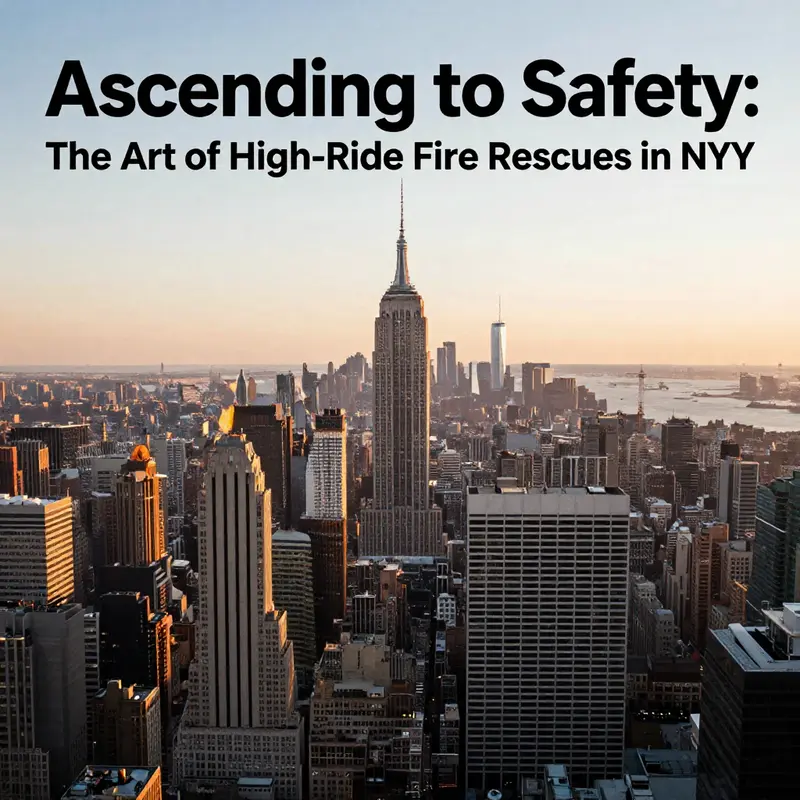
As one of the most densely populated urban areas in the world, New York City presents unique challenges when it comes to fire rescues, particularly in high-rise buildings. With incidents involving life-threatening situations occurring on upper floors, the city’s firefighters must be exceptionally trained and equipped to handle these emergencies. Central to their preparedness is the FDNY High-Rise Simulator, where intricate scenarios are practiced to ensure readiness for real-life incidents. In this exploration, we will delve into the comprehensive training provided at the simulator, the specialized techniques employed like high-angle rope rescues, and the coordinated efforts between interior and exterior teams that define successful high-rise operations. Each chapter will illuminate critical aspects of how NYC firefighters rise to the challenge of saving lives during high-rise emergencies.
Anchored Precision: Training for NYC’s High-Rise Rescue Realities at the FDNY High-Rise Simulator
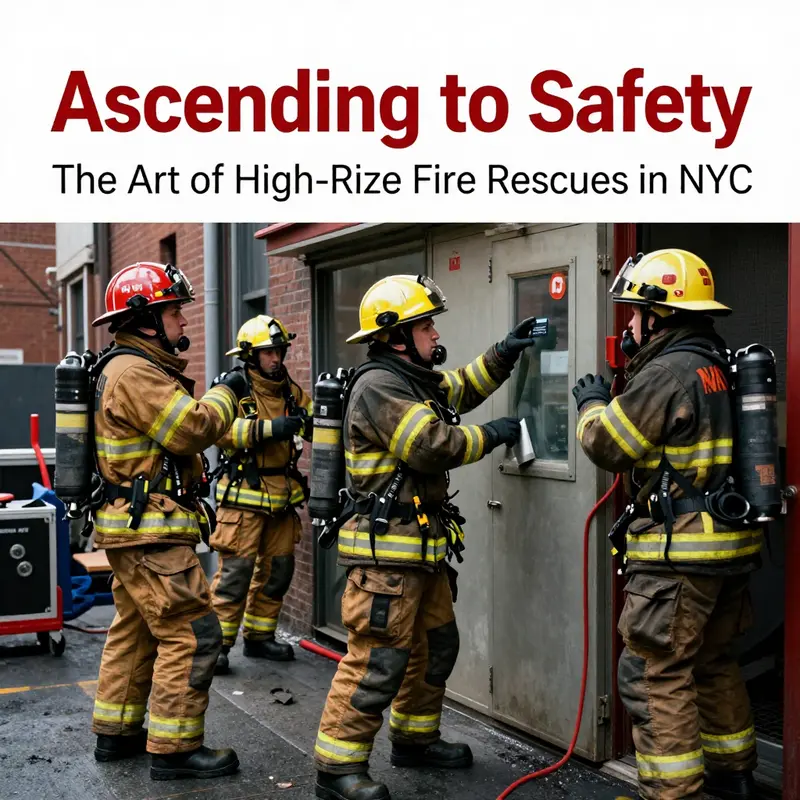
The silhouette of New York City’s skyline is more than a backdrop for daily life; it is a living curriculum for the fire department. In a city where a single building can define a neighborhood and a single emergency can involve hundreds of people, the challenge of rescuing occupants from high-rise fire scenarios demands more than courage. It requires a meticulously designed blend of training, equipment, and coordinated tactics that translate a spark in a stairwell into a safe, orderly egress for those trapped above. The FDNY High-Rise Simulator on Randalls Island stands at the center of that translation. Opened as a state-of-the-art training facility, it marked a turning point for the city’s fire service, bridging a long-standing gap in high-rise readiness. Its creation, funded by generous donations from the FDNY Foundation and the Leary Foundation, underscored the city’s commitment to preparing every engine and ladder company to confront the layered realities of modern urban fires. The simulator’s value lies not only in its realism but in its capacity to illuminate the operational tensions that shape every high-rise mission: where victims may be on non-sequential floors, how smoke travels through a complex vertical maze, and how teams must synchronize within the shifting conditions of a burning building.
The training environment recreates the look and feel of urban towers with astonishing fidelity. It enables responders to rehearse scenarios that previously were difficult to practice at scale. Firefighters move through mock stairwells that resemble actual cores, with non-sequential floor numbering that mirrors many New York residential buildings. This detail matters. In real incidents, firefighters often encounter floors that do not follow a linear ascent or descent, a quirk of many high-rises that can complicate navigation, command decisions, and patient location. The simulator’s ability to replicate these quirks allows crews to develop mental maps of complicated vertical layouts before they ever face smoke and heat in a live incident. The result is more precise movement, clearer communication, and fewer moments of hesitation that can compromise safety or turn a rescue into chaos.
Beyond the architecture, the simulator brings to life the pressures of the environment firefighters must endure. Smoke densities, heat exposure, and restricted visibility are recreated to demand fresh approaches to movement and search. The conditions are designed to challenge crews without risking life or limb, giving them the chance to experiment with different tactics in a controlled setting. This is critical because a high-rise rescue is not a single act of strength but a sequence of coordinated moves: locating victims, isolating the fire, creating safe egress routes, and transferring care to providers who can stabilize and transport patients. The training emphasizes both the art and the science of these sequences, reinforcing that success hinges on a shared mental model among interior firefighting teams and exterior rescue units.
One of the most important distinctions the simulator brings into focus is the need for adaptive plan making. High-rise emergencies rarely unfold in a straight line. Fire growth, stairwell integrity, and elevator availability can change in minutes, and responders must anticipate these changes while keeping the patient’s safety at the forefront. The facility thus doubles as a proving ground for contingency thinking. Crews practice redirection when stairwells become compromised, test alternative egress plans when primary routes fail, and rehearse rapid handoffs of patients between interior teams and exterior rope-rescue specialists. The realism of the environment helps to socialize a culture of flexible, scalable tactics rather than rigid, one-size-fits-all procedures. In this sense, the High-Rise Simulator is less a laboratory and more a crucible where the department’s collective experience is forged into muscle memory.
The facility’s capacity to train on non-fire emergencies within high-rise contexts also broadens its utility. Fire departments facing urban operating realities must be prepared for medical emergencies, confined-space rescues, or elevator entrapments that involve similar risk profiles to a fire incident. The simulator provides a controlled space in which firefighters can rehearse these scenarios with the same attention to detail as they would a fire-driven rescue. The objective is not to create a single best practice but to develop the adaptability that distinguishes a well-prepared crew from one that improvises under stress. To this end, the training program emphasizes situational awareness, team communication, and precise coordination, so that every member understands their role and can execute it with calm confidence even when the environment becomes unpredictable.
The training philosophy also leverages the power of storytelling embedded in the city’s history of high-rise incidents. The East Side has seen dramatic rescues that captured public attention, and the lessons drawn from those events inform the simulator’s curricula. A notable case from the recent past involved a rope-based rescue on a high-rise facade where a patient was positioned many stories above ground. The rescue demanded a high-angle rope system, meticulous rigging, and synchronized action between interior crews and exterior rescuers. Such operations require an exacting sequence of belays, harness management, and controlled descent or ascent. While the specifics of every operation must remain dynamic, the underlying principle remains constant: the patient’s safety is the top priority, and every action is planned to minimize risk to rescuers and bystanders alike. The high-rise simulator makes this principle tangible by turning it into practiced routine rather than a perilous specialty.
The impact of this training extends beyond the walls of the Randalls Island facility. It touches every unit that responds to high-rise calls, from the fastest engine company to the most seasoned ladder crew. A crew entering a burning tower after hours often carries with it a shared mental map built through repeated practice in the simulator. They know the probable locations of stairwells, the likely paths of travel, and the critical moments at which a rescue must transition from extraction to medical care. The result is a broader readiness that translates into shorter response times, safer operations, and better outcomes for occupants who depend on timely intervention. In this sense, the High-Rise Simulator is not simply an educational tool; it is a strategic investment in the safety of the city’s residents and visitors.
The practical reality of high-rise rescue hinges on the integration of advanced equipment with disciplined human performance. The simulator deliberately presents scenarios that require precise hoisting and lowering techniques, rope systems, and harness configurations. Although the equipment used in the field is highly specialized, the training emphasizes the fundamentals: precise tension control, stable anchor points, and clear communication of commands. Rope rescue, when executed correctly, reduces the danger posed by dangerous elevations and enables responders to position an immobilized patient in a way that minimizes discomfort and risk. The training also reinforces safety protocols for the rescuers themselves, including fall protection, team positioning, and the careful sequencing of rigging tasks. Every drill becomes a rehearsal for a real operation in which a few inches of misstep can have outsized consequences.
The High-Rise Simulator also helps to sharpen coordination across multiple units and agencies. A high-rise rescue in New York City often involves a combined effort: interior firefighting teams fighting the fire and performing initial searches, exterior rescue units handling rope work and high-altitude access, and medical teams ready to provide care and prepare for transport. The facility creates a shared language and a common tempo that reduces friction among these teams when space and time are at a premium. Through repeated drills, responders learn to synchronize their movements, anticipate each other’s needs, and adapt to evolving conditions on the scene. The net effect is a more cohesive, interoperable response that can withstand the pressures of a densely populated urban environment.
Among the most illuminating aspects of the simulator is its capacity to normalize the ambiguity that characterizes high-rise emergencies. In the real world, responders rarely have the luxury of perfect information. The ability to interpret limited cues, adjust plans on the fly, and sustain a calm, methodical pace under stress separates effective teams from reactive ones. The High-Rise Simulator cultivates this mindset by exposing crews to imperfect data and forcing them to rehearse decision-making under pressure. Trainees learn to triangulate the patient’s location, assess the viability of alternative routes, and maintain a coherent command structure even when the building’s internal geography is challenging. The emphasis on cognitive clarity is as important as physical technique, because a misread situation can derail an otherwise technically proficient operation.
This holistic approach—combining architectural realism, environmental stress, adaptive planning, and cross-unit coordination—defines how NYC firefighters train for high-rise rescue. It reframes high-rise emergencies as complex, multi-layered operations rather than single acts of bravery. In doing so, it not only prepares responders to act with speed and precision but also reinforces a culture of safety that protects both victims and rescuers. The High-Rise Simulator, with its cutting-edge design and generous philanthropic support, embodies a forward-looking commitment to urban resilience. It signals that the city expects its firefighters to be prepared for the most demanding scenarios its skyline can present, and it gives them the tools to translate preparation into life-saving action when minutes, and sometimes seconds, matter most.
For readers curious about the broader arc of innovation in fire-service training, this conversation about the High-Rise Simulator echoes a larger narrative. It reflects how cities invest in forward-thinking facilities, how philanthropy can accelerate public safety goals, and how cutting-edge training becomes a practical backbone for life-saving work. The story of New York’s high-rise readiness is not about a single drill or a single rescue; it is about the disciplined evolution of a department that must anticipate the next skyline, the next floor plan, and the next challenge with equal seriousness. The result is a department that can deploy precision under pressure and a city that can rely on responders who have repeatedly practiced what real life will demand. The simulator, in this sense, is both a classroom and a proving ground where the complex, improvisational reality of high-rise rescue is turned into confident, consistent action.
If you want to explore how this innovation translates into ongoing readiness, consider a broader look at how fire departments integrate new training concepts and facilities into daily practice. The idea of a dedicated high-rise training environment, along with the disciplined use of rope rescue techniques in a controlled setting, helps demystify the process of urban rescue and reinforces the value of preparedness as a living habit rather than a one-off event. The experience of the FDNY High-Rise Simulator demonstrates that readiness is built through repetition, reflection, and a shared commitment to safety, all conducted within a framework that acknowledges the unique geometry and demands of a city built upward.
The city’s approach also invites reflection on how other urban departments can translate similar principles into their own contexts. By prioritizing realistic building configurations, investing in high-fidelity scenarios, and creating robust linkages between training, equipment, and incident command, police, fire, and emergency medical services can reinforce a comprehensive response model for skyscraper emergencies. In that sense, the High-Rise Simulator becomes a case study not only in firefighting technique but in the broader practice of urban resilience.
Within this expansive narrative, a singular thread remains constant: the safety of those trapped in the upper reaches of tall buildings depends on people who can think clearly, move decisively, and work together with unbroken focus. The FDNY High-Rise Simulator is both mirror and mentor for those people. It mirrors the complexities of real-world rescue — non-sequential floors, smoke-filled corridors, and the constant interplay between interior and exterior teams — while teaching the behaviors that turn those complexities into manageable, sequential actions. It teaches that high-rise rescue is less about dramatic moments on a fire’s edge and more about the sustained, disciplined execution of a plan that respects human limits and the physics of elevation and air. In the end, the city does not merely respond to alarms; it trains for them, rehearses them, and evolves with them, so that when the moment arrives, the response is as precise as it is brave.
For readers drawn to the more narrative textures of innovation in public safety, the chapter’s throughline remains clear: training at the High-Rise Simulator embodies a philosophy of readiness that blends realism with safety, adaptation with standardization, and courage with controlled technique. The results are measured not only in published statistics but in the quiet confidence of a crew that knows its tools, its roles, and its plan. That confidence, cultivated through repeated drills that simulate the city’s most challenging environments, is what turns possible rescues into reliable outcomes. It is the practical fruit of a facility that listens to the skyline and answers with practiced hands, precise movements, and the steadfast teamwork that underpins every successful high-rise operation.
Internal link for further context on innovation in fire services: Innovation Museum: Transforming Fire Services.
External reading: for a direct look at the institution behind the simulator, its mission, and its ongoing training initiatives, see the FDNY Foundation’s High-Rise Simulator page: https://www.fdnyfoundation.com
Ropes, Anchors, and Lifelines: How NYC Firefighters Execute High-Angle Rescues in Skyscrapers
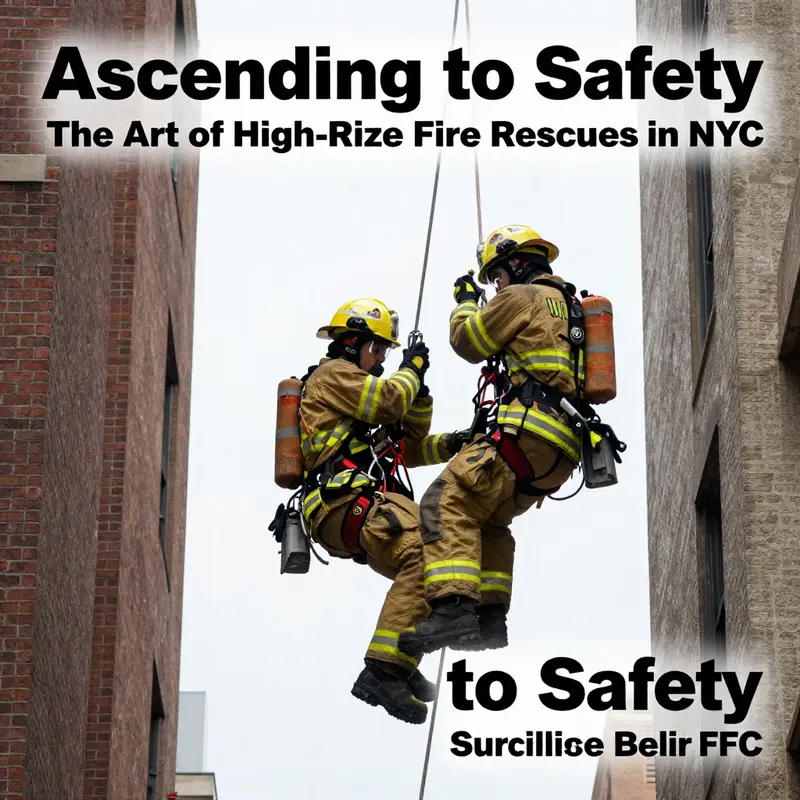
High-angle rope rescue is a precise, practiced response used when stairs, elevators, and other vertical routes fail. In New York City, where people live and work dozens of stories above street level, these skills are essential. The FDNY has built doctrine and training around the idea that every firefighter must carry a personal means of self-rescue. That principle shapes technique, gear choices, and the culture of high-rise response.
A rope rescue begins with a rapid assessment. Firefighters must decide whether interior strategies, exterior operations, or a hybrid approach will move victims to safety. This decision depends on the fire’s location, smoke conditions, structural integrity, and available egress. The most challenging rescues happen when stairwells are blocked, elevators are disabled, or floors have become structurally unstable. When vertical evacuation is the only option, high-angle rope systems provide controlled movement for both rescuers and victims.
Anchors are the foundation of every high-angle operation. Crews search for strong, immovable points near the incident. Structural beams, parapet walls, balcony supports, and certified rooftop anchors are common choices. When a building lacks a reliable anchor, firefighters improvise with multiple wrapped anchors to distribute load and reduce risk. Inspecting anchor points is a disciplined process. Teams look for corrosion, previous damage, and hidden weaknesses. In older buildings, additional redundancy is standard. A single anchor rarely supports the entire system; redundancy ensures life safety if one point fails.
Rope selection complements anchor strategy. Fire departments use ropes designed for life safety, not general utility. These ropes resist heat, abrasion, and shock load. Firefighters carry personal safety ropes for self-rescue and team operations. The issuance of personal ropes to every firefighter was a policy response to past losses. After a tragic 2005 incident, the department reissued personal safety ropes to all members. That policy change reflects a cultural shift. Personal ropes are now as standard as helmets and boots.
Rappel techniques allow firefighters to descend when stairs are unusable. Controlled descents rely on friction devices or body-managed friction. In New York City, teams practice rappelling down facades, through stairwells, and inside atriums. Each environment demands a different approach to manage rope angles and friction. A controlled descent must be smooth to avoid pendulum swings and to prevent contact with hot surfaces. Firefighters rehearse techniques that minimize dynamic loading on anchors during descent.
Ascending a rope is equally important. Rescuers may need to climb to reach trapped occupants above a staging area. Ascension tools let a firefighter move upward using mechanical advantage and friction systems. One common ascension method uses friction hitches that lock under load but slide when unloaded. These knots and light mechanical devices allow hands-free movement when attaching stretchers or tending to patients. Teams practice ascension until each action becomes second nature, because in smoke and heat, deliberate movement saves lives.
Mechanical advantage systems convert small force into larger load movement. Hauling systems allow crews to lift victims through windows, muster them onto roofs, or raise equipment. Simple two-to-one and three-to-one pulley systems are staples. More complex systems combine pulleys and anchors to create higher mechanical advantages. Training stresses smooth operation and continuous monitoring. A hauling system that moves a victim quickly but without control is dangerous. Housekeeping during a haul—tending slack, watching for entanglements, and communicating—is as critical as the rope rig itself.
Belay and fall-arrest systems provide continuous protection. A belay keeps a rescuer or patient from falling if the primary device fails. Redundancy is not optional; it is a rule. Teams typically employ at least two independent lines when moving people. The secondary line is often attended by a dedicated firefighter who watches and controls tension. Fall-arrest devices lock under sudden loads, limiting fall distance. These devices require regular inspection and testing to ensure reliable performance under thermal and abrasion stress.
Rescuing a conscious, semi-conscious, or unconscious person changes the technical profile of an operation. A conscious adult can be harnessed and moved with relative simplicity. An unconscious or injured patient demands a technical rescue litter. Litter rigging requires secure attachment points, padding for spinal protection, and a plan for vertical and horizontal movement. Teams train to secure a patient in low-visibility conditions, using tactile signals and rehearsed hand movements. The act of packaging a patient for a haul must protect the airway and cervical spine while keeping the rescue efficient.
Team protocols define roles during every rescue. A two-person entry team is a common unit. One firefighter manages the line and makes anchor connections. The other moves or tends to a patient. Larger rescues call for coordinated sectors: interior fire attack, search, ventilation, exterior rope team, and incident command. Clear radio discipline and hand signals link the sectors. Communication must be concise and direct. In smoke-choked stairwells, visual and tactile signals supplement radios. The teamwork cultivated in training translates directly to steadier, safer rescues on scene.
Confined spaces are an ever-present challenge inside high-rises. Narrow corridors, collapsed partitions, and blocked stairways force creative rope work. Personal ropes become lifelines in these conditions. They let firefighters maintain orientation and find egress paths. Standard practice is to tie in at the building entry and clip off to anchors at each floor. This continuous connection reduces the risk of disorientation. In operations after dark or in thick smoke, a connected rope can be the difference between retreat and tragedy.
Training shapes competence and confidence. The FDNY operates a High-Rise Simulator that reproduces the noise, heat, and obstacles of real buildings. Simulated smoke, freezing conditions, and structural surprises replicate the hazards that crews face. Drills emphasize the speed of decision-making under stress. Crews practice anchor selection, haul rigging, patient packaging, and rappelling in scenarios that mirror past incidents. These repetitive exercises engrain muscle memory. In high-angle rescues, reflexes built in training guide safe actions when cognition is impaired by heat or exhaustion.
Real incidents shape doctrine as much as training facilities. Lessons from historical events drove major reforms. The department’s response to a deadly fire in 2005 illustrates this dynamic. Investigations revealed that missing personal ropes contributed to firefighter deaths and injuries. The department adopted comprehensive remedial measures. Personal ropes were reissued. Training modules were revised to emphasize personal safety systems. This institutional learning reduced risk and forged a new standard: every firefighter must be prepared to self-rescue.
Beyond firefighter safety, high-angle techniques extend to civilian rescues. Notable rescues, like the lowering of a woman from a 20th-floor window using rope systems, show the methods in action. These rare operations demand precise coordination between interior and exterior teams. Exterior teams often build anchor points on rooftops or adjacent structures. They must account for wind, facade geometry, and potential falling debris. Exterior rigging adds complexity because it introduces additional variables, such as anchor reach and line friction against sharp edges.
Edge protection and rope passageers mitigate damage when lines move across structural edges. Simple padding or purpose-built edge rollers reduce wear and friction. Without them, a rope can be compromised quickly when rubbing against metal or concrete. Firefighters routinely drape webbing or deploy edge devices to protect ropes during hauls. These small steps enhance safety and extend the useful life of life-safety materials.
Equipment inspection and maintenance are procedural essentials. Ropes that see heat, soot, or heavy abrasion must be retired or tested. Fire departments maintain logs of rope usage, exposure incidents, and service life. Routine inspections look for flat spots, core damage, discoloration, and unusual stiffness. Carabiners, pulleys, harnesses, and other hardware also undergo function checks. A neglected piece of hardware can negate an otherwise perfect rig.
Human factors and stress management play into rescue outcomes. High-angle operations are physically demanding and mentally draining. Shift rotations, hydration, and rest are not luxuries. Crews train in stress inoculation to condition responses under physiological load. Managing adrenaline and maintaining communication under fatigue distinguishes a practiced crew from an ad-hoc team. Leadership during a high-angle rescue involves calm, clear direction and respect for the established safety protocols.
Interagency coordination becomes crucial in large incidents. Police, emergency medical services, public works, and building management often work alongside firefighters. Rooftop access, utility shutoff, and crowd control affect rescue timelines. Pre-incident planning with building owners clarifies anchor points, roof layouts, and interior stair configurations. Many high-rises now participate in joint drills with the fire department. These rehearsals save time when seconds matter.
Technology complements rope skills but does not replace them. Thermal imagers, rope sensors, and radio systems provide information but still require skilled operators to interpret results. Technology helps with situational awareness and can speed patient location. But cables, batteries, and electronics fail in extreme heat. Firefighters continue to rely on tactile and visual cues, and on the tactile feedback of a rope, to gauge load and movement.
A culture of continuous improvement undergirds all training. After-action reviews analyze successes and failures. Small changes in knot choices, anchor angles, or hauling methods are adopted and tested. Fire departments publish training bulletins and update standard operating procedures. This iterative process evolves doctrine to meet new building types, materials, and occupancy patterns.
There are limits to rope rescue. High winds, falling debris, and rapidly spreading fire create environments where exterior operations become untenable. Firefighters balance risk to rescuers against the likelihood of saving lives. When risks are unacceptable, the focus shifts to containment and search, while evacuation plans and sheltering procedures protect civilians as best they can.
High-angle rope rescues in New York City are the product of history, training, and disciplined practice. They combine anchor science, rope craft, mechanical advantage, and human teamwork. They are rehearsed in simulators and refined after every real incident. From the issuance of personal ropes to the complex hauling systems used on a 20th-floor rescue, each evolution reflects experience and the relentless priority of life safety. For more on how the FDNY trains these life-saving skills, see the FDNY Training Division: https://www.nyc.gov/site/fdny/about/training.page
For further discussion on how technology shapes decision-making and leadership in rescue services, read this piece on the impact of technology on fire department leadership: Impact of technology on fire department leadership.
The Upstairs–Downstairs Alliance: Coordinated Rescue Tactics in NYC High-Rise Fires
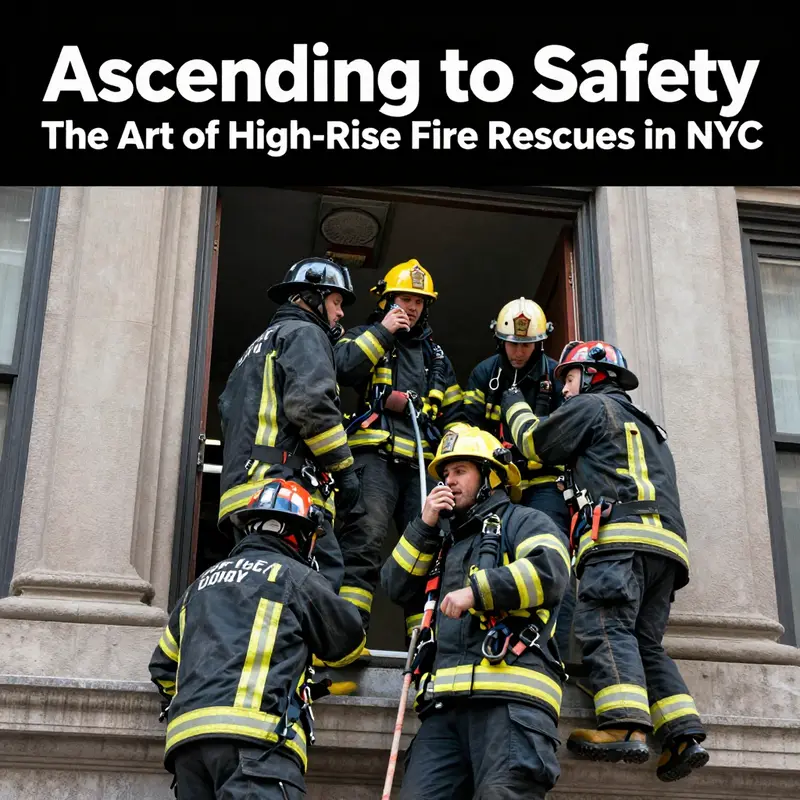
When a high-rise fire erupts in a dense urban landscape, the building becomes a living, breathing organism with two synchronized hearts beating in unison—one inside and one outside. In New York City, this coordinated heartbeat is the product of deliberate training, precise communication, and a shared understanding that success hinges on the seamless partnership between interior teams that press into the flames and exterior teams that protect access, create staging, and shepherd victims to safety. The choreography of this alliance is hard-won, refined through years of real incidents, and sharpened further by immersive training that mimics the pressures of a live event while preserving the safety net of controlled practice. It is not a single maneuver but a fluid continuum of roles, signals, and contingency plans that allows responders to move as a single unit through a fractured vertical maze, floor by floor, stairwell by stairwell, breath by breath.
From the moment the first alarm slices through the city’s noise, the interior crew and the exterior crew begin to operate on parallel tracks that are always converging. Inside the building, the priority is threefold: locate the seat of the fire, locate and rescue occupants, and create pathways for air to flow while preventing smoke from choking the stairs. The interior team relies on tight teamwork, radiotelephony discipline, and the ability to improvise within a preplanned framework. They advance with charged lines and portable ventilation equipment, moving through smoke-filled corridors and stairwells that seem to Defy gravity because of their density and confusion. Each member carries the burden of visibility reduced to a slit of light, yet they maintain a calm, almost methodical cadence. They search, listen, feel for signs of life, and relay information that shapes the exterior response as it unfolds.
Outside, the exterior crews are carving a different path through the same structure. They establish access, set up command posts, and synchronize the apparatus that will lift people from upper floors or lower them to safety. Aerial ladders, platform trucks, and rope rescue capabilities form the backbone of exterior operations. They are not merely support; they are the critical theater where external engineers of fate toggle between restraint and release, balancing speed with safety as they work to reach balconies, windows, or roof-level egress points. The exterior teamwork rests on a foundation of exacting logistics: multiple sectors—the command, interior operations, exterior operations, and safety—each with clear boundaries and overlapping zones of responsibility. The result is a system that can absorb the shock of a rapidly changing incident while preserving the clarity needed to react quickly and correctly.
Communication is the thread that binds interior and exterior actions into a coherent response. It is a discipline equal in importance to hose lines and ladder placements. Standardized radio procedures, clearly defined roles, and a shared mental model reduce the likelihood that teams will talk past each other as smoke swirls through the stairwells. The Incident Command System, widely taught and rigorously applied, provides the scaffolding for this coordination. It designates a single incident commander who oversees strategy, assigns function-specific chiefs, and ensures situational awareness travels in a constant loop between the inside and outside worlds. A well-practiced dialogue emerges: interior teams report heat, movement, and occupant status; exterior teams confirm access, egress routes, and the readiness of rescue systems. The exchange is not a string of commands but a living conversation about risk, priority, and possibilities.
A recurring challenge in this high-rise ballet is the very architecture that defines the problem. New York’s skyline is a city of mixed-era towers, many with non-sequential floor numbering, irregular stair configurations, and a tangle of mechanical spaces that complicate both entry and egress. The highest floors often host the most precious and perilous rescues because they demand sustained exposure to heat, smoke, and falling debris, while medical stabilization and evacuation must occur under pressure. Non-sequential floor numbering, in particular, can derail a response unless it is countered by meticulous preplanning and real-time orientation. Fire responders counter this risk by investing in detailed building information, up-to-date pre-incident surveys, and digital mapping that travels with the incident command, allowing teams to visualize floor layouts even when visibility is zero. This careful attention to building-specific details—elevators that may be out of service, stairwells that funnel smoke, or the location of dedicated mechanical shafts—becomes the quiet backbone of the rescue strategy.
The training that underpins these capabilities is as critical as the equipment carried by responders. In the city’s high-rise response domain, the interior and exterior teams rehearse together in conditions that approximate the chaos of a real event, practicing every step from initial reconnaissance to lifeline deployment. The training facility dedicated to high-rise scenarios provides a controlled, realistic theater in which crews can develop the muscle memory needed for complex rescues. Trainees practice navigating stairwells that replicate smoke and heat, performing rapid searches, and executing ventilation that balances pressure and airflow to create tenable conditions for occupants and responders alike. They simulate confined-space rescues, where limited room for movement heightens the precision of every maneuver. And they rehearse rope-rescue scenarios that could carry a life-saving difference from extreme heights, where gravity and fear are constant companions and the climber’s safety depends on flawless technique, trusted harnesses, and well-coordinated pulley systems.
Within this training ecosystem, the East River’s memory lingers as a reminder of what can go right when teams align. The 2022 incident on East 52nd Street, where a woman was rescued about 20 stories above ground using a rope-based system, stands as a case study that illuminates both the risk and the art of high-angle rescue. It is not simply about technology or strength; it is about the synthesis of planning, harnessing, lowering, and, crucially, the human judgment that guides those operations under duress. Rope rescues require a patient, calculated rhythm rather than a rushed rush to the top or bottom. The rescuer on the exterior must stabilize the system, protect the victim, and maintain communication with interior crews who manage fire suppression and occupant care. The simultaneous management of life safety on two planes—the inside and the outside—reduces time to rescue while maintaining control over the environment for everyone involved.
This is not a spectacle but a disciplined workflow. The interior crew concentrates on locating the most urgent occupants, establishing a safe path, and initiating mechanical or natural ventilation to push smoke out and fresh air in. They also work to create egress paths, sometimes using temporary doors, walls, or vents to channel air and dilute heat. As the interior operations progress, exterior crews build a scalable ladder and rope-rescue plan that can be adjusted as conditions inside change. If stairwells become untenable due to heat or smoke, the exterior unit pivots to alternate egress routes—perhaps a balcony or a window that has been prepared for entry or removal. The ladder trucks and platform devices have to be positioned with surgical precision to minimize exposure to the hazard while maximizing access to those needing help. The rope system, when used, is made safer by redundancy: multiple points of attachment, redundant lines, and back-up belay systems. The complexity of this dual-front operation makes real-time coordination indispensable, underscoring the need for a shared mental model and a practiced, nearly telepathic ability to read one another’s signals.
The role of technology in fostering this synergy cannot be overstated. Modern communication rigs, portable ventilators, and scene-management dashboards allow teams to share live status across the interior and exterior lines. Maps and building information, kept current through ongoing preplanning, help responders anticipate changes in the fire’s path and adjust their actions accordingly. In practice, this technology translates into faster, safer decisions. When interior crews encounter a compartment that is particularly difficult to access—perhaps due to a locked door, a blocked hallway, or a collapsed ceiling—the exterior teams can re-task the rescue plan in real time, deploying rope systems, constructing alternate egress, or repositioning ladders to reach an otherwise inaccessible floor. The objective is not to force a single plan through every obstacle but to adapt a flexible, layered approach that preserves life and reduces risk across all personnel.
The interdependence of interior and exterior teams depends on a shared vocabulary and a disciplined sequencing of tasks. The interior operations section adheres to a discipline of primary, secondary, and tertiary searches, prioritizing zones by occupancy risk, visible signs of life, and the likelihood of rapid fire progression. Exterior operations, meanwhile, focuses on securing the perimeter, ensuring safe access points, and maintaining the chain of command at a macro level. A safety officer sits at the pivot point between these factions, watching for hazards that might threaten either side. A liaison officer, often situated near the command post, maintains a steady line to the building owner or property manager, helping interpret building systems and facilitating access to mechanical spaces or elevators that may be used in special operations. This distributed leadership structure supports fast decision-making while preserving accountability, which is essential when heat, smoke, and fear push responders toward instinctive actions that might otherwise conflict.
Preplanning is where the quiet strength of this system begins. Pre-incident information sharing, so central to managing non-sequential floor planning, helps both interior and exterior teams anticipate where flow might become constrained and how to best sequence searches. It also aids in determining whether the building’s elevators can be safely used for rescue or should be bypassed in favor of stairs or rope operations. Preplanning extends beyond the building to the surrounding blocks. By understanding the pattern of traffic, the location of hydrants, and nearby anchor points for rope systems, responders build contingencies that reduce the likelihood of improvisation under stress. The High-Rise Firefighting Guide, a formal framework established by the city, codifies many of these practices, detailing the recommended procedures for different incident scales and fire behavior scenarios. While this chapter will not recite every line of that guide, it is important to note how the guide informs the daily discipline of coordination, training, and execution. In practice, responders cross-check the plan with real-time intelligence, adjusting as conditions evolve.
The human element remains central to the success of these operations. A calm, precise demeanor under pressure, reinforced by regular drills, translates into steadier teamwork when the building’s pressure and heat rise. Each responder learns to trust that the other side of the wall—inside or outside—will execute their role with the same level of care and professionalism. This trust is built during long hours of shared practice and is reinforced by a culture that treats preparation as a form of public service. The public, after all, depends on responders to act with clarity even when the stakes feel personal and the danger feels intimate. That trust—between interior and exterior teams, between command and field, between the responders and the people they aim to protect—becomes the invisible bond that allows life-saving decisions to be made quickly and correctly.
To illustrate how this trust translates into practice, consider the sequence of operations during a typical high-rise rescue with imminent life risk. Exterior teams establish access routes and prepare rescue systems before interior teams confirm occupant status and safety. As the interior team advances, they perform targeted searches and set up ventilation to create survivable conditions in the stairwells. If a victim is located on an upper floor, the exterior team deploys the rope-rescue plan, ensuring the needed anchor points, belay lines, and protective gear are in place. The two teams converge at the rescue point, where a coordinated handoff occurs: interior responders provide casualty care and secure egress while exterior rescuers manage the transition from the building to the exterior safety zone. Throughout this sequence, the tone of communication remains measured and precise. The command post monitors the evolving geometry of the fire scene and adjusts resources accordingly, ensuring that neither side loses situational awareness or becomes overextended. This disciplined rhythm sustains momentum while maintaining safety, a balance that is difficult to maintain but indispensable in high-rise operations.
The city’s ongoing commitment to prevention and preparedness further strengthens this alliance. Regular training cycles, community education, and post-incident reviews help identify gaps and reinforce best practices. A culture of continuous improvement grows from each event, each drill, and each lesson learned. The result is a resilient system that remains vigilant against the unknowns of high-rise emergencies. In this regard, the city’s training ecosystem mirrors the very architecture of the buildings responders face: layered, interconnected, and capable of bearing heavy loads under pressure. If one layer tightens, the others respond with better coordination, better timing, and better outcomes. This is the essence of the upstairs–downstairs alliance—an enduring, dynamic partnership built on trust, planning, and practice, always focusing on the imperative to save lives.
For those who want to explore the broader context of how innovations in training and practice shape this interwoven approach, a deeper dive into the philosophy behind modern training and its public-facing discourse can be illuminating. A resource that captures how forward-thinking institutions present their evolution is the Innovation Museum transforming fire services, which offers insights into how training, technology, and culture converge to improve high-rise resilience. You can explore this concept here: Innovation Museum transforming fire services.
The systems described here are not theoretical; they are lived daily in the city’s emergency response. They rely on the steady hand of leaders who understand that the line between interior and exterior is not a boundary but a continuous loop of responsibility. It is a loop that tightens when the building breathes—when metal and concrete expand, when stairwells fill with smoke, when a rope-tightened rescue line lowers a life to safety, and when the sound of a radio crackles with a concise update that changes the next move. The loop tightens further through memory—through the stories of past rescues, the lessons learned from near misses, and the quiet confidence that, when the alarm rings, the two halves of the response will act not as separate teams but as one living system, capable of adjusting its tempo to the rhythm of the building’s danger and the city’s need.
As the city continues to grow and its skyline evolves, the principle remains unwavering: high-rise rescue is a test of coordination as much as courage. It demands a shared discipline that blends interior search, fire suppression, and ventilation with exterior access, laddering, and rope-based extrication. It requires preplanning that respects the unique architecture of each tower and training that turns moments of crisis into rehearsed, purposeful action. And it depends on a culture of communication—where radio discipline, command structure, and real-time information flow empower responders to make the right decision, at the right place, at the right time.
In sum, the Upstairs–Downstairs Alliance is more than a descriptive phrase; it is the practical expression of a city’s commitment to life safety in its most vertical form. It embodies the recognition that rescue on high is a team sport conducted across two planes—inside the fortress of concrete and steel and outside in the open air and the street. The synergy generated by interior and exterior teams—each aware of the other’s constraints and capabilities—turns a perilous ascent into a carefully managed operation. It is a testament to preparation, to discipline, and to the relentless pursuit of new ways to keep people safe when floors burn and visibility vanishes. And it remains a living, evolving doctrine that grows stronger with every drill, every incident review, and every opportunity to refine the craft of high-rise rescue.
External resource: https://www1.nyc.gov/assets/fire/documents/High-Rise-Firefighting-Guide.pdf
Final thoughts
The complexity of high-rise fire rescues in New York City necessitates a well-structured approach that integrates advanced training, specialized techniques, and seamless teamwork. Firefighters’ preparedness, honed at the FDNY High-Rise Simulator, equips them to tackle challenges presented by towering structures and life-threatening situations. The critical methods, such as high-angle rope rescues, exemplify the unique skills required in these operations. Furthermore, the coordination between interior and exterior teams is fundamental in ensuring successful outcomes during emergencies. Public awareness of these efforts not only fosters respect for the firefighters’ courage and professionalism but also reinforces community preparedness for potential fire incidents. The next time you gaze at the skyline, remember the dedicated individuals ready to risk their lives to protect and save others when the call arises.