
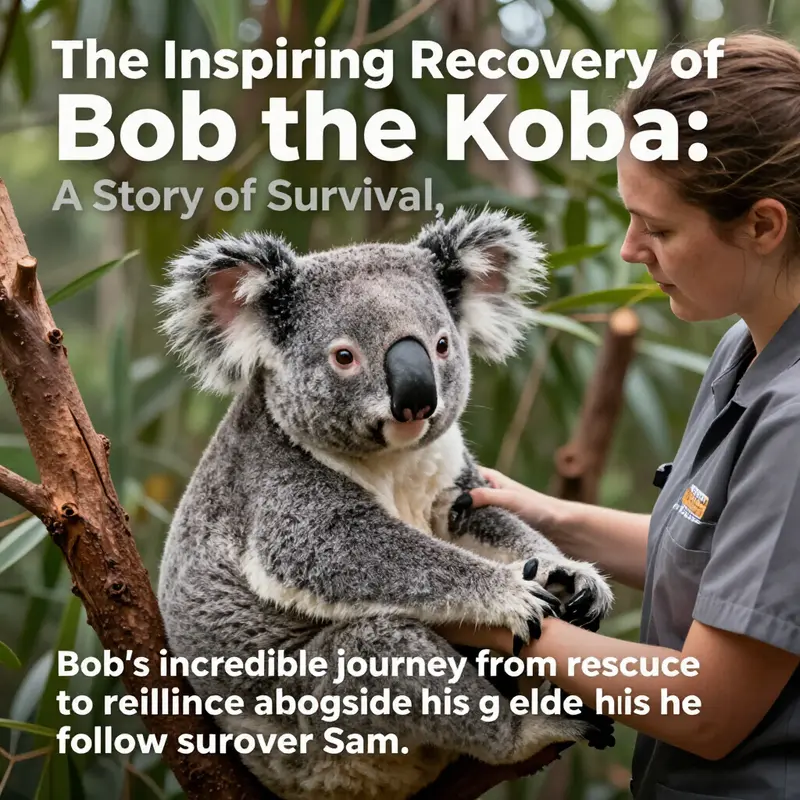
The heartwarming journey of Bob, a koala rescued from the ravaging Australian bushfires, represents not only survival but also the power of companionship and conservation. Bob, along with his friend Sam, illustrates the determination of wildlife to recover from devastating circumstances. Each chapter of this article delves into various aspects of Bob’s recovery – from his healing process and the bond with Sam, to the symbol of hope he has become, and the impactful conservation efforts that his story inspires. Understanding Bob’s journey allows us to appreciate the strength of both wildlife and community in overcoming adversity.
From Ember to Enclosure: Bob the Koala’s Long Recovery After the Fire
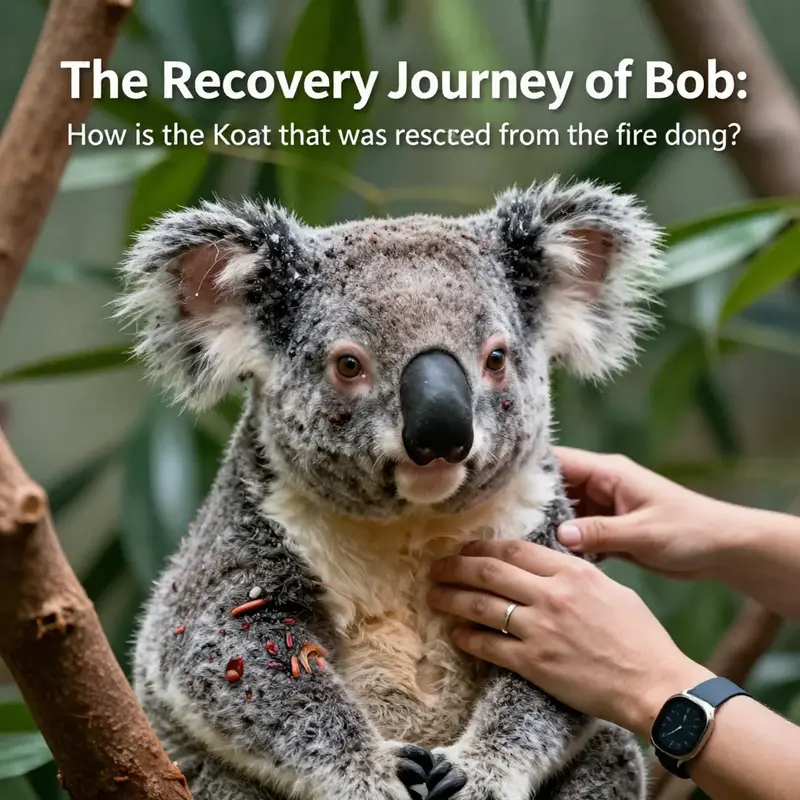
When the smoke finally cleared from the embers of Australia’s fiercest bushfires, a koala named Bob emerged as a living testament to survival under extremely harsh conditions. Found in a charred eucalyptus tree near Taree, New South Wales, Bob’s body told a story many wards of wildlife care rarely finish with neat chapters. He was severely burned, dehydrated, and his future looked as uncertain as the ash that surrounded him. He was rushed to the Port Macquarie Koala Hospital, a place that had already earned a reputation for treating some of the most badly wounded koalas brought out of the fires. The moment his rescuers laid eyes on him, the urgent work began—not just to stabilize a critically ill animal, but to offer him a lifeline to a life he could still hope to reclaim. The early days were a blur of alarms and careful hands, but also of quiet, hopeful moments when the staff could glimpse the faint flicker of curiosity that makes a koala’s life worth fighting for. In those first hours and days, Bob’s condition was grave. He had extensive burns to his face and paws, which meant continual pain and a high risk of infection. Dehydration compounded the threat to his already fragile state. Yet the medical team did not waver. They focused on the essentials: keeping the wounds clean to stave off infection, managing pain to ease his distress, and providing nutritional support to help his body recover strength for the long road ahead. The medical regimen was straightforward in its aims but complex in execution. Regular wound cleaning became a ritual, a careful, almost meditative process performed by clinicians who understood that even the smallest touch could make a difference between rehabilitation and relapse. Pain management was not merely about comfort; it was about enabling Bob to engage with the world again—the small acts of movement that signal recovery and the gradual return of instinct. Nutritional support was tailored to his fragile state. Eating is a koala’s lifeline, after all, and Bob needed all the calories and nutrients his stressed system could tolerate while his tissues healed. The team worked with the clear understanding that recovery is as much psychological as physical. Koalas, like all wildlife, carry scars that are not just skin-deep. They carry memories of fear, deprivation, and the abrupt shift from wild independence to human care. In Bob’s case, the presence of another survivor named Sam—a koala also recovering from burns—introduced a crucial dimension to the healing equation. The two shared space, meals, and moments of rest, and their bond became a bright thread running through a very dark period. This companionship mattered as much as any medical procedure. It offered a form of social enrichment that can be hard to quantify but is essential to long-term recovery. The staff observed how their proximity and mutual reassurance helped quell stress, reduce pacing, and encourage exploration of the new environment within the hospital’s enclosure network. The companionship did more than provide comfort; it helped recreate a sense of normalcy at a time when everything felt unstable. Bob’s early progress was measured in small, steady increments: the first signs of alertness after meals, a tentative shift from immobility to a cautious grip on a branch during supervised gatherings, and the slow, deliberate tests of balance that indicated his paws and joints were regaining strength. Each minor milestone mattered because it connected him to the world he had known before the fires—canopy, leaves, the feel of bark under his claws, and the instinct to climb toward the safety canopy that dominates koala life. The staff documented these moments with careful attention, not as a ledger of successes, but as a map of a patient’s gradual return to control over his own body. The road to recovery was not linear. There were days when momentum paused, when pain flared or when a stubborn wound required additional care. Yet Bob persisted, buoyed by the care that surrounded him and by the presence of Sam, who offered a mirror of resilience. The two became inseparable companions, sharing resting nooks and foraging routines under the watchful eyes of the veterinary team. The bond extended beyond simple companionship; it became a shared language of survival, a coping mechanism that emphasized mutual trust and the understanding that they were in this together. By the time the months passed from the initial rescue, Bob showed resilience beyond the most optimistic expectations. He began to display natural curiosity again, tilting his head to inspect unfamiliar scents, tracking movement with a keener eye, and returning to a climbing posture with more confidence. His caregivers noted that he looked forward to enrichment activities designed to simulate ancestral koala behaviors. These activities, even when conducted within a controlled hospital environment, were essential for preserving the mental and emotional states that support physical healing. Each day or week brought a new signal of progress, and the team logged these signals as carefully as a clinician would for a human patient. The preparation for any potential release into the wild was a careful, incremental process that requires more than just physical health. It demands an assessment of behavior, foraging competence, and the ability to navigate threats in a landscape altered by fire. The question was not only: could Bob survive in the wild? It was also: would he be able to thrive there again, given the changes in his habitat and the social dynamics of a landscape that had burned so deeply just a few seasons earlier? Over the months, Bob’s health steadily improved, but the team remained cautious. The decision-making around release is complex and rooted in evidence gathered over time. Bob’s condition became a focal point for discussions about the best path forward for his welfare. In addition to medical healing, the team considered the psychological and ecological aspects of release. Would Bob’s foraging skills, his ability to navigate tree canopies, and his temperament align with a return to a wild setting? These questions required extended observation, careful testing, and sometimes the acceptance that a long-term sanctuary life might be the wisest option. By early 2026, the trajectory of Bob’s life had shifted decisively toward a successful, ongoing rehabilitation. He is thriving in a large, naturalistic enclosure that mimics a koala’s native habitat, a space designed to support both physical recovery and behavioral expression. The enclosure offers a realistic arboreal landscape with plenty of eucalyptus, a variety of tree species, and complex branching that encourages movement and exercise. Within this environment, Bob continues to practice the skills that are essential for a wild koala: foraging for eucalyptus leaves of varying species and densities, climbing with confidence, and moving through the canopy with controlled, deliberate speed. These activities are not mere play; they are the practical rehearsals of survival. The team monitors Bob closely, not to rush him into a decision about reintroduction, but to ensure that every factor is favorable should the moment come where a return to the wild is deemed viable. At the same time, a degree of caution remains because the long-term viability of a rescue koala released back into a changed landscape is not guaranteed. The bushfires of 2019-2020 left a scar on the ecosystem that continues to unfold in unpredictable ways. Food availability, habitat connectivity, and predation pressures can influence the success of a future release. For now, Bob’s story has become a powerful emblem of what can be achieved when dedicated care, patient rehabilitation, and compassionate companionship converge. His days in the sanctuary are filled with purposeful activity, steady medical oversight, and the presence of Sam—two survivors who offer hope to others facing the same ordeal. The idea that a rescued animal can not only recover but also adapt to a life of meaningful capability in a controlled environment is an important one. It highlights the value of wildlife medical centers that can translate compassion into durable outcomes for creatures who bear the consequences of climate-driven disasters. The path ahead remains open to ongoing health assessments, continued enrichment, and the possibility that Bob may eventually rejoin a habitat that resembles the wild he once roamed. In the meantime, Bob embodies resilience: a symbol of healing that resonates far beyond the borders of the hospital. His story, and the companionship that formed with Sam, offers a narrative of recovery that invites communities to reflect on the broader implications of fires, climate change, and the human responsibility to protect and rehabilitate wildlife. Readers who want to explore more about the ongoing efforts behind Bob’s care can follow updates from the Port Macquarie Koala Hospital, where staff members continue to document progress and evolving protocols for care and rehabilitation. For a broader context on how rescue stories like Bob’s contribute to wildlife conservation and public awareness, a short introductory note about rescue storytelling can be found in a related post. See the Hello World post for a concise overview of how these narratives begin and frame subsequent care journeys. Hello World. As Bob’s life continues to unfold in the sanctuary, the public can witness a narrative that blends medical science, animal welfare, and environmental stewardship into a single, enduring testament to resilience. The chapter of his life does not end with a diagnosis or a discharge date; it extends into the realm of ongoing care, careful observation, and the quiet, steadfast belief that even creatures scarred by fire can reclaim a future that carries hope rather than fear. The work of wildlife centers, researchers, and dedicated volunteers remains central to this hope. They translate compassion into practical outcomes—habitat restoration, careful monitoring, and the creation of spaces where animals like Bob can relearn the rhythms of wild life without losing the safety net of advanced medical support. For those who follow Bob’s journey, his progress invites a broader conversation about how communities respond to disasters and the role they play in shaping a living landscape where resilience is more than a concept—it is a daily practice. The path from ember to enclosure, from fear to function, demonstrates that recovery is possible, even when the road is long and the terrain difficult. The chapter closes not with certainty about release but with a clear statement: Bob is thriving within the sanctuary, his health robust enough to support continued exploration, his social bond with Sam a constant source of strength, and his story a beacon for the countless other animals who endure the hidden wounds of catastrophe. As conservationists and carers draw lessons from his experience, the larger message becomes evident—the care of a single koala can illuminate a brighter future for many. The ongoing updates from Port Macquarie Koala Hospital document a culture of meticulous care, patient persistence, and a hopeful outlook that aligns with the wider goals of wildlife conservation in Australia and beyond. External resources underscore the collaborative nature of this work, reminding readers that the welfare of rescued wildlife depends on informed, sustained, and compassionate action. External resource: Port Macquarie Koala Hospital.
Survivors in the Smoke: The Remarkable Bond of Bob and Sam and What It Teaches About Koala Recovery
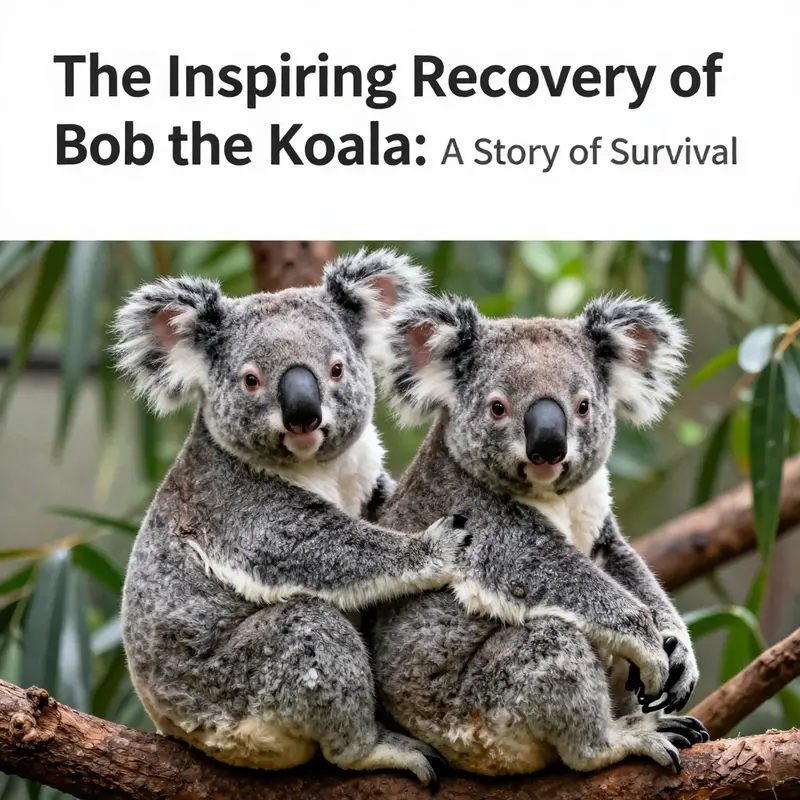
The rescue story begins in a landscape still warm with ash and memory. Bob, a young koala, had spent days wandering a scorched Australian hinterland as flames lapped at eucalyptus canopies and left behind a silence that felt almost tangible. When the teams arrived, they found him not far from a burnt trunk, clinging to a solitary branch as if the tree itself could still be a shelter. The burn injuries were severe, a harsh reminder of the fires that ripped through communities and habitats with little warning. In the cautious steps of veterinarians and carers, Bob’s fate hinged on the speed and tenderness of a rescue that could capture not just the body’s healing needs but the mind’s stubborn will to endure. The immediate hours in the wildlife center near Melbourne marked the beginning of a long, patient road back to health. It was a road that would be measured not only in wounds closed or fur regrown, but in the kind of emotional ballast that only companionship can provide during recovery from trauma.
In those early days, as Bob stabilized, another arrival altered the tempo of the ward and the mood of everyone watching over him. Sam, another koala survivor of the same firestorm, joined Bob in the same medical enclosure, and the two quickly formed a bond that would come to symbolize hope for staff, volunteers, and anyone who follows stories of wildlife rescue. Sam wore his scars with a quiet dignity, and Bob, perhaps sensing in Sam a mirror of his own fear, leaned closer in the shared space of treatment nets and soft bedding. The staff watched as these two creatures discovered in each other a counterweight to the stress that came with pain, medical procedures, and the uncertainty of the days ahead. If resilience could be measured in small rituals—feeding schedules, the stamina to move from one perch to another, the comfort of a shared branch—then Bob and Sam had already become living meters of a much larger recovery.
Koalas are typically solitary by temperament, creatures of a quiet logic who prefer their own trees and their own routines. Yet captivity—whether for rehabilitation, medical care, or protection from fire’s violence—can blur those natural boundaries. In the case of Bob and Sam, the shared vulnerability of two animals facing the same catastrophic event created an unspoken pact. They found in each other the safest place to lick wounds both visible and invisible. For a species whose daily life depends on the precise rhythm of feeding, hydration, and rest, the ability to sense another’s presence offered something almost tactile: a sense that they were not alone in the world, that someone else understood the texture of fear and the taste of ash in the air. This companionship did not replace the medical care Bob required, but it complemented it in a way clinicians have long observed in both domestic and wild animal rehabilitation: social connections can reduce stress, stabilize heart rates, and alter the trajectory of healing when fear and trauma threaten the body’s capacity to recover.
From a practical standpoint, the care team needed to attend to the dual task of healing and social enrichment. Medical staff carefully scheduled medical rounds and wound management around periods when Bob and Sam could be together without compromising the seriousness of their treatment. The koalas received a regimen of pain relief, anti-inflammatory support, and wound care that reflected the best-practice approach to wildlife trauma in a setting where each patient’s story is different, yet the shared experience of fire creates a common denominator. Beyond the physical work, there was the day-to-day economy of care—the gentle handling that respects delicate burns on fur and skin, the nutrition plan designed to restore energy after dehydration, and the quiet moments in the enclosure when the pair would lean against one another, heads almost touching, in what looked like an intimate, almost human moment of solace. In these instances, a simple act—sharing a perch, exchanging a breath, letting a tail rest near another’s shoulder—took on the weight of a lifeline.
The human component of this story—rescuers, veterinarians, volunteers, and researchers—also learned from the way Bob and Sam navigated the shock of their new reality. They learned that the trauma of fire is not a solitary wound but a social wound that ripples through the knit of an animal’s daily life. The companionship between the two koalas offered evidence that social contact, even among species that are often described as solitary, can play a crucial role in emotional regulation during rehabilitation. Care teams observed that when Bob looked toward Sam, his breathing slowed, his posture softened, and his vigilance—often a protective, survival-driven habit—temporarily loosened its grip. Sam’s presence did not erase the fear, but it helped calibrate it. The two koalas, through small, repeated acts of closeness, demonstrated a kind of mutual buffering against the sustained threat of a post-traumatic environment.
The broader context of their rescue must be acknowledged. The fires of 2009, which left a trail of devastation across Australia and claimed more than one life in the wild’s complex web, tested the resilience of countless beings. It also tested the resilience of the human communities that responded with immediacy, patience, and a willingness to see wildlife as part of the shared landscape they were fighting to preserve. In this light, Bob and Sam’s bond becomes more than a touching anecdote. It stands as a symbol of how emotional connections can accelerate recovery and support long-term welfare strategies. The care provided at the wildlife center—medical treatment, environmental enrichment, and the humane recognition that even in the wild, social bonds can matter—reflects a growing understanding in wildlife rehabilitation: that the path to survival can be paved with kindness as much as with science.
As weeks turned into months, the details of Bob and Sam’s routine started to form a narrative about adaptation rather than merely survival. The staff documented how Bob learned to modulate his movements on a perch, how he gradually gained the strength to explore a larger space, and how Sam’s own recovery seemed to parallel Bob’s, with the two testing new boundaries together. Their bond functioned like a practical therapy, a natural intervention within the enclosure that helped reduce stress hormones and encouraged exploratory behavior at a pace consistent with healing. It is tempting to read this as a purely emotional phenomenon, but researchers and caregivers recognized a measurable truth: companionship can create an environment where injury is less punitive and recovery is less lonely. In spaces where trauma remains a live undercurrent, the presence of a trusted companion becomes a kind of nonverbal permission to heal.
The social dimension of their experience also invites reflection on the ethics and purpose of wildlife rescue in crisis times. The fires created a complex landscape in which animal welfare, ecological restoration, and human safety intersected in practical and sometimes painful ways. Rescuers faced decisions about triage, relocation, and the duration of care for animals like Bob and Sam. The choice to keep them in a wildlife center, where they could receive continuous medical attention while forming a supportive bond, illustrates a deliberate strategy: prioritize immediate welfare while laying the groundwork for longer-term resilience. In the case of Bob and Sam, that strategy appears to have yielded a double benefit. It allowed two survivors to experience healing in a shared space and, in doing so, offered a living example to observers that resilience is not a solitary endeavor. It is reinforced by the presence of others who understand, in their own way, what it means to endure loss and to begin again.
What does this mean for the broader arc of koala recovery after fires? It suggests that rehabilitation practices should value social dynamics as part of care plans. It also underscores the importance of creating spaces that allow survivors to express natural behaviors and to form bonds that can support their emotional well-being. The anecdote of Bob and Sam is not a single, isolated moment; rather, it contributes to a body of knowledge that guides future interventions. In many wildlife centers, staff now consider social enrichment as essential as nutrition, temperature regulation, and wound management. The idea is not to force friendship where there is no natural instinct to bond, but to provide environments where, if a connection forms, it can be nurtured without compromising the animal’s physical health. In a sense, the story of Bob and Sam becomes a blueprint for compassionate care—an approach that respects the complexity of animal minds while acknowledging the power of companionship to restore dignity after trauma.
The public’s response to such narratives matters, too. Rescue stories have a unique strength: they captivate attention, mobilize donations, and bring fans of wildlife to the work of conservation in a tangible, memorable way. The image of two koalas recovering side by side can humanize, or more accurately, koalize, the crisis in a way that makes distant threats feel present. It invites people to consider not only the fires themselves but the ongoing, day-to-day work of rehabilitation and habitat protection that follows in their wake. It also invites a broader conversation about how to support wildlife in times of climate stress, how to coordinate cross-disciplinary efforts among veterinarians, ecologists, volunteers, and community groups, and how to translate heartbreak into concrete, lasting action. The story’s emotional core—the bond between Bob and Sam—works as a bridge between science and sympathy, reminding us that the goal of rescue is not simply to save a life in that moment but to help a life find a steady, hopeful path forward.
The documentation and dissemination of such stories matter for the long arc of conservation. While the immediate outcome for Bob and Sam—whether they will reintegrate into a wild setting or remain in a protected enclosure for ongoing monitoring—depends on a range of factors, the principle endures: recovery is a mix of medical healing, environmental safety, and emotional wellbeing. The companionship they found in one another demonstrates that even in the wake of devastating events, animals have a reserve of social resilience that thoughtful human care can help access. This insight has practical implications for how wildlife centers design enrichment programs, how field teams plan post-fire rehabilitation, and how researchers study the psychological dimensions of trauma in non-human mammals. The bond between survivors becomes a living case study, one that informs both the ethics of care and the science of adaptation.
For readers seeking further context on these themes, it is worth exploring broader narratives that echo this same message. An AFP report detailed the love story between two koalas rescued from fire, highlighting the tenderness that can emerge in the most unlikely places. Such coverage helps convey the rarity and significance of these moments, and it encourages continued attention to the needs of wildlife in the aftermath of disaster. In the broader arc of the article you are following, Bob and Sam’s story sits as a luminous thread, reminding us that adaptation is as much about emotional safety as it is about physical healing, and that the social fabric of care can help animals not merely survive but begin to thrive again.
To connect with a wider community of care and to see how ongoing efforts at rehabilitation and conservation are framed and discussed, consider exploring the kind of everyday storytelling that organizations cultivate on their blogs. For instance, a simple post on the TPB Rescue blog, Hello World, offers a window into the early stages of welcoming a patient into care and the small, meaningful rituals that mark a new beginning. The post’s title itself is a quiet nod to the longer journey that begins with a single, tentative step, much like the first steps Bob and Sam took together in that shared enclosure. You can learn more by visiting the blog here: Hello World. This link is not merely a garnish; it embodies a broader practice of sharing, learning, and growing through connection—exactly the kind of openness that makes the science of rescue more humane and the public’s engagement with wildlife more sustained.
In closing, the story of Bob and Sam is both a close-up of a specific moment in a rehabilitation process and a signal about how we understand recovery in wild animals. It is a reminder that the path to healing is rarely a straight line. It often threads through fear, pain, tenderness, and surprising moments of companionship that can alter the course of a life. Their bond teaches us to value the social dimensions of welfare, to recognize that resilience can be nurtured in the presence of another, and to continue supporting the people and programs that make those moments possible. While the details of Bob’s and Sam’s long-term destinies may be uncertain in the public record, the image of two survivors leaning toward each other on a quiet branch in a recovering landscape remains a powerful emblem. It is a story that invites empathy without reducing the complexity of the science, a narrative that helps readers understand why ongoing conservation and rehabilitation efforts matter—and why, even after the flames have passed, the work of healing continues with patience, expertise, and a touch of shared humanity.
External resource: For additional context on the original AFP report about two koalas rescued from fire and their bond, you can read The Love Story between 2 Koalas Rescued from Fire at https://www.france24.com/en/asia/20090211-a-love-story-between-2-koalas-rescued-from-fire
From Ash to Renewal: The Koala Rescue as a Beacon of Recovery and Hope
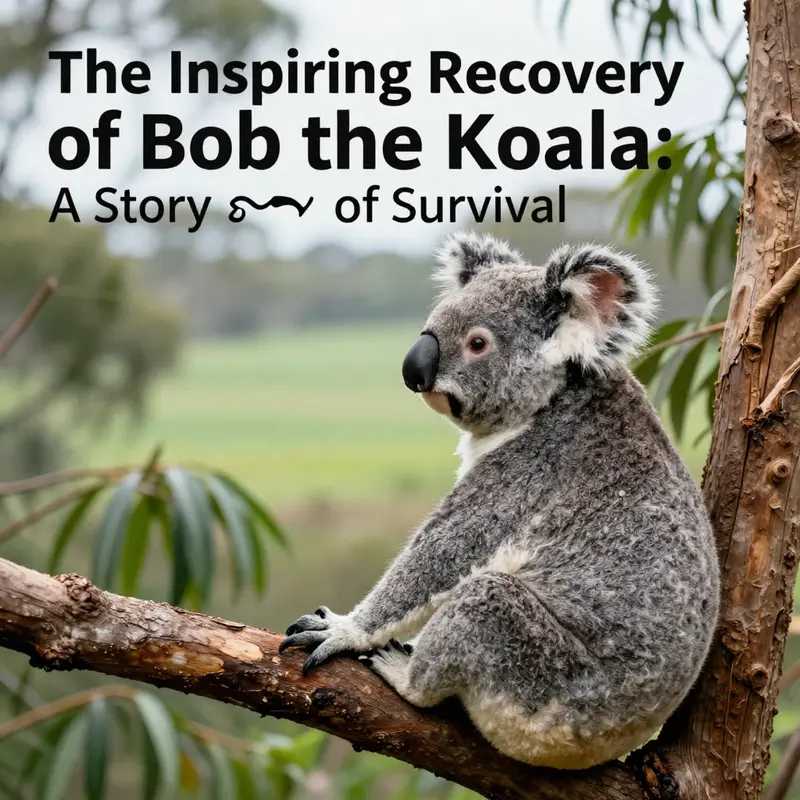
The year wore its scars on the Australian landscape as surely as the flames themselves left their marks on bark, soil, and the minds of people who watched the bushfires blaze with a ferocity that seemed to rewrite the map of home. In those early moments of smoke and ash, a small creature named Bob became a symbol not just of survival, but of the slow, stubborn work of healing that follows catastrophe. Rescued from the fire near Melbourne, Bob’s body bore the visible toll of heat and flame—burns on paws and chest, a cautioned reluctance in movement, and a fur pattern that suggested a life interrupted. Yet his eyes held a quiet stubbornness, the kind of gaze that creatures often keep when the world has demanded too much and still demands more. Alongside him in the rehabilitation center, another koala survivor named Sam offered a quiet companionship that felt almost like a pact between two solitary souls who found themselves on a shared, unspoken path toward recovery. The pair did not simply endure; they learned to lean into each other’s presence, turning isolation into a small circle of resilience that could withstand the long, patient work of healing medical wounds, rebuilding strength, and relearning the rhythms of koala life.
Bob’s rescue story travels beyond the single event of his survival. It threads through the broader narrative of how nature reclaims, how medical care can mend what fire has scarred, and how companionship acts as a critical companion to physical healing. In wildlife centers, the care given to burned koalas like Bob is a blend of science and tenderness. Medical staff monitor pain, protect vulnerable skin, manage hydration, and ensure nutrition that mirrors a koala’s occasional drift from eucalyptus to fresh greens as part of a staged rehabilitation. Burn care is meticulous; it involves cleaning, shielding delicate tissue, and controlling infection, all while recognizing the koala’s need to rest and reduce stress. The healing of damaged skin is slow, sometimes appearing not to progress for days, then suddenly a centimeter of fur or a renewed spring in a limp step signals the turning point. Throughout these moments, caregivers watch not only the physical signs but the koala’s behavior—eye contact, pause, appetite, and willingness to re-engage with the world outside the safe enclosure. It is in this patient observation that the story of Bob begins to unfold as a narrative about resilience, rather than merely a medical case.
Sam’s role in this recovery adds a humanizing layer to the science of healing. Koalas are often described as solitary by habit, tending their own trees and routines. Yet in the controlled and supportive environment of a wildlife center, social contact becomes a powerful catalyst for recovery. The presence of another survivor can soothe a nervous animal, reduce stress, and encourage the kind of slow exploration that rebuilds not just physical stamina but confidence. The two koalas, side by side, print a quiet message on the day-to-day life of the center: recovery is rarely a solitary triumph. It is earned through shared space, mutual reassurance, and the sense that someone else understands the ache of loss and the stubbornness of hope. This kind of social pairing does not erase the trauma of the fire; it reframes it. The trauma remains, but it becomes a shared substrate upon which healing can grow, stitch by stitch, leaf by leaf, heartbeat by heartbeat.
The rehabilitation journey for Bob and Sam is a mirror of the broader potential for ecological restoration. Their individual recoveries echo the possibilities that exist for damaged habitats when they are treated with care, when science is applied with patience, and when communities rally behind wildlife protection. The koala’s path from severe injury to renewed vitality illustrates a central idea: healing in nature is possible when there is space for recovery, time for regeneration, and people who are willing to invest in the slow, often unglamorous work that underpins it. It is a reminder that ecosystems, like individual animals, require ongoing attention and intervention to recover from catastrophic events. When a wildfire severs a koala’s habitat, the road back is not merely about patching up a single animal; it is about restoring the conditions that allow a whole community of life to return to the trees, the vines, and the understory that shelter them. This is the essence of conservation in a warming world, where the line between tragedy and renewal is a matter of scale, time, and the coordinated effort of researchers, caregivers, volunteers, and policymakers.
The story of Bob and Sam also casts a light on the kind of public engagement that conservation needs. A single rescued koala can become more than a statistic or a medical file; the narrative can become a catalyst for broader support for wildlife protection. When people learn about the injuries, the careful care, and the gradual reintroduction into safer habitats, they often feel a renewed sense of duty to protect the places that wildlife depend on. This connection is especially critical in an era when climate change and habitat loss threaten more and more species with abrupt shifts and slow declines. The resilience demonstrated by Bob and Sam is not simply a personal victory; it is a signal that ecosystems possess a latent capacity for renewal if we give them the conditions to recover. In practical terms, that means maintaining healthy, connected landscapes, reducing additional stressors such as human-wildlife conflict and pollution, and supporting organizations that perform the quiet, essential labor of rescue, care, and research. The koala, with its iconic pose in a tree and its quiet, almost meditative pace, embodies a way of looking at recovery that invites empathy instead of despair.
As the weeks turned to months, the care team tracked progress in ways that balanced caution with optimism. The koalas’ recovery is not a straight line; it moves in fits and starts, with days of slow improvement followed by sudden signs of strength. The early stages emphasize basic needs: warmth, shade, a stable diet, and the absence of stress. The mid-stages add mobility, balance, and the re-engagement with leafy diets, while the late stages focus on conditioning, social acclimation, and readiness for potential release into a safer habitat. Each stage demands a different kind of attention, and in the hands of experienced carers, the progression becomes a choreography of healing. The narrative of Bob’s recovery—how he gains traction after the fire, how he learns to navigate his surroundings with greater confidence, how his fur grows back and his eyes regain a certain clarity—illustrates the slow power of time, and how it is often the most faithful ally in healing from trauma. In this larger arc, Sam remains a steady companion, a constant reminder that recovery is rarely solitary and that companionship can be a quiet medicine in its own right.
The koala rescue story also carries a message about ecological restoration. If Bob’s life after the fire is a case study in personal healing, the surrounding landscapes embody the potential for a larger ecological comeback. Native species can recover when fires are managed with attention to chronology and severity, when habitat corridors exist to allow movement and genetic exchange, and when caretakers monitor the regrowth of critical food sources like eucalyptus. The resilience of nature is not a simple, linear surge; it is a mosaic of regrowth, seedling establishment, and gradual reestablishment of food webs. Bob and Sam’s success invites readers to imagine a landscape where such recoveries become more routine, where communities recognize that protecting habitat is both a duty and a way to invest in a future where wildlife can reclaim spaces wounded by fire yet still endure.
An essential thread running through this narrative is the social and ethical dimension of rescue work. The public’s response to stories like Bob’s often translates into tangible support for wildlife centers, rescue networks, and conservation programs. Donations fund medical supplies, specialized wildlife enclosures, and the research that improves treatment protocols for burns and trauma in koalas. Volunteers contribute hours of care and enrichment activities that keep animals engaged during recovery. Scientists and veterinarians collaborate to refine rehabilitation strategies, identify best practices for rehydration and nutrition, and study the behavior of recovering animals to inform future releases. The care ecosystem that holds Bob and Sam becomes a microcosm of how society can contribute to healing when confronted with climate-driven disasters. It demonstrates that compassion, when grounded in science and sustained by community effort, can translate into real, measurable improvements in the chances of survival for individuals and the broader prospects for species.
Despite the hopeful cadence of Bob’s progress, the chapter quietly acknowledges a truth that conservation work insists we face: resilience is not a guarantee, and not every story ends with a return to the canopy. The details of Bob’s current condition are not specified in the materials at hand, and in many real-world cases, the outcomes depend on a complex interplay of health, habitat availability, and continued protection from threats. What remains clear, however, is that recovery is possible and that, through careful medical care, patient rehabilitation, and the power of companionship, a koala wounded by fire can become a living emblem of renewal. The koala rescue becomes more than a narrative about a single animal; it becomes a lens through which we can view the broader trajectory of wildlife conservation in a climate-stressed era. It invites us to see recovery as a process that requires time, coordinated care, and a shared commitment to safeguarding the places where these creatures live and thrive. In this light, Bob’s story is not just a tale of endurance; it is a testament to the possibility that even severe disruption can lead to new equilibrium, new habits, and a reimagined relationship between people and the wild they share this land with.
For readers seeking to understand the ongoing work behind such stories, the world of wildlife rescue and rehabilitation offers a continuum of care—from initial triage at the edge of disaster to the steady drums of daily care in a wildlife center, to the hopeful but careful tests of release into a safer habitat. Each step is part of a larger commitment to living with the reality of a changing climate and the need to protect the species that shape the character of the landscape. Bob’s journey, anchored in the resilience that koalas can summon even after burning experiences, underscores the potential for recovery when communities, scientists, and caregivers stand together. It is a narrative that invites admiration for the courage of the animals and gratitude for the dedication of those who accompany them through the long arc of healing. And it offers a durable, hopeful counterpoint to the fear and loss that fires can evoke—a reminder that recovery is possible, and that each rescued life becomes a beacon for what restoration can endure in a world of ongoing environmental change. For anyone seeking more about the real-world trajectories of rescued wildlife and the science that guides rehabilitation, official updates and stories of recovery provide a steady horizon of information and inspiration. https://www.awc.org.au/koala-rescue/
From Ember to Renewal: The Rescue Koalas Bob and Sam and the Shape of Australia’s Wildlife Future
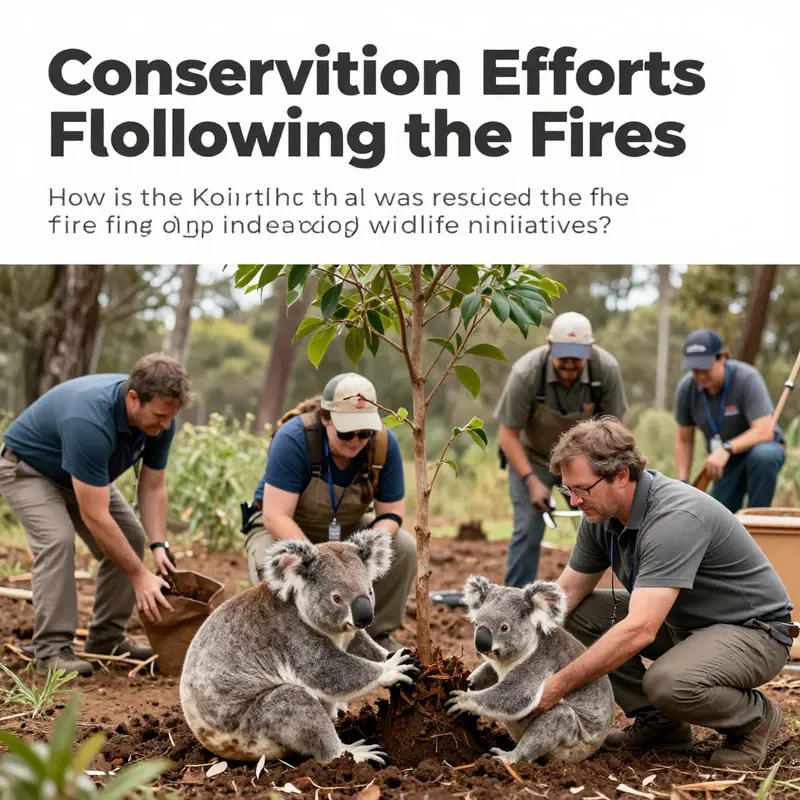
From Ember to Renewal: The Rescue Koalas Bob and Sam and the Shape of Australia’s Wildlife Future
Across the ashes of a landscape that once rang with birds and the crackle of embers, two koalas carved out a path from disaster toward a different kind of hope. Bob, rescued near Melbourne after the 2019–2020 bushfires, bore the marks of a long and brutal ordeal: burns that told a story of pain, dehydration that whispered of months without steady meals, and the kind of trauma that leaves even the strongest creatures wary of the world’s noise. His arrival at a wildlife center was not merely a routine intake; it was the start of a careful, patient conversation between human caregivers and a creature learning to trust again. The team approached his care with the precision of clinicians and the gentleness of guardians. Wounds were cleaned and dressed, fluids were administered with the cadence of a heartbeat, and every movement was watched for signs of comfort or fear. The medical work was essential, but the true turning point lay in understanding that rehabilitation for a koala is as much about psychological repair as it is about body repair. A koala who has learned to survive a fire needs more than medicine; he needs a life that makes healing possible.
A short time after Bob began his quiet recovery, Sam joined the same corridor of care, a female koala rescued from a burnt forest near Mirboo North. Her burns were extensive, and dehydration had left her energy stores dangerously low. Yet Sam carried in her eyes a stubborn resilience that rescuers have learned to read as a kind of stubborn optimism. The medical team moved quickly to stabilize her, but it was clear from the first days that the road to her recovery would hinge on more than intravenous fluids and wound care. Sam required the same steady routines that would become familiar to Bob: predictable feeding times that encouraged appetite, gentle handling that reduced stress, and the presence of another survivor with whom she could share the simple acts of dawn and dusk—the quiet companionship that can soften a koala’s fear. In the shelter’s cheerful bustle, Sam and Bob began to reflect a core truth that underpins effective wildlife rescue: recovery is a social act as much as a medical one, a dance of care that returns not just strength but a sense of belonging in a world that has become overwhelming.
As the two koalas settled into companionship, the staff observed changes that suggested healing extended beyond individual bodies. When Sam and Bob slept side by side or shared a grooming touch, caregivers noted a reduction in stress indicators and an increase in appetite and movement. This was not merely anecdotal warmth; it was a signal that the care environment itself could be a therapeutic agent. Their bond created a microcosm of ecological cooperation within the walls of the wild-animal hospital. The center near Melbourne, a hub for triage, medical treatment, caregiver training, and follow-up monitoring, soon became a living laboratory where ideas about wildlife rescue could be tested in real time. The two survivors offered a proof point that companionship matters, especially for arboreal species that move through a world of branches and sky where isolation can compound fear. The deeper implication was clear: humane rescue practices, when paired with patient social support, can accelerate recovery and improve long-term outcomes for animals who enter care when their communities are most vulnerable.
The implications of Bob and Sam’s stories reach beyond the walls of the shelter. Their experiences highlight a gap in traditional emergency response, one that arises when the needs of tree-dwelling animals are not adequately anticipated in the heat of crisis. Arboreal species like koalas face unique risks in fires: they have limited ability to flee along the ground, fire can cut off escape routes they cannot fly or run away from, and their specialized diets demand rapid access to safe food sources once the flames pass. The rescue community began to articulate this reality in broader terms, recognizing the need for dedicated infrastructure that can respond swiftly to climactic emergencies affecting arboreal wildlife. In practice, this has meant developing rapid-response teams trained specifically to handle koalas and other tree-living species, and ensuring that shelters can accommodate vertical releases and perches that mirror natural habitats. The shift is not about reducing the urgency of saving individuals; it is about expanding the toolkit so that the entire system can protect more species with greater efficiency and compassion. For readers who want a concise entry point into the philosophy guiding these shifts, the tpbhrescue blog serves as a useful primer: tpbhrescue.org/hello-world/. This link, while simple in its origin, points to an ethos that keeps frontline rescue work anchored in core principles—clear triage, steady care, and a commitment to ongoing learning—principles that informed the Bob and Sam narrative from the first day of care.
The broader policy and practical implications grew from the ground up as data from the rescues and rehabilitations were compiled and analyzed. The experience of Bob and Sam fed into a wider effort to understand how injuries from bushfires unfold and how outcomes vary with different treatment approaches and environmental contexts. The 2025 report by Cope, Holly, Sonawane, Indrie, and Haering underscores what field workers have long suspected: the value of detailed data about injury patterns, survival rates, and long-term health outcomes cannot be overstated. This research is not an abstract exercise; it translates directly into smarter rehabilitation policies, more accurate prognosis models, and more robust arguments for climate-resilient conservation frameworks. In practical terms, the knowledge generated by these rescues informs decisions about resource allocation, which kinds of medical interventions yield the strongest return on recovery, and how to design monitoring programs that can track the long arc of a koala’s life after trauma. By connecting the clinical to the policy, Bob and Sam helped reframe a moment of crisis into a longer arc of learning and reform.
Conversations about fire management and post-fire response began to reflect what the koalas needed to survive in a warming climate. Local, state, and federal agencies reexamined not only the immediate tactics used to suppress fires but also the ecological planning required to sustain koala populations through and after fires. Key questions emerged: Where should habitat corridors be strengthened or restored to maintain connectivity? How can feeding trees be protected or replanted so that koalas can access sustenance after a event without exposing themselves to the hazards of burned landscapes? What forms of rapid post-fire monitoring can reliably indicate whether a habitat remains viable for koalas in the weeks, months, and years after a fire? The answers required collaboration across disciplines—ecologists, veterinarians, land managers, climate scientists, and even social scientists who study how communities respond to disaster. Bob and Sam’s case became a touchstone for these discussions, a reminder that every rescue has the potential to influence policy when it is paired with careful data collection, transparent reporting, and a willingness to adapt practices in light of new evidence.
As policy conversations matured, climate change loomed larger in the framing of wildlife recovery. Bushfires in Australia are not aberrations; they are increasingly likely events in a hotter, drier world. This reality has shifted the purpose of recovery from a mere act of salvage to an ongoing commitment to resilience. Climate-resilient conservation means protecting critical habitats, extending and strengthening corridors that koalas use to move between feeding and nesting sites, and supporting restoration projects that rebuild the ecological networks koalas depend upon. It also means integrating wildlife considerations into land-use planning and disaster response so that protections are not left to chance. The aim is not to inoculate the landscape against all harm but to create a system that can absorb shocks and recover quickly when a disturbance occurs. In this light, Bob and Sam’s stories become a blueprint for future action, showing how compassionate care, scientific inquiry, and policy foresight can work together to safeguard arboreal life in a changing climate.
Public engagement grew alongside policy and practice. The rescue stories fed into a broader cultural conversation about what it means to protect wildlife in times of crisis. People who watched Bob and Sam’s progress felt a direct connection to the forests and the livelihoods dependent on them. This connection translated into tangible support: volunteers offered hands-on help, researchers shared preliminary findings, and donors contributed to the sustained operation of wildlife centers and habitat restoration projects. Educational programs emerged to translate the science and the fieldwork into accessible knowledge for schools, communities, and households. The recurring message was simple but powerful: protecting koalas and their habitats is not someone else’s problem. It is a shared responsibility that benefits all of us, from the resilience of our ecosystems to the health of our neighborhoods, as forests recover and wildlife reoccupies the spaces we share. In this sense, Bob and Sam helped bring to life a more expansive view of conservation—one that values compassion, evidence, and collective action as indispensable tools for a more hopeful future.
If this integrated approach endures, it offers a hopeful template for the future of wildlife under fire: rapid, compassionate response; rigorous, transparent monitoring; adaptive management; and a willingness to invest in the ecosystems that make recovery possible. The fires that threatened life and habitat can also become the fires that kindle a stronger, more resilient relationship between humans and koalas—and between communities and the landscapes they call home. The path from Ember to renewal is not a straight line, but a trajectory that moves toward greater readiness, stronger science, and deeper communal care. As Australia continues to confront climate-driven threats, the Bob and Sam story remains a touchstone: a reminder that even in the darkest days, careful rescue, sustained support, and collaborative governance can transform tragedy into lasting stewardship. External reference: https://www.environment.gov.au/conservation/wildlife/bushfire-recovery
Final thoughts
Bob’s remarkable journey from suffering to recovery not only highlights the resilience of wildlife but also emphasizes the importance of community involvement in conservation efforts. His bond with Sam showcases the power of companionship in healing, while their story exemplifies hope in the face of adversity. As we engage in wildlife conservation initiatives, Bob’s narrative inspires us to protect our natural world, signaling a collective commitment to nurturing our environment and its inhabitants. The legacy of Bob the koala serves as a reminder that through solidarity and action, recovery and resilience are achievable.