
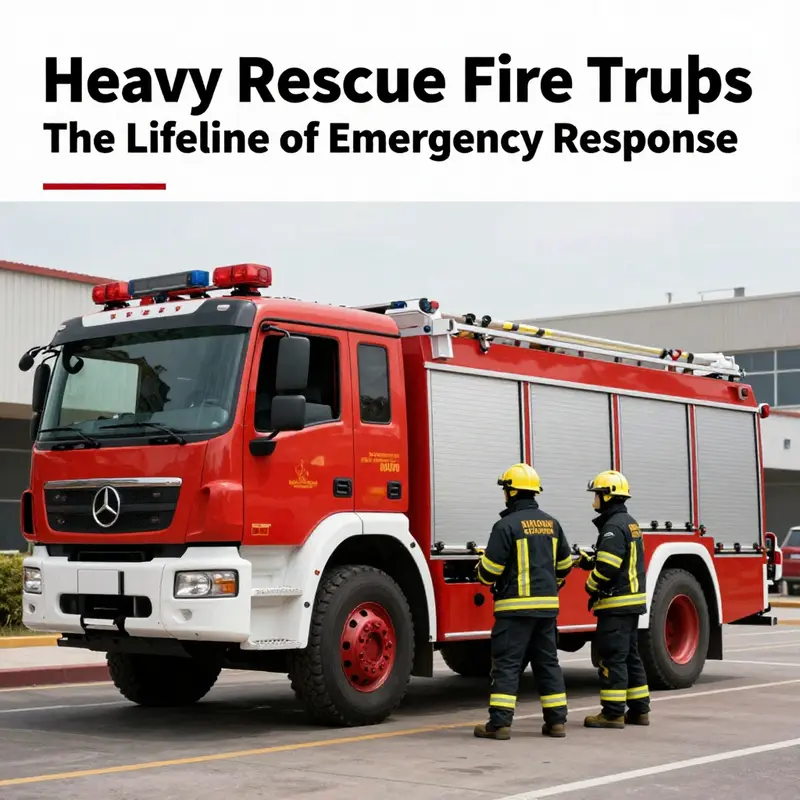
Heavy rescue fire trucks are not merely vehicles; they are crucial assets in emergency response, equipped to handle complex and dire situations. Built to support firefighting and multi-faceted rescue operations, these trucks integrate advanced technology and specialized tools essential for saving lives and protecting communities. This article elucidates their various functions and uses in emergency situations, highlights technological advancements that enhance their capabilities, examines the economic considerations for fire departments regarding these vital vehicles, and discusses their profound societal impact in urban environments. Each chapter will provide comprehensive insights that underscore the importance of heavy rescue fire trucks, fostering a better understanding of their indispensable role in emergency services.
null
null
Rising to the Challenge: How Tech-Driven Heavy Rescue Fire Trucks Extend Reach, Speed, and Safety in Modern Emergencies
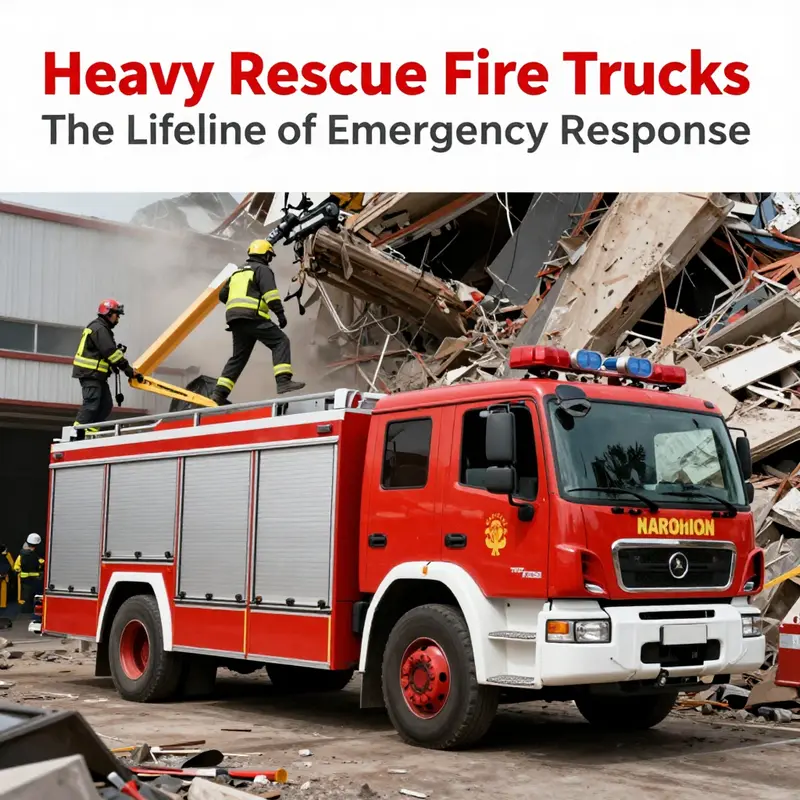
In the intensity of a large-scale emergency, a heavy rescue fire truck sits at the heart of the response—not merely as a rolling engine of water and hoses, but as a versatile, self-contained operations hub. These vehicles are purpose-built to endure the most demanding scenarios: enormous structural collapses, industrial fires with volatile fuels, and complex urban incidents where timing, access, and safety decide life and death. They carry more than equipment; they carry a philosophy of mobility, resilience, and resilience’s partner, technology. A heavy rescue truck acts as a mobile command post, a staging area for rescue teams, and a platform for specialized operations. Its design enables responders to stabilize hazards, extricate victims, and establish a working tempo that keeps pace with evolving incident dynamics. The result is a vehicle that embodies the convergence of firefighting, rescue, and advanced logistics in a single, purpose-built platform. Each mission reveals how the truck’s integrated tools and systems translate into real-world outcomes: faster access to trapped victims, safer structural stabilization, and a more controlled, coordinated response in environments that are hostile to human teams alone.
At the core of these capabilities is a suite of heavy-lifting and recovery tools. The hydraulic cranes and winches integrated into modern heavy rescue platforms are not add-ons but central to the vehicle’s mission profile. When a collapse blocks a corridor or debris blocks a roadway, the ability to lift, move, and reposition massive objects without waiting for a dedicated crane crew cuts precious minutes from a rescue timeline. In urban search and rescue (US&R) operations, these tools often determine whether a trapped person can be reached quickly enough for survival. The same lifting systems also enable the safe removal of hazardous debris, vehicle wreckage, and compromised structural elements that could further endanger victims or responders if not stabilized. In practice, this capability reshapes the risk calculus for incident commanders, allowing them to plot a course through a scene that previously might have demanded more limited, slower assets.
Equally critical is vehicle extrication and structural breaching. Heavy rescue trucks are designed to accept modular interfaces for hydraulic cutters, spreaders, and rams. This interoperability allows responders to rapidly couple and deploy the tools that sever entanglements, pry open wrecked passenger compartments, or breach damaged walls to reach victims. In many scenarios, the difference between trapped and freed hinges on how quickly responders can create a safe, accessible route into an affected space. The emotional and physical toll on victims, witnesses, and crews alike often correlates with the speed and precision of these extrication operations. The truck’s integrated power and hydraulic systems sustain these actions under demanding conditions, from extreme heat to thick smoke, where fuel efficiency, reliability, and operator control are non-negotiable.
Beyond access and rescue, heavy rescue trucks maintain a formidable firefighting capability, particularly in environments where a conventional engine’s role would be stretched thin. A large on-board water reserve paired with a high-performance pump system can deliver sustained flows that rival dedicated firefighting apparatus. Some configurations also carry foam concentrates for fires involving flammable liquids—an adaptation that reflects the realities of industrial sites and petrochemical settings. The mobility of these trucks, combined with a robust water delivery capability, means they can fight large-scale fires while simultaneously supporting rescue efforts. This dual role—combating active flames and facilitating rapid, safe rescues—highlights the versatility that defines a modern heavy rescue platform.
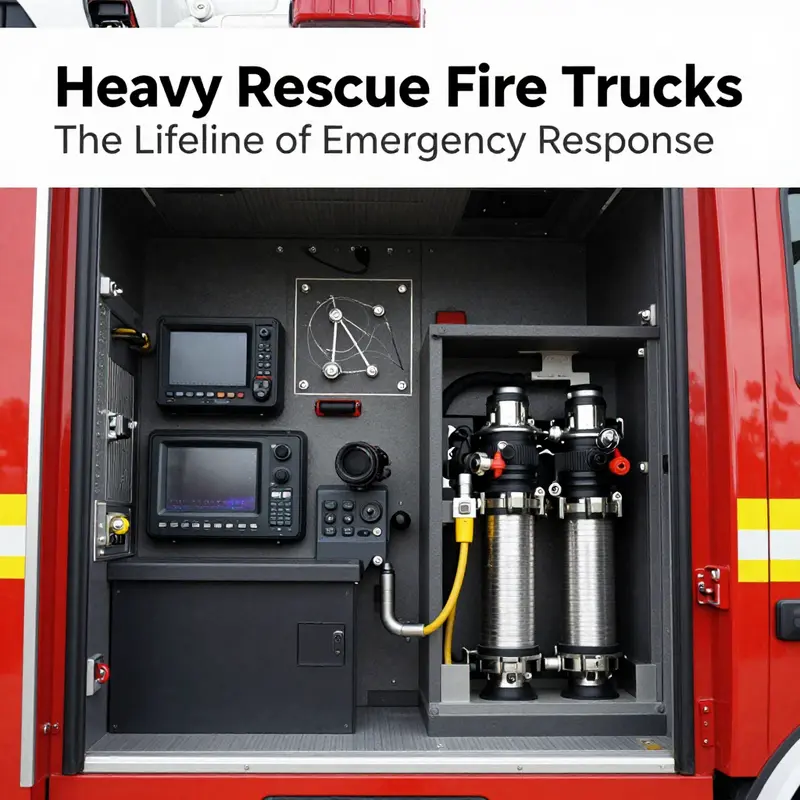
On-site power generation and lighting complete the operational triad. Integrated generators ensure that lighting, power for tools, and essential electronics remain reliable long into the night or through thick, smoke-filled conditions. High-intensity lighting is not merely a convenience but a necessity for safety, enabling search and rescue teams to work with visibility akin to daylight. In prolonged incidents, continuous illumination helps crews move through debris, identify hazards, and execute coordinated tasks with greater confidence. The ability to sustain operations without reliance on external power sources is a hallmark of the heavy rescue concept and a key factor in mission success when the scene presents environmental challenges such as power outages or remote locations.
When the scene demands coordination and situational awareness, the heavy rescue truck’s command and communications systems come to the fore. The vehicle often functions as a mobile command post, equipped with satellite communications, rugged data networks, and real-time video feeds from drones or thermal imaging cameras. This connectivity allows incident command to monitor evolving conditions, assign tasks, and share information with nearby units or regional centers. In practice, it means better resource management, fewer duplications of effort, and a more coherent overall strategy. The capacity to stream live data from the field to a central operations center reduces ambiguity and supports faster, more informed decision-making. As incidents grow in complexity, the value of a centralized, multi-source picture cannot be overstated. It becomes the backbone of a response that must adapt as conditions shift—from a suspected collapse to an evolving hazardous materials scenario, and ultimately to a mass casualty situation where every minute matters.
A significant evolution in heavy rescue trucks is their all-terrain mobility. Some variants push the envelope with tracked or otherwise optimized chassis that minimize ground impact while maximizing traction on rubble, mud, or uneven terrain. This capability is game-changing when responders must cross unstable surfaces or access sites where standard vehicles cannot venture. The ability to traverse challenging terrain without becoming immobilized enables teams to reach as well as reach around barriers, and to do so without delaying crucial actions. In combination with power, lighting, and life-support features, all-terrain mobility makes the vehicle a more flexible platform that can operate effectively in a broader spectrum of disaster environments.
Inside the vehicle are additional layers of protection and capability designed to shield responders in dangerous atmospheres. Specialized rescue capabilities—such as self-contained breathing apparatus (SCBA) storage, internal air filtration, and even pressurized cabins—provide a safer interior for crews conducting interior operations in smoke-filled or toxic environments. These features reduce fatigue and exposure, enabling more time on scene and more precise, deliberate actions in critical moments. The safety envelope is not incidental; it is a deliberate design principle that recognizes the physical and psychological stress of rescues that unfold under extreme heat, choking smoke, and unstable structural conditions.
In this context, the newest developments in heavy rescue technology amplify what a single vehicle can accomplish. The research results presented here sketch a trajectory where heavy rescue trucks become increasingly intelligent, connected, and autonomous—without replacing the essential judgment and skill of human responders. The movement toward intelligent automation does not suggest that crews will be replaced; rather, it reallocates risk and workload so that human operators can focus on the decisions that require nuanced assessment and empathy. A notable example is an autonomous rescue unit designed to detect flames, make real-time decisions, and perform firefighting tasks under hazardous conditions, including oxygen-deficient environments. Such a unit operates for extended periods—more than two hours in extreme environments—while navigating obstacles taller than a few dozen centimeters and climbing gradients that would challenge conventional robotic systems. The idea is not to remove human presence but to extend the reach of human capability into environments that would pose unacceptable risk otherwise. In practice, this means fewer responders exposed to heat and smoke, and more reliable access to victims who otherwise might be beyond reach.
Communication and coordination have also benefited from these technological advances. The remote command center concept employs a multimodal fusion communication system designed to push signal reliability through thick barriers and over substantial distances. The capacity to penetrate walls thicker than three meters and maintain a stable link over more than a kilometer widens the radius of safe, informed decision-making. The intelligent algorithms powering resource scheduling, task grouping, and multi-machine collaboration translate into measurable gains in rescue efficiency—reports indicate increases of up to sixty percent in overall response effectiveness. This is not merely a matter of speed; it is about the reliability of decisions under pressure, the orchestration of diverse assets, and the ability to reconfigure a plan in real time as the incident evolves.
The broader implications of these developments reach beyond the immediate action on the ground. They touch on how communities perceive emergency response, how training programs adapt to new tools, and how incident command centers interface with field crews. Heavy rescue trucks, once defined primarily by their lifting power and extrication tools, are increasingly recognized as mobile platforms that integrate sensing, automation, and remote coordination. This shift preserves the human element—training, experience, and teamwork—while expanding the envelope of what responders can safely attempt. It also drives a more proactive posture in incident planning. A robust heavy rescue capability can influence planning decisions, from the design of urban structures to the placement of responding units. When communities anticipate the possibility of complex incidents, the presence of a heavily equipped, technologically integrated rescue asset becomes a strategic asset in public safety, not only a reaction to danger after it appears.
For readers curious about how these ideas translate into real-world improvements, consider how the Innovation Museum frames this transformation. The museum highlights how fire services are evolving through technology, integration, and new operational paradigms. Such an exploration helps connect the practical tasks of lifting, breaching, and trapping with the broader trend toward automated sensing, machine-guided decision support, and resilient communications. The chapter thus links the concrete capacity of the heavy rescue truck to the broader systems that enable safer, faster, and more coordinated responses. This is not an abstract trend; it is a set of actionable capabilities that responders carry with them into the firehouse, onto the street, and into the most challenging scenes they will face. As the technology matures, training will continue to emphasize how to integrate these tools with traditional rescue skills, how to manage risk while leveraging automation, and how to maintain robust interoperability with neighboring agencies and regional networks.
In sum, a heavy rescue fire truck is not a single-purpose machine but a living platform—one designed to endure, adapt, and extend human capability through a precise blend of hydraulics, high-pressure water delivery, power and lighting resilience, and smart, scalable technology. These vehicles enable responders to stabilize collapsing structures, quickly access blocked areas, fight large or complex fires when conventional engines reach their limits, and sustain operations long after the initial surge of activity. They also embody a shift toward safer, smarter rescue missions where the emphasis is on reducing risk to people—both victims and responders—while maximizing the chance of a successful outcome. The chapter that follows will further explore how these capabilities evolve under the pressures of resource constraints, urban growth, and the ever-present demand for faster, more precise emergency responses. For now, the narrative remains: heavy rescue trucks are the Swiss Army knives of modern fire and rescue, calibrated not only to respond but to adapt, measure, and improve every time they roll.
Innovation Museum Transforming Fire Services
External resource for context and further detail: https://www.sanyglobal.com/en/products/fire-fighting-vehicles/
Heavy Rescue Fire Trucks: Balancing Cutting-Edge Capability with Fiscal Reality
When a city feels the tremor of a major incident, the first responders arrive with speed and purpose. Yet speed alone is not enough. In the most demanding emergencies, crews rely on a vehicle that is less a single-purpose tool and more a mobile platform—one with the power to lift, cut, move, illuminate, and coordinate. A heavy rescue fire truck sits at that intersection of capability and necessity. It is not merely a larger version of a standard fire engine; it is a purpose-built, self-sufficient operations center designed to sustain complex rescues over hours, sometimes days. In the collective memory of urban disasters and industrial accidents, these machines are remembered for what they enable: safer extrications, more rapid stabilization of dangerous scenes, and a structured flow of information that keeps teams aligned when conditions shift rapidly. Yet behind that image of efficiency and courage lies a persistent question that fire departments must answer before making the leap from concept to chassis: can the department justify the cost and the ongoing commitment to operate a heavy rescue vehicle in a way that genuinely improves outcomes for the community it serves?
The heart of the heavy rescue concept rests on capabilities that extend well beyond the reach of conventional apparatus. These trucks are designed to handle multi-layered emergencies where every minute and every inch of space matters. Heavy lifting and recovery are central to their purpose. With powerful hydraulic cranes or winches, they can elevate fallen debris, hoist collapsed structural members, or remove a disabled vehicle from a trapped victim. In urban search and rescue (US&R) operations after earthquakes or building collapses, that lifting power translates into real lives saved—situations where time is a variable in danger and distance becomes a corridor for rescue rather than a barrier to freedom. Vehicle extrication and structural breaching are similarly critical. The vehicles are outfitted with modular tool interfaces that accept hydraulic cutters, spreaders, and rams in rapid succession. This modularity allows crews to adapt on the fly to the geometry of a wrecked car or the unpredictable angles of a compromised building, opening paths to trapped occupants without compounding their injuries or exposing responders to unnecessary risk.
Beyond manipulation of metal and masonry, heavy rescue units bring formidable firefighting capability to the table. A large-capacity water tank and a high-performance pump system enable high-volume firefighting, which can be essential when the line between a controlled blaze and a spreading catastrophe is fragile. In industrial or petrochemical settings, the ability to carry foam concentrate adds a layer of protection for potentially flammable liquids, a feature that standard pumpers might not prioritize. The unit’s reach extends further with extended on-site power and lighting. Generators feed high-intensity lights and essential electrical systems, sustaining night operations or working through smoke and darkness where every shimmer of illumination can change the outcome of a rescue. This light is more than convenience; it is a force multiplier that improves situational awareness, enabling incidents to be managed with the same clarity as during daylight.
Inside the apparatus, advanced command and communication systems transform the truck into a mobile command post. Real-time video feeds from drones or thermal imagers are streamed to a centralized incident command, while data-sharing capabilities—maps, building schematics, and pre-plan data—keep field operations synchronized with the fire department’s broader strategy. The purpose is not merely to respond to a fire or a collapse, but to orchestrate a complex, multi-domain response from a single, knowable node. For teams operating in challenging terrain or unstable ground, certain variants of heavy rescue vehicles introduce all-terrain mobility. Some models emphasize low ground pressure and enhanced traction to traverse rubble, mud, or steep slopes that would stall lighter machines. In the most extreme conditions, specialized rescue capabilities come into play. Self-contained breathing apparatus (SCBA) supplies and internal air filtration systems allow crews to operate inside toxic or smoke-filled environments with a higher degree of protection, reducing exposure while increasing the likelihood of successful rescues.
In practical terms, these attributes translate into a vehicle that is more than the sum of its parts. A heavy rescue truck is a platform that can be configured for the specific demands of a community: vehicle extrication, confined-space operations, hazardous materials incidents, or a broad spectrum of technical rescues. It operates with a level of self-sufficiency that lowers reliance on multiple smaller units and can harmonize with a department’s incident command structure. As technology evolves, these trucks are increasingly integrating smart features that extend their reach even when the crew is working at the edge of the scene. Remote control operation—effective up to about 150 meters—enhances safety by allowing operators to manipulate certain tools from protected positions. A 360-degree panoramic monitoring system, coupled with infrared detection, provides critical awareness when visibility is compromised by smoke or night conditions. This isn’t futuristic fluff; it is a concrete improvement in safety margins and decision-making at the scene.
With capability, however, comes cost—and not only the sticker price of the vehicle itself. The economic considerations surrounding heavy rescue trucks encompass the full lifecycle of ownership, from the moment a department signs a purchase order to the final day of service and replacement planning. The upfront expenditure is substantial. These are not light-duty vehicles; they require heavy-duty chassis frames, rugged suspensions, reinforced bodies, and an array of sophisticated hydraulic systems and high-capacity power supplies. Storage needs are unique as well, given the extensive inventory of specialized tools, attachments, and spare parts needed for rapid deployment in varied emergencies. The strategic calculation then turns on whether the department’s anticipated incident profile justifies that capital investment. If a community faces a high volume of vehicle extrications, major structural collapses, or industrial incidents, the case for a dedicated heavy rescue unit becomes more persuasive, particularly when a single vehicle can serve multiple, high-impact roles across the response spectrum.
Operational costs, in contrast to the initial price tag, present a different kind of challenge. Fuel consumption tends to be higher for heavier, more complex apparatus, and maintenance costs can be amplified by the complexity of hydraulic systems, electronic controls, and the need for specialized diagnostic tools. The maintenance cycle for a heavy rescue truck is not merely more expensive; it is more carefully scheduled, often requiring factory-trained technicians capable of addressing high-hydraulic load components, sophisticated braking systems, and integrated power generation units. Insurance premiums can reflect the higher risk profile associated with frequent, high-stakes operations in demanding environments. Moreover, the training requirements for operators and crew members are ongoing and multi-faceted. A heavy rescue truck equips personnel to perform duties that demand precise technique, specialized safety protocols, and coordination across teams. As a result, ongoing education, certification, and scenario-based training represent a consistent portion of the total cost of ownership.
Given these realities, a department’s economic justification hinges on more than a single successful rescue story. It rests on a disciplined alignment between the vehicle’s precise capabilities and the community’s risk landscape. A well-informed purchase is not a simple line-item choice; it is a strategic decision that should reflect the expected distribution of call types, the geographic and demographic profile of the jurisdiction, and the department’s longer-term capital plan. In regions with dense urban cores, frequent building trades and complex vehicle traffic, a heavy rescue unit can markedly reduce incident duration by delivering rescue tools and command infrastructure directly to the scene rather than dispatching a parade of smaller units. In industrial corridors, where hazardous materials incidents or structural complications may arise, the readiness advantages of a single, self-sufficient platform can translate into fewer escalation events, reduced exposure for responders, and more predictable incident handling, all of which contribute to lower cumulative liabilities and diminished secondary damages to property.
However, the economic calculus is not a one-size-fits-all formula. Departments must calibrate acquisition and deployment strategies to their actual incident profiles. A community with a lower call volume but a high consequence risk might opt for a modular approach—holding a lighter, highly mobile platform as a foundation and coordinating with regional partners to access heavier capabilities when needed. Conversely, densely populated megacities with continuous, high-risk traffic, industrial zones, and aging structures may justify a full, dedicated heavy rescue fleet as a core element of their emergency medical and public safety ecosystem. In both approaches, the shared objective is to maximize bang for the buck: to shorten rescue times, minimize danger to both victims and responders, and protect critical infrastructure and housing from secondary failure. This requires not only initial procurement wisdom but disciplined ongoing governance. Fleet maintenance plans, preventive service schedules, and performance audits become routine components of the department’s risk management framework. Training pipelines, including scenario-based drills that mirror the most challenging operations, ensure that the crew can exploit every capability a heavy rescue truck offers without compromising safety.
One practical approach that speaks to both capability and economy is strategic procurement that emphasizes interoperability and modularity. Heavy rescue units are designed to be compatible with a broad ecosystem of attachments and tools, enabling departments to adapt to evolving threats without purchasing an entirely new platform. This modularity extends into software and digital systems as well, where evolving command-and-control features and sensor suites can be upgraded without compromising the core mobility and reliability of the chassis. In addition, departments increasingly explore collaborative purchasing with neighboring agencies or regional consortia. By pooling demand, they can achieve more favorable pricing on not only the vehicle itself but the required maintenance plans, training programs, and spare parts inventories. Such collaborations also pave the way for mutual-aid arrangements that maximize the utility of a single vehicle across multiple jurisdictions, thereby spreading the cost burden while increasing the probability that a given community can benefit from high-level rescue performance when it matters most.
The narrative of economic viability also intersects with the broader evolution of fire service technology. Modern heavy rescue trucks are not static monuments of metal and hydraulics; they are evolving platforms that embrace remote operation, panoramic surveillance, and sensor-driven decision support. The potential to control certain functions remotely, observe a scene in 360 degrees, and identify heat signatures through infrared imaging changes the risk calculus for every operation. These features can enhance safety and efficiency, allowing teams to perform delicate extrications or proceed with operations in conditions where direct exposure would otherwise be unacceptable. Yet each new capability multiplies the maintenance layer, demands additional training, and invites new failure modes to mitigate. Departments must weigh these factors against the incremental gains in safety and speed. The result is a careful, data-informed budgeting approach that recognizes both the existential value of rapid, reliable rescue capabilities and the finite nature of municipal resources.
To ground these considerations in practical terms, many departments adopt a lifecycle view of the heavy rescue asset. Initial capital cost is just the first milestone. The next is the amortized cost of ownership over a typical service life, often well into two decades, during which the vehicle will need periodic upgrades, reconditioning, and, eventually, a full replacement strategy. This lifecycle mindset also motivates preventive maintenance and a robust inventory of spare parts, ensuring that the truck remains mission-ready rather than idle for extended periods awaiting a repair. It also supports workforce planning: recruiting, certifying, and maintaining a cadre of operators with the expertise to exploit the vehicle’s specialized capabilities. In other words, the economic argument for a heavy rescue truck gains strength when it is embedded in a holistic approach to public safety that integrates asset management, training pipelines, and regional collaboration.
The overarching message, then, is nuanced rather than simplistic. A heavy rescue fire truck embodies a high cost, but it also embodies a potential to reshape the department’s operational tempo in meaningful ways. When deployed with alignment to a community’s risk profile, it can reduce incident duration, improve safety outcomes, and protect lives and property in ways that smaller, less capable vehicles cannot. The key is rigorous, upfront planning followed by disciplined stewardship: a clear articulation of the scenarios most likely to stress the system, a transparent model for evaluating the expected benefits, and a governance framework that keeps the asset aligned with evolving threats and budgets. In communities where the call profile includes frequent vehicle extrications, complex structural challenges, and industrial hazards, the case for a dedicated heavy rescue unit becomes more compelling. In other settings, where risk is more diffuse or incidents are sporadic, a hybrid or regional approach may deliver nearly the same safety gains at a lower unit cost, while maintaining the readiness needed for the rare but high-impact emergencies that define the mission.
As this chapter threads together capability and economics, it also points toward the future of heavy rescue operation: a future in which financial prudence and technical prowess are not enemies but teammates. The investment in a heavy rescue platform is legitimate when it is paired with a plan for prevention, training, and continuous improvement. When departments look beyond the sticker price to the full spectrum of life-safety outcomes, the heavy rescue truck emerges not merely as a machine, but as a disciplined strategic asset. It stands ready to translate engineering into action, risk into resilience, and delay into decisive, life-saving response. And in that translation—from technology to operational reality—the market realities of cost, maintenance, and training become the critical thresholds that determine whether a community can access the level of readiness that modern emergencies demand. For readers and policymakers alike, the message is clear: invest with eyes open, design for durability, and measure impact with a framework that accounts for the unpredictable nature of the incidents that define public safety as a public trust.
For readers seeking a deeper look at how communities approach procurement and deployment of heavy rescue capabilities, one illustrative path is to explore the broader ecosystem of customized fire-truck solutions tailored to diverse rescue needs. These platforms emphasize adaptability, cost-effectiveness, and sustained support, reflecting the principle that a successful heavy rescue program blends engineering excellence with practical, on-the-ground viability. See the discussion on Comprehensive customizable fire trucks for developing countries meeting diverse rescue needs efficiently. Comprehensive customizable fire trucks for developing countries meeting diverse rescue needs efficiently.
In closing, the heavy rescue unit is a statement of intent: a department commits to being able to shoulder the most demanding emergencies with a single, capable platform. The cost is undeniable, but so is the potential to save lives, shorten danger windows, and limit damage at scale. The challenge for every fire department is to design a program that respects fiscal limits while safeguarding the community with the highest possible readiness. When the economic plan is honest, the technology is harnessed, and the training is thorough, the heavy rescue truck offers more than equipment. It offers a structured path to safer streets, more confident responders, and a more resilient city—one where the response to crisis is not a roll of the dice but a well-practiced, well-supported capability that communities can count on when the world suddenly shifts from routine to peril.
External resource for further context on standards and best practices in fire apparatus and operations: https://www.nfpa.org/
Stabilizing the City: How Heavy Rescue Fire Trucks Shape Urban Life, Safety, and Resilience
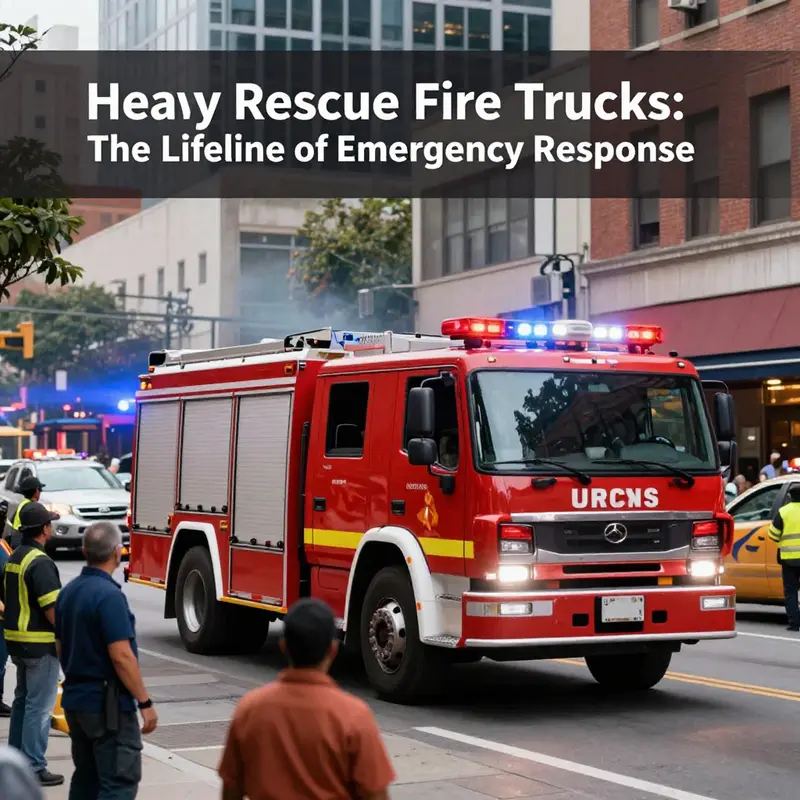
In the dense tapestry of urban life, heavy rescue fire trucks sit at the intersection of immediate danger and long-term resilience. They are not merely engines of suppression but mobile command centers, tool sheds on wheels, and platforms for coordination when time is scarce and stakes are high. Their presence signals a city’s commitment to rapid, capable responses to disasters that overwhelm ordinary firefighting apparatus. In practical terms, a heavy rescue vehicle arrives with a suite of capabilities designed to address the most challenging scenarios: structural collapse, complex vehicle extrications, hazardous material incidents, and the need to stabilize environments so that other responders can operate safely. This breadth of function means that the vehicle touches many layers of urban life—from the safety of a trapped resident to the continuity of a local business district after a catastrophe, from the mental calm of a family awaiting a rescue to the planning horizons of municipal budgets and urban design. The societal footprint, then, is not just measured in rescued victims or saved structures but also in the evolving relationships between residents, responders, and the public institutions that organize emergency readiness.
A heavy rescue truck embodies an operating philosophy that values versatility and self-sufficiency. In the immediate aftermath of a major incident, it acts as a force multiplier, condensing multiple granular tasks into a coherent on-site strategy. Lifting and recovery capabilities powered by hydraulic cranes and winches enable responders to remove debris, shored structures, or disabled vehicles that block access routes or threaten further collapse. In the aftermath of earthquakes or large building failures, this capacity can determine whether a second surge of victims remains trapped beneath rubble or can be reached in time to save lives. The vehicle’s extrication tools—hydraulic cutters, spreaders, and rams—function like a modular toolkit that can be rapidly reconfigured to adapt to a changing rescue scenario. This modularity matters in urban environments where no two incidents unfold in exactly the same way. The same machine that can pry open a wrecked car door may later breach a compromised wall to reach an interior void, or it may hold a precarious facade with shoring while other crews complete a safe entry. Such flexibility translates into tangible outcomes: faster extrications, deeper access, and fewer opportunities for a person to slip away during the critical minutes of a collapse.
High-pressure firefighting remains a core component of the heavy rescue platform, extending its utility beyond rescue into life-sustaining violence control of fire in challenging spaces. Large-capacity water tanks and robust pumping systems empower responders to apply blast-resistant bursts of water where the risk of backdrafts or quick spread is heightened by poor access. In industrial or petrochemical settings, where flammable liquids complicate suppression efforts, foam concentrates add another layer of defense. The same vehicle that hydraulically opens a path to a trapped victim can also flood a zone with a controlled, high-volume stream to prevent fire from advancing into a corridor or an upper floor where life safety remains a priority. Extended on-site power and lighting capabilities ensure that the incident site is not obscured by smoke or darkness. Generators, high-intensity lighting towers, and shielded electrical workspaces give responders a stable operational environment that reduces fatigue and mistakes during long-duration operations. Urban incidents often stretch into hours or even days, and the uninterrupted electricity supply these vehicles provide helps sustain communications, medical support, and the careful sequencing of rescue actions.
The chapter of urban resilience written by these machines is not merely about hardware. It is about how technology translates into better coordination and safer outcomes. Advanced command and communication systems turn a heavy rescue vehicle into a portable node of the city’s broader emergency management network. Real-time video feeds from drones or thermal imaging cameras, satellite links, and data-sharing capabilities with incident command centers expand situational awareness far beyond what ground personnel can discern from their vantage points. This integration matters in crowded, mixed-use neighborhoods where hidden dangers—such as unstable stairwells, gas accumulations, or shifting debris fields—can create cascading risks. The mobile command post allows the incident commander to see, decide, and deploy with a breadth of information that previously would have required a larger, slower buildup of resources. It also serves as a bridge between on-scene operations and the larger municipal safety framework, ensuring that decisions about evacuations, sheltering, and resource allocation are informed by the most current data available. In such moments, public confidence in emergency services grows when residents understand that the response is coordinated, transparent, and capable of rapid adaptation to changing conditions.
This capability set also reframes the social contract around risk in the city. When heavy rescue trucks are visible at the scene of a major incident, they communicate a promise that the urban safety net remains intact even in the face of extraordinary hazards. The psychological reassurance they provide matters as much as the physical interventions they perform. People in affected neighborhoods see the fire department not as a distant, bureaucratic institution but as a unified team with the equipment and training to reach them quickly, assess the danger, and take decisive steps to stabilize the environment. That reassurance has a downstream effect on community cohesion. It shapes how residents perceive risks—whether to evacuate, how to prepare, or how to interact with responders during an emergency. It also influences attendance at safety education programs and engagement with local preparedness initiatives. When cities invest in these vehicles, they invest in a visible, recurring reminder that community safety is a shared responsibility, not merely a reaction to danger after it emerges.
Yet the societal value of heavy rescue trucks is not realized without attention to the urban context in which they operate. The very presence of a large, heavy vehicle at the edge of a neighborhood can reorganize the spatial and social dynamics of a city block. Traffic flow, pedestrian movements, and parking patterns adapt to the needs of the incident response system. The risk of congestion is real: a truck’s size and weight can disrupt normal traffic patterns, potentially delaying other emergency vehicles if streets are narrow or heavily utilized. This is not a trivial concern. Dynamic traffic conditions, which adapt as incidents evolve, can influence the tempo and efficiency of rescue operations. The literature and field practice increasingly highlight the need for intelligent traffic management during emergencies. Pre-planned clearances, prioritized routes, and staging areas that anticipate the arrival of heavy rescue units help mitigate delays, but they require ongoing collaboration among city planners, traffic engineers, and fire department leadership. The cost dimension cannot be ignored either. The high maintenance and operating expenses of these vehicles—routine testing of complex hydraulic systems, fuel, tires, and fleet readiness—place a sustained demand on public budgets. Fire departments must balance the need for state-of-the-art rescue capacity with competing community needs, ensuring that funding decisions reflect both current demand and long-term resilience goals. In many cities, this balance involves transparent budgeting, performance metrics, and clear communication about the incidents these vehicles prevent or reduce in severity. When residents understand the financial logic behind these investments, support for urban emergency readiness tends to become more robust, even in neighborhoods that may rarely experience a major incident.
The human element remains central to the chapter of heavy rescue operations in cities. Operators and crew members must be highly trained to maximize the utility of the equipment. The most sophisticated vehicle cannot deliver its potential without skilled personnel who can interpret complex scenarios, manage delicate forcible entry, and perform high-stakes rescue under smoke, heat, and time pressure. Training needs are ongoing: new tools, updated safety protocols, and evolving best practices require regular drills and continuing education. This requirement translates into budgetary commitments for personnel development, which, in turn, reinforces the social contract with the city. A well-trained crew projects competence and confidence, which contributes to broad public trust in the overall emergency response system. It also aids in the mental well-being of responders themselves, who face intense operational demands. Departments increasingly emphasize the psychological health of teams as part of readiness, recognizing that sustained performance hinges on resilience, proper debriefing, and support networks. The public, in turn, benefits from a workforce that can maintain high standards of care and safety while navigating the complexities of urban environments.
Connectivity and forward-looking innovation help bridge the gap between today’s capabilities and tomorrow’s urban challenges. Modern heavy rescue platforms are extending their reach through smart technologies that enhance safety and efficiency. Remote control operation, available up to 150 meters in some models, offers an extra layer of protection for operators when a task would be more dangerous if performed from close quarters. The advent of 360-degree panoramic monitoring and infrared detection expands the rescue toolbox, enabling crews to locate heat signatures, assess structural integrity, and guide extrication without unnecessary exposure to hazards. In practice, these features translate into fewer risky maneuvers, quicker victim location, and more precise decision-making under pressure. The urban landscape continues to evolve with new hazards—multi-story timber constructions in some neighborhoods, aging infrastructure in others, and the persistent threat of industrial incidents. Heavy rescue trucks, as part of a broader ecosystem of adaptation, contribute to how cities anticipate and respond to these evolving risks. They embody a philosophy that combines robustness with adaptability, ensuring that urban centers can adjust to different disasters without sacrificing the speed or quality of the initial response. This dynamic is not purely mechanical; it also informs policy, training, and community engagement in ways that shape how a city’s safety culture develops over time.
If there is a guiding thread across these observations, it is that the social impact of heavy rescue fire trucks grows in proportion to how well a city plans, designs, and communicates around emergency readiness. The benefits—faster rescues, stabilized structures, clearer incident command, and restored public confidence—are most powerful when accompanied by thoughtful urban planning. Routes must be kept clear, staging areas must be integrated into neighborhood design, and public communication must explain what responders are doing and why. When cities harness intelligent traffic management, allocate resources for ongoing training, and invest in the infrastructure that supports on-site operations, the heavy rescue platform becomes less a symbol of disruption and more a symbol of preparedness. In this sense, the vehicle is less an isolated tool and more a catalyst for a broader culture of safety, collaboration, and shared responsibility. Communities then experience not just a single rescue but a continuity of safety that spans street-level response to long-term urban resilience.
For readers curious about how ongoing innovation shapes frontline practice, consider exploring the broader conversation around emergency services technology. A useful perspective on how innovation translates to everyday operations can be found at the innovation hub that tracks transforming fire service practices, including enhancements in rescue technology and command integration.
innovation-museum-transforming-fire-services
External research and technical analyses also offer valuable context on the evolving nature of rescue vehicles and their role in urban safety. A detailed overview of rescue truck configurations, capabilities, and industrial uses provides a complementary lens on how these machines function within broader emergency response systems. See Rescue Fire Trucks Explained for a comprehensive technical baseline: https://www.fireengineering.com/rescue-fire-trucks-explained/.
The societal impact of heavy rescue fire trucks in urban environments is thus a composite story. It blends life-saving immediacy with structural stabilization, public reassurance with fiscal accountability, and cutting-edge technology with the daily discipline of training and coordination. In the most successful models, urban planners, fire departments, and community leaders treat these vehicles as investments in both safety and social integrity. They acknowledge that the value of a rescue truck is measured not only by the number of victims it saves in a given incident but also by the ways it reinforces trust, strengthens institutions, and accelerates recovery after disaster. When a city can navigate the tensions between congestion, budget constraints, and the imperative for rapid response, the heavy rescue platform stands as a symbol of a resilient urban future. It is a practical instrument of safety and a beacon of public confidence—a machine that carries with it the promise that, even in the midst of ruin, community life can endure, rebuild, and flourish with renewed vigor.
Final thoughts
Heavy rescue fire trucks play an integral role in the landscape of emergency services, proving essential for effective response in critical situations. As urban environments continue to evolve, so too must the technologies and strategies employed by first responders. Understanding the functions, technological advancements, and economic considerations surrounding heavy rescue fire trucks allows communities, educators, and emergency professionals to appreciate their life-saving capabilities profoundly. Furthermore, recognizing their societal impact reinforces the need for continued investment in both equipment and training, ensuring that firefighters and rescue personnel are well-prepared to respond to any crisis with efficiency and courage.