
Flash Point: Fire Rescue is more than just a board game; it is a platform that fortifies teamwork and strategic thinking while engaging players in life-saving scenarios. Understanding how to navigate the game effectively is beneficial not only for players but also for communities, educators, and individuals in emergency services. This guide delves into the essentials of playing Flash Point, covering the crucial aspects of game setup, gameplay mechanics, hazard management, survivor rescue, and understanding winning and losing conditions. Each chapter enriches your knowledge, enabling both fun and learning experiences that reflect real-life firefighting tactics.
null
null
In the Thick of It: Mastering the Core Mechanics of Flash Point Fire Rescue
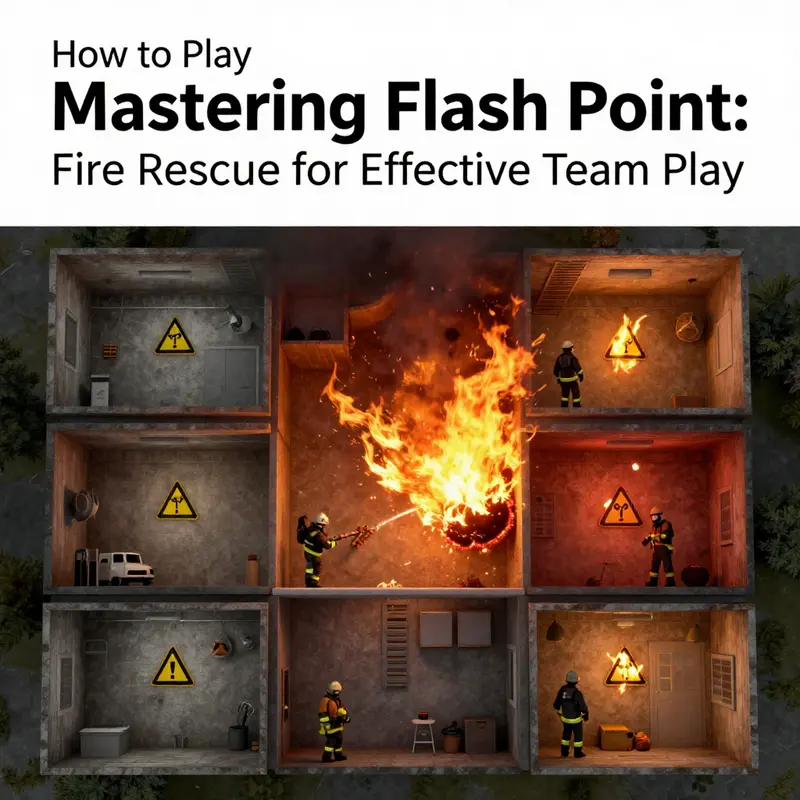
The moment the alarm rings and the first red blaze flickers across the board, you step into the shoes of a team whose lifeline is minutes, not seconds. Flash Point Fire Rescue is less a game about lone heroics and more a test of cooperative nerve, where each firefighter carries a unique tool, a distinct responsibility, and a shared goal: to locate and extract survivors before the building’s hostility—fire, smoke, and structural strain—consumes every avenue of escape. The core experience rests on a delicate balance of movement, resource management, and swift, precise communication. It is not simply about chasing extinguishing actions; it is about orchestrating a rescue under pressure, with every decision counting toward safeguarding lives. As you move through the modular layout of the building, you feel the pulse of the game: a rhythm of AP costs, tool uses, potential rescues, and the looming threat that a single misstep can cascade into chaos. The essence of play grows from how well you translate a plan into action within a few measured steps, how you read the flames and the smoke, and how you adapt when new hazards arrive from an unseen corner of the map. This is teamwork in its most tactile form, where every space cleared, every survivor stabilized, and every door opened carries weight beyond the dots and plastic of a board such as this. The set-up itself is a quiet act of strategy, choosing between two rule sets that shape the experience. The Family Rules offer a gentler introduction, a streamlined path to the core ideas of movement, search, and rescue that keeps everyone within reach of the objective without overwhelming new players with the full cascade of realistic hazards. In contrast, the Experienced Rules deepen the simulation with more volatile fire behavior, additional environmental dangers, and the real possibility that a room can ignite in an instant or that floors may fail beneath you—realistic, brutal reminders of how fragile a rescue can be when every action is measured against time. The choice between these rulesets matters, not as a pedantic preference but as a lens for learning how the core mechanics interact when the pressure rises. The digital version mirrors this depth, assigning roles automatically in some setups or letting players pick their specialty in others, while still preserving the heartbeat of the mechanics that make the tabletop version so tense and rewarding. The bridge between the two experiences is not just a matter of fidelity; it is about understanding how the same core systems translate across formats and what remains constant when the map changes from cardboard to pixels. To truly internalize the flow, you must first ground yourself in the language of the game: action points, proximity, and the sequence of goals that define a successful turn. Each firefighter’s move costs a certain number of AP, usually one per space or tool use, and every choice must be weighed against the risk of delay elsewhere. You begin with the sense that you are not moving through space alone but moving with intention, coordinating with teammates as if every shift in the room’s warmth or the glow on a wall could tell you something important about what comes next. The gloves come off in the way you think about doors and ladders. An axe can crack a stubborn barrier that blocks access to a corridor where a trapped survivor waits, while a ladder extends upward, giving you vertical leverage to reach a burning higher floor. The space you traverse becomes a narrative of decision: which corridor to prioritize, where to place a lay of hoses or a beacon of light that guides the team toward an unseen survivor, which room to scuttle into to pin the fire’s advance and buy precious seconds for a rescue. In this sense, the core mechanics are a language and a map at once, a way to describe collective action that rewards forethought and penalizes hesitation. The rules also insist on managing the fire as a dynamic entity. Fire spreads from room to room, smoke thickens visibility, and the potential for flashover—a sudden ignition event that can instantly alter the entire landscape—looms as a constant threat. In practice, this means you cannot treat a large blaze as something to be extinguished outright with a single act; rather, you must guide victims to safety while constraining the fire’s movement, using the right tools at the right moment, and preserving routes of egress. The interaction between players becomes a choreography of roles and timing. The Driver, for instance, may navigate through dangerous zones or reposition heavy equipment; the Paramedic stabilizes injured survivors and keeps the team healthy enough to keep fighting forward. A Hazardous Materials Specialist can neutralize toxins or avoid explosive surprises, while a Search & Rescue expert excels at locating hidden survivors behind debris or within obscured rooms. These roles are not merely cosmetic differences; they shape the tactical decisions you make about where to move, what to search, and how to allocate limited resources. The act of rescuing a survivor is its own little microcosm within the larger mission. You must approach to become adjacent to the person, perform a rescue action that costs a precise amount of AP, and then shepherd the survivor toward an exit point—whether at ground level or on a safer balcony above the smoke-thickened floor. If a survivor is injured, this is where a Paramedic’s skill becomes pivotal, or where a basic first-aid kit can stabilize a life enough to survive a hazardous moment on the way out. Some survivors are concealed by walls or debris, which adds a layer of detective work to the process. The game rewards careful searching and smart use of character abilities that reveal hidden survivors, a reminder that the most crucial rescues are not always the loudest. This interplay between exploration and rescue becomes a core driver of momentum, a constant reminder that the objective sits not just in rescuing everyone but in doing so efficiently enough to prevent the building from collapsing under the weight of its own hazards. A key practical rhythm emerges from the need to balance risk and reward. You will learn to prioritize high-value rescues—injured survivors, those in hard-to-reach spots, or those whose extraction would block essential egress routes—while keeping a watchful eye on the building’s structural integrity and the spread of fire. The messaging around this balance is clear: you cannot chase every blaze with equal zeal, and you must avoid overcommitting your hands to a single area at the cost of leaving others exposed. The flow of turns demands constant communication. Players call out who will move where, who will search what corridor, and who will secure an exit path for the next turn. The practice of sharing information becomes as vital as any tool in your kit. It is here that the content about teamwork from broader safety and leadership discussions can be meaningful; even a quick, focused reminder about how to communicate clearly and calmly under pressure can transform a tense sequence into a controlled, decisive action. For teams eager to strengthen this aspect, a resource on effective conversation—summarized as concise exchanges and explicit role delegation—offers practical guidance you can translate directly into play. becoming-a-great-conversationalist provides a useful perspective on how clear, purposeful talk anchors collaborative work, a principle that translates cleanly from real-world teams to the gaming table. When you add this layer of discipline to the core mechanics, the experience moves from a puzzle of movements to a shared performance where trust and timing synchronize. The digital version further emphasizes these threads by offering tutorials and practice modes, designed to ease new players into the cadence of the turns while giving veterans opportunities to rehearse advanced sequences. Local co-op allows you to rehearse with friends in the same room, while online play (as it evolves) expands the field of teamwork to distant teammates who still must coordinate as if shoulder-to-shoulder in a smoke-filled hallway. An added promise for fans who crave customization is the prospect of House Rules—the chance to tailor the burn, smoke behavior, or timing to fit a group’s appetite for risk and realism. The possibility of expansions—such as a Rescue Dog DLC or other forthcoming content—points to how a core mechanism can support growing complexity while maintaining the essence of cooperative problem-solving. The practical upshot of all these elements is not simply knowing what to do on a turn but understanding why those choices matter. You want to maximize the number of survivors saved while minimizing risk to your team and avoiding premature collapse. The sense of “flow” comes from building a mental map of the building as you play: which routes stay clear, where to position your team to block a fire’s advance, which survivors are accessible now and which will require a staged approach, and how to conserve powerful abilities for moments when the heat rises and a split-second decision decides life or death. As you gain experience, the rhythm sediments into instinct. The early game teaches you the language of the board and the discipline of point-by-point execution. The midgame tests your ability to adapt as new hazards appear, and the late game rewards your capacity to multi-task—directing a rescue while still managing a spreading fire and keeping a lookout for structural concerns. The beauty of Flash Point Fire Rescue lies in how these layers interlock. The rules, the roles, the tools, and the ever-present clock converge into a narrative of cooperation under pressure. You are not merely chasing a win condition; you are building a shared story of courage and careful planning, where every rescue feels earned and every near-miss sharpens your sense of what comes next. For readers who want a practical, real-world echo of these dynamics, a wide range of safety and team communication resources can illuminate how teams coordinate when time is tight and stakes are high. To explore the broader context outside the tabletop window, see the official Steam page for the digital edition, which anchors the core rules in a modern, accessible format and provides guidance, practice modes, and community feedback that sharpens the understanding of these mechanics over time. Official Steam page.
null
null
null
null
Between Rescue and Collapse: Navigating Winning and Losing in Flash Point Fire Rescue
The room yawns with smoke, a pale gray horizon pressing against the ceiling as the building exhales heat in spirals. In the game’s rhythm, every turn is a tight heartbeat, a sprint against time where the difference between success and catastrophe is measured in inches and inches of decision. This is not mere luck or brute force; it is a disciplined dance of movement, search, rescue, and the careful management of scarce resources. The core question that threads through every session remains stubbornly simple on the surface and brutal in practice: can you evacuate all survivors before the structure yields to flame, collapse, or the capricious violence of a flashover? Knowing the answer means understanding where you win, where you lose, and how the two hinge on your team’s cooperation and the precise ordering of your actions.
Winning in Flash Point Fire Rescue rests on a clear, cumulative objective: all survivors must be rescued and carried to an exit, protected by the team’s careful handling of danger. Scenarios typically place three to five survivors in rooms scattered across multiple floors, each with its own map of risks. The path to victory runs through that map as players marshal their actions—moving across spaces, breaking through doors with the right tools, hauling stretchers, and, crucially, locating those who lie hidden or trapped by debris. Rescues are not instant; they require proximity, the correct sequence of actions, and the luck of the board’s hazard markers aligning in your favor. The exit points, which are pre-marked on the map, become the safe harbor where survivors are delivered, placed on a stretcher or carried by hand, and then escorted away from the danger that clings to the structure like a fever.
The mechanics of the game reinforce the win condition with a quiet, inexorable pressure. Action Points (AP) govern what a firefighter can accomplish in a single turn, often 4 to 6 depending on the role. A single space costs 1 AP to traverse, while rescuing a survivor or moving a stretcher requires tight budgeting of those points. The run to safety is a trial of efficiency: can your team devote enough AP to reach the most vulnerable survivors, or must you prioritize those closest to the exits to prevent a cascading failure? The emphasis on proximity matters because carrying survivors to an exit is often a two-step process: approach and rescue, then retreat with the rescued person to a safe zone. The game’s core rule—rescuing, not extinguishing large fires directly—pushes players toward a realism that mirrors real-world priorities: in a real fire, the priority is to get people out while windowing the fire’s most lethal fronts into defensible space.
In this light, the losing conditions sharpen the sense of urgency with brutal clarity. A single misstep can erase progress. If one or more firefighters are killed or incapacitated, the mission can end with the loss of all survivors still inside. The hazard that most often truncates a session is the building collapsing under sustained damage or an explosion that tears through walls, floors, and corridors. Even when survivors are in sight, a catastrophic event like a flashover can render a room untenable in a heartbeat, destroying the immediate chances of rescue and threatening any firefighter who lingers within the inferno’s reach. Time, in this context, is not a ticking clock but an expanding threat: the longer the team remains inside, the more floors suffer, the more exits become compromised, and the more likely a perfect rescue turns into partial success at best. In some scenarios, a strict time limit governs the mission, turning a cautious approach into a race against a predetermined deadline. The learner’s instinct—time equals safety—demands a disciplined approach to pacing, even when the urge to dive deeper into a room is strong.
These win/lose thresholds are not abstract abstractions; they channel every choice you make on the board. The first and most consequential choice is often where to deploy your team. A Driver might sprint through flames and carry heavy objects, opening routes that others can exploit. A Paramedic can stabilize injuries and prevent morale from dipping as the environment grows harsher. A Hazardous Materials Specialist may be the difference between diffuse, dangerous hazards and a clear path to a trapped survivor. A Search & Rescue specialist can uncover hidden survivors behind debris, where the fire’s roar remains muted just long enough for a crucial discovery. Each role brings a toolkit of actions, but the real power lies in the collaboration—how the team aligns its movement, search patterns, and rescue operations to maximize the chance of a safe evacuation while maintaining a protective perimeter around the most vulnerable players inside.
From a tactical perspective, the winning strategy hinges on three intertwined decisions: where you begin, what you prioritize, and how you manage the ever-shifting environment. The map is a living thing, its rooms breathing fire and smoke in measured increments each turn. You must constantly decide whether to push toward a distant survivor, search behind a closed door, or reinforce a corridor that channels danger away from a vital exit. The “Find” ability, available to certain roles, is a reminder that not every survivor’s location is obvious. A successful search cycle yields a psychological dividend: it confirms you are not leaving someone behind and gives you a clear plan of where to focus the team’s efforts next. In practice, the most effective teams create a roving, adaptive plan that remains flexible as the hazard markers shift. You may start with a bold sweep but quickly pivot when a corridor becomes untenable or a room threatens to flash over, shifting to cover the escape route instead of chasing a single, far-off rescue.
Equally important is how you balance the desire to rescue with the need to preserve your own team’s safety. The line between bravery and recklessness is thin, and the rules reward restraint. The Reality of a flashover in Experienced Rules changes the calculus: a room can flip from dangerous to deadly, and a firefighter in a flashover zone risks permanent harm or death. In game terms, this creates a stark incentive to keep fire spread contained, to isolate dangerous zones, and to ensure at least one safe room remains accessible as a fallback. The tension between advancing to reach a survivor and retreating to a safe zone is the heartbeat of the play. It is a constant reminder that rescue is the goal, but only as long as your team remains capable of continuing the mission. This is why the win condition’s emphasis on evacuating everyone is both fair and punishing; it compels teams to plan not just for a single rescue, but for a chain of rescues that culminate in everyone’s safe departure.
Face-to-face with the hazard’s relentless logic, teams learn to guard the exits and to treat safety as a resource that must be invested across turns. The smoke, which reduces visibility and slows movement, becomes a kind of adversary you negotiate with rather than simply overpower. It forces you to rely on communication, to establish a shared map of the building, and to keep every member apprised of where the others are heading next. The driver’s mobility through fire, the paramedic’s medical kit, the hazardous materials expert’s awareness of toxic exposure, and the search-and-rescue specialist’s knack for uncovering hidden survivors—all these abilities must be synchronized. The aim is to sculpt a route that minimizes backtracking, guards fragile angles into exits, and preserves enough team capacity to endure the building’s growing fragility as the turns accumulate. In other words, victory is a ritual of disciplined teamwork, where every decision to advance or hold serves the larger goal of safe evacuation.
For players who inhabit the digital version, the experience is often sharpened by tutorials, practice modes, and the possibility of automatic role assignment. Yet the essence remains the same: you must translate a series of small, precise actions into a larger, life-preserving outcome. The digital adaptation introduces convenient features like streamlined action counting and built-in practice rooms, which help new players feel the weight of the decision-making without getting bogged down in logistics. These tools can accelerate the learning curve, permitting a shift from rule-following to intuitive coordination. As you grow more comfortable, the speed and fluidity of your team’s movements mirror the escalating pressure you would feel in a real emergency: every choice matters, every space you clear or defend, every survivor you locate, and every minute you save by planning ahead rather than improvising on the fly.
The personal discipline of a good team carries through to the post-mission reflection. After a session ends, whether you have rescued everyone or faced a collapse, the experience offers a granular sense of what could be improved. Perhaps you realized you overcommitted to a distant rescue and left an exit underprotected, or maybe you learned to better stage a rapid loop through a corridor to maintain a safe line of retreat. The process mirrors professional practice: after-action reviews that distill what worked, what failed, and how the team could better synchronize in the next run. In that spirit, players are encouraged to experiment with different roles, test alternative routes, and refine their communication cadence. Even in defeat, there is a quiet, instructive victory—a deeper understanding of the fragile balance between expanding the rescue perimeter and preserving the team’s ability to complete the mission.
For readers seeking a broader view on how innovations in fire services shape real-world practice, consider exploring broader discussions about transforming fire services in the contemporary era. This can provide a helpful perspective on how the ideas behind the game’s win/lose dynamics map onto real protective work and why the emphasis on evacuation, stable egress, and crew safety resonates beyond the tabletop. innovation museum transforming fire services. You may also find it useful to sample the game’s official digital storefront description to understand how the platform translates the same core challenges into accessible practice, especially if you are curious about the Steam version and its features.
External resources and further reading can deepen the sense of realism behind the decisions you make in the game. For a direct look at the digital adaptation’s presentation and audience features, you can visit the Steam page that hosts the game’s information, trailers, and community discussions. This external link offers context for how players engage with the game across different formats and how the designers balance realism with approachable play. https://store.steampowered.com/app/709680/FlashPointFire_Rescue/
In sum, the win/lose calculus in Flash Point Fire Rescue is not merely about collecting survivors or extinguishing flames. It is about mastering a sequence of purposeful, collaborative actions that protect both the people inside the building and the players themselves. It is about choosing when to push into danger and when to conserve your team’s strength for the rescue that matters most. It is about accepting that, in this setting, speed is valuable but not at the expense of safety, and that every scenario invites you to refine your approach, learn from what you have tried, and return to the structure with smarter questions and better coordination. The chapter on winning and losing conditions thus becomes less a checklist and more a philosophy of tactics: a reminder that in a high-stakes, cooperative pursuit, success is the fruit of collective planning, disciplined execution, and a shared commitment to every survivor’s chance to reach safety.
Final thoughts
Engaging with Flash Point: Fire Rescue cultivates critical skills in communication, decision-making, and emergency response strategy. This game not only entertains but also acts as a simulation for real-life rescue scenarios, making it an excellent tool for various audiences including community members, educators, and emergency personnel. By immersing yourself in this cooperative experience, you gain insights that extend beyond the tabletop, fostering teamwork and preparedness for actual emergencies.