
How Injection Molded ABS Fairings Are Built for Real-World Durability
Injection molded ABS fairings keep showing up in bodywork comparisons, and the manufacturing method is why. It shapes how a panel cracks, how far it flexes, and what it takes to repair one after a bike goes down.
From Pellets to Precision: The Injection Molding Process
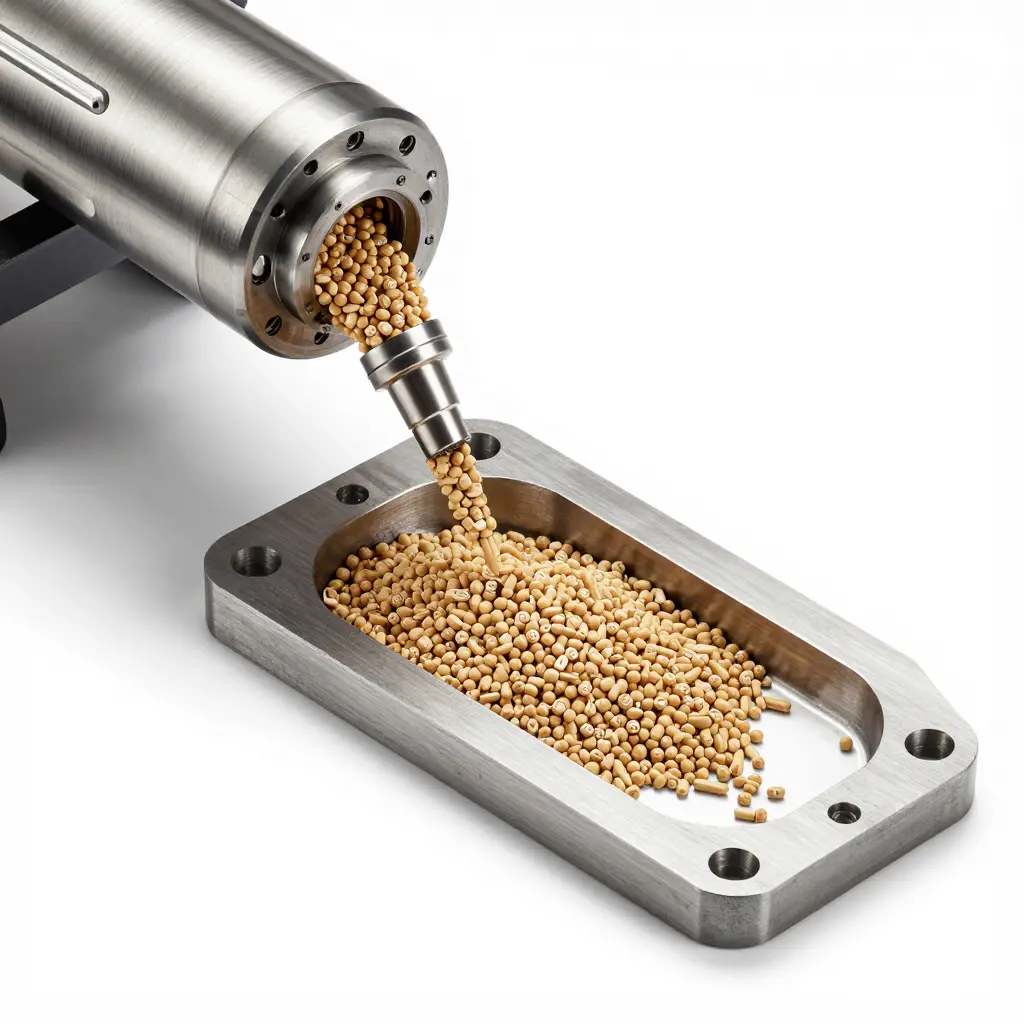
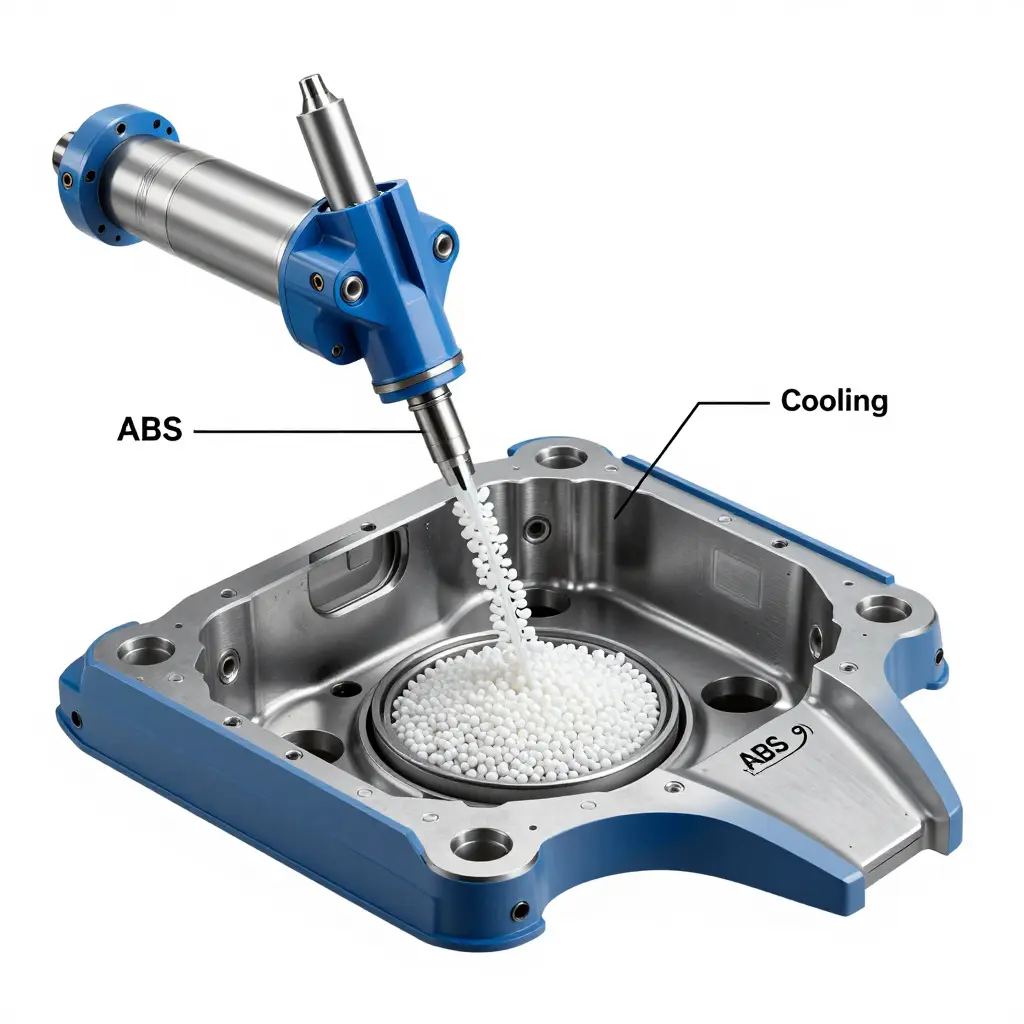
Production starts with small ABS pellets fed into a heated barrel, where they melt into a thick, honey-like liquid at roughly 220-260 degrees C. A screw then pushes – injects – that molten plastic under high pressure into a precisely machined steel mold. The mold is the heart of the process: a two-part steel block with a cavity cut to the exact shape of the finished panel, with tolerances often measured in fractions of a millimeter.
Once the cavity fills, water channels inside the steel tool cool the part rapidly. The ABS solidifies into its final shape, the mold opens, and ejector pins push the finished fairing out. A full cycle might take under a minute, and the same steel tool can stamp out thousands of nearly identical panels.
Consistent Wall Thickness: The Hidden Advantage
Forming the part inside a rigid metal cavity gives every panel uniform wall thickness – typically 2.5 to 3.5 mm across the entire surface. That consistency matters more than most riders realize. There are no thick resin pools, no thin spots, and none of the hand-laid inconsistency you find in fiberglass. Uniform walls mean predictable stress behavior: when force is applied, it distributes evenly rather than concentrating at weak points.
What Makes ABS Different
ABS is a thermoplastic, and its chemistry gives it a distinct set of traits:
- Impact resistance: it absorbs shock by flexing rather than shattering outright.
- Flexibility: it bends under load and often springs partway back, unlike rigid thermoset resin.
- Thermal stability: it holds its shape across a wide temperature range.
- Surface quality: it takes paint and finishes smoothly without heavy sanding.
- Recyclability: production scrap can be re-melted and reused, unlike cured fiberglass.
Why This Matters After a Low Side Drop
When a bike slides on its side, the fairing takes a scrape and a hit. Rigid, brittle fiberglass tends to shatter or spider-crack across a wide area, sometimes cracking through to the mounting points. A flexible ABS panel deforms and flexes on impact instead. Cracking still happens, but it tends to stay local: a crack or a scuff rather than an explosion of shattered resin. Because ABS is a thermoplastic, heat-based methods such as plastic welding, or even careful reflowing, can often restore it. And since the wall thickness is consistent, a repair area has predictable material to work with, which makes the fix more reliable and less expensive.
Uniform walls, flex, and local rather than catastrophic cracking are why ABS became the default for stock motorcycle bodywork, and why repair shops can often save a panel that would otherwise be thrown away.
How Fiberglass Fairings Are Made: The Hand Layup Story
Price a replacement panel after a low side drop and the word “fiberglass” probably comes up. How these fairings are built explains how they crack, how they feel, and why they cost what they do to fix.
Most aftermarket fiberglass motorcycle fairings are not stamped out by a machine. Instead, a builder starts with a mold and works by hand.
The Hand Layup Process
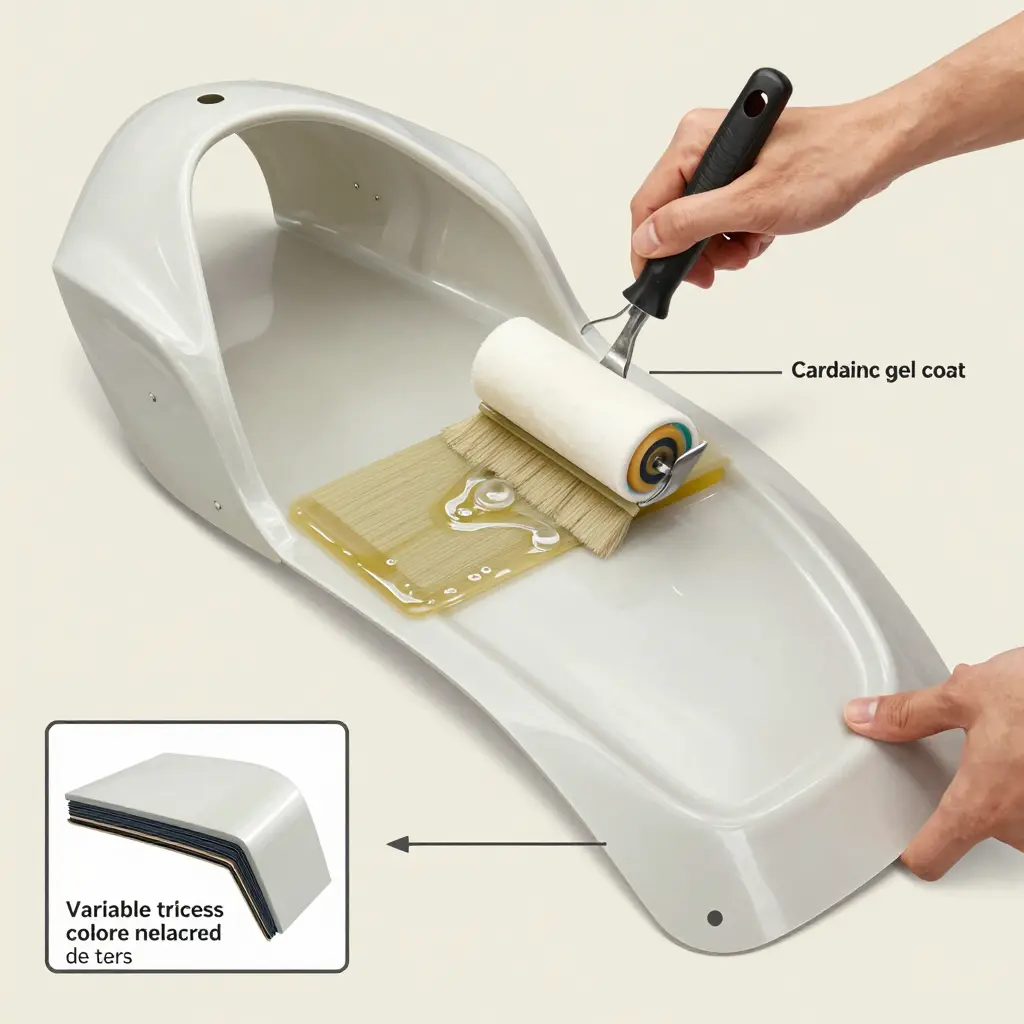
A release agent goes onto a finished mold first. The builder then lays down a gel coat, which becomes the visible outer finish. Next comes the structural core: layers of glass fiber matting or woven cloth soaked in catalyzed resin.
A brush or roller works resin into the fibers, pressing out trapped air bubbles. Layer by layer, the builder builds up thickness. The part then cures, hardens, and is popped from the mold, followed by trimming, sanding, and drilling.
Because a person controls every layer, the result is never perfectly uniform.
Variable Thickness and Rigid Cured Fiberglass
Hand layup creates variable thickness. Corners and mounting points usually get extra layers for strength, while broad flat areas may end up thinner. Once cured, fiberglass is remarkably rigid, and that stiffness shapes almost everything about how the panel behaves in a crash.
- Built by hand: layer-by-layer layup inside a mold
- Variable thickness: reinforced where strength matters, thinner elsewhere
- Rigid when cured: stiff, with very little flex
- Repairable: cracks can be ground out and re-laid with fresh matting
- Heavier often: fairing weight tends to exceed injection-molded ABS
Cracking and Repair After a Low Side Drop
Cured fiberglass is stiff rather than flexible, so it does not bend easily. In a low side drop, it tends to crack, splinter, or spiderweb at stress points instead of deforming and springing back. The upside is repairability: a shop can grind out the damage, lay fresh matting and resin, and refinish the surface, often blending the repair into the original shape.
Compare that to injection molded ABS, which is produced in steel molds for consistent thickness and lighter fairing weight. ABS often flexes on impact, but that same flexibility can make it harder to fuse back together cleanly once it tears.
So the trade-off is fairly clear: fiberglass offers repairability and shape flexibility, while ABS offers consistency and lower weight. Neither is strictly better; it depends on how you ride and how you plan to handle the inevitable drop.

A simple side-by-side schematic showing how an ABS fairing is injection molded (mold cavity plus injected material) compared with how a fiberglass fairing is built up by hand (stacked layers of mat and applied resin).
Cracking Behavior After a Low Side Drop: ABS vs. Fiberglass
A low side drop – where a motorcycle slides out and goes down on its side – is the most common way fairings meet the pavement. How a fairing responds to that first contact depends almost entirely on its material. The two dominant options, injection molded ABS fairings and fiberglass fairings, fail in fundamentally different ways, and understanding that difference helps riders and shops anticipate both visible damage and hidden structural problems.
The Mechanics: Energy Absorption, Flex, and Rigidity
When a bike slides, kinetic energy transfers into the fairing through scraping and impact, and the material either absorbs that energy or redirects it. ABS is a thermoplastic: it bends, rebounds, and spreads stress across a broad area. Fiberglass is a thermoset composite reinforced with glass fibers, making it far stiffer but far less forgiving.
The core trade-off is flex versus rigidity. A flexible material deforms and recovers, while a rigid one resists deformation until it suddenly gives way. That single distinction explains nearly every difference in how fairing cracking develops between the two types.
How Injection Molded ABS Fairings Typically Respond
Injection molded ABS fairings tend to flex under impact. You often see deep scuffing and gouging along the contact points, because the surface grinds rather than shatters, and the overall panel frequently stays intact even when it looks badly scratched. Cracking, when it appears, is usually localized: a crack near a mounting point, a snapped mounting tab, or a stress hairline along a sharp edge. The material is ductile enough that damage stays contained rather than racing across the part.
Molded ribs and contours also spread the force, so energy dissipates over a wider region. This is why a dropped bike with ABS plastics often remounts cleanly after a tab repair or a scuffed panel is refinished.
How Fiberglass Fairings Typically Respond
Fiberglass fairings behave very differently. Their rigidity means they resist bending until the load exceeds their tolerance – then they fracture. Instead of flexing, they crack in a brittle manner, sometimes with a sharp snapping failure at the point of impact.
A low side drop on fiberglass commonly produces spider cracking, a web of fine fractures radiating outward from the impact. It can also trigger larger crack propagation that travels well beyond the initial contact zone, occasionally splitting an entire panel. Even when the surface looks only lightly damaged, the underlying laminate may have delaminated, hiding structural weakness beneath a smooth finish.
Contrasting Crack Behaviors
- Injection molded ABS fairings: flex under load, scuff and gouge on the surface, keep cracks localized, and most often fail at mounting tabs or stress points rather than across the panel.
- Fiberglass fairings: resist flexing, fracture in a brittle manner, generate spider cracking radiating from impact, and allow larger cracks to propagate across the part.
Why the Pattern Matters
The failure pattern signals what repair will involve. Localized ABS damage is usually repairable by patching, plastic welding, or tab replacement. Widespread fiberglass cracking and delamination often require laminate repair or full section replacement, since cracks can continue to grow under vibration even after a cosmetic fix.
Neither material is universally superior. ABS trades some rigidity for energy absorption and contained damage, while fiberglass trades flexibility for stiffness and a higher risk of propagation. Knowing which behavior to expect after a low side drop gives owners and technicians a realistic picture of the damage before the first bolt comes off.
The table below compares how each material responds once a low side drop sends the bike sliding across the pavement, from the first point of impact to the repair bay. It focuses on fairing cracking, because that damage pattern drives most repair bills and cosmetic headaches.
Cracking Behavior After a Low Side Drop
| Material Type | Typical Failure Mode | Crack Propagation Tendency | Impact Energy Absorption | Ease of Spot Repair |
|---|---|---|---|---|
| Injection Molded ABS Fairings | Flexes and dents on impact, shows stress whitening, then cracks at mounting tabs and high-stress edges | Low to moderate – cracks stay localized and often stop at internal ribs or stiffeners | High – the material flexes and deforms to spread the impact, frequently springing back with only surface scars | Easy – heat reshaping, plastic welding, or ABS slurry patching blends cleanly and paint hides the fix |
| Fiberglass Fairings | Brittle fracture with spiderweb cracking, gelcoat chipping, and possible delamination of the resin layers | High – cracks travel quickly along the fiber strands and radiate outward from the strike zone | Low – the rigid panel transfers energy instead of flexing, so it tends to shatter rather than absorb | Moderate to difficult – repairs demand resin layup, sanding, and re-gelcoating, and color matching is tough |
ABS bends, absorbs, and forgives after a low side drop; fiberglass cracks more dramatically and takes more labor to look right again.
Weight Comparison: Injection Molded ABS vs Fiberglass Fairings
Weight is one of the first practical differences riders notice when they start comparing motorcycle fairings, but fairing weight is not a single fixed number. It shifts with the bike, the number of panels, and above all with how thick the material is built. A few general tendencies are still worth knowing before you buy, repair, or replace a set.
Where the weight actually comes from
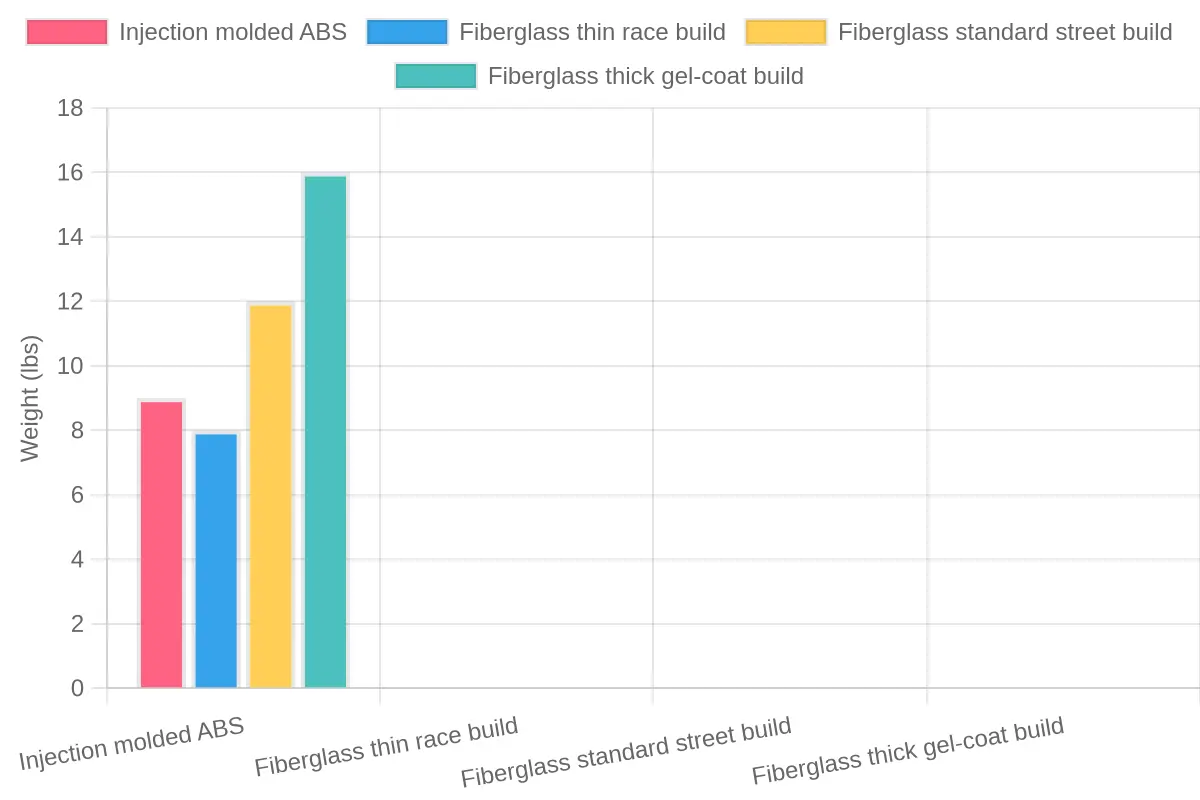
Injection molded ABS fairings are produced in steel molds that press melted plastic into shape under controlled pressure. That process lets a manufacturer hold consistent, thin wall thicknesses across an entire panel, which usually keeps total weight predictable and repeatable from one set to the next.
Fiberglass fairings, by contrast, are typically laid up by hand with resin and cloth. Because thickness is decided by the builder, a “thick” fiberglass build – often used for extra durability or a deeper gel-coat finish – tends to weigh more than a thin, race-oriented layup. Two fiberglass sets for the same bike can differ noticeably in weight, while two ABS sets are usually closer to each other.
Why weight matters for handling
Fairings sit high and forward on most sport and sport-touring machines, so adding mass there can dull turn-in and make the bike feel less eager to change direction. A lighter set may help the front end feel a touch more responsive. That said, most street riders are unlikely to feel a small difference, and suspension setup generally matters far more than a pound or two of material.
Why weight matters for acceleration and braking
Extra fairing weight is mass the chassis has to move and stop, so it works mildly against acceleration and can add a little to stopping distance. On a full kit the effect is modest, but it compounds with every other gram saved. This is part of why race teams often chase thin, light fiberglass.
The thin-wall advantage of ABS
The ability of injection molded ABS fairings to hold consistent thin walls is a genuine manufacturing strength. Uniform, thinner panels tend to trim overall fairing weight while keeping fit and mounting points accurate. Fiberglass can be made thin too, but hitting that consistency by hand is harder, and many builders add material to avoid weak spots – which puts weight back on.
Weight and the low side drop decision
After a low side drop, weight interacts with repair choices in a practical way. Heavier, thick fiberglass panels may resist cracking in some impacts, yet they can cost more to fix and gain even more weight once patched with extra resin and mat. Lighter ABS panels may crack more readily in a hard slide, but their predictable weight and consistent fit often make full replacement simpler and easier to source. When weighing repair against replacement, the real effort is often measured in labor and downtime, not just grams.
The takeaway
Treat these as tendencies, not rules. ABS leans toward consistent, thin, repeatable panels; fiberglass ranges widely, with thick builds generally heavier. Match the material to how you ride and how you prefer to manage repairs.
Putting fairing weight into perspective
Mass is one of the first numbers riders compare when weighing injection molded ABS against fiberglass motorcycle fairings. The chart below breaks down the typical fairing weight of each material across the most common component categories.
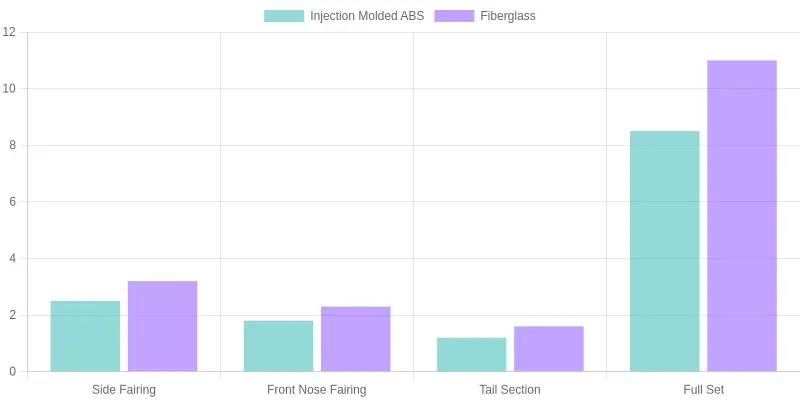
Caption: Across every component category, injection molded ABS fairings weigh noticeably less than their fiberglass counterparts, with the gap widening most dramatically on a full set.
ABS keeps things lighter across the board. The difference is modest on small pieces like a tail section, but it adds up fast once you are talking about a complete set of motorcycle fairings. That weight advantage matters for handling, acceleration, and the effort required to hold a line through a corner.
The numbers behind the bars
| Component | Injection Molded ABS | Fiberglass |
|---|---|---|
| Side fairing | 2.5 kg | 3.2 kg |
| Front nose fairing | 1.8 kg | 2.3 kg |
| Tail section | 1.2 kg | 1.6 kg |
| Full set | 8.5 kg | 11.0 kg |
Weight is only one variable in the larger ABS vs fiberglass conversation. Lighter panels feel sharper, but durability after a low side drop and the cost of getting back on the road matter just as much. For riders and repair shops balancing performance against repairability, the fairing weight figures above are a useful starting point rather than the whole story.
Fairing Repair Cost After a Low Side Drop
A low side drop is the mishap every rider eventually meets. The bike goes down, the bars and pegs scrape, and the fairings take the brunt of the slide. The fairing repair cost that follows can range from a weekend of careful DIY work to a bill that makes you wince – and the single biggest variable is what your fairings are made of.
The Cost Drivers That Actually Matter
Four factors shape every estimate:
- Material availability. Injection molded ABS fairings are model-specific. If you ride a popular bike, replacement panels are easy to source. On a rare machine, OEM panels can be scarce and pricey.
- Labor time for surface prep and refinishing. Sanding, filling, priming, and color-matching eat hours, and paint plus clear coat is often the most expensive single line item.
- Repair versus replacement. Some panels can be bonded or welded back to strength; badly shattered ones must be replaced entirely.
- Paint matching. A tri-coat or metallic factory finish is far harder (and costlier) to match than a simple solid color.
Injection Molded ABS Fairings: Bond, Weld, or Replace?
ABS is a thermoplastic, so cracks and small punctures respond well to plastic welding, followed by reinforcement and refinishing. That keeps a low side drop repair in the “fixable” column more often than people expect. The catch is that ABS tears at mounting tabs and stress points, and once a panel shatters into fragments, bonding rarely holds.
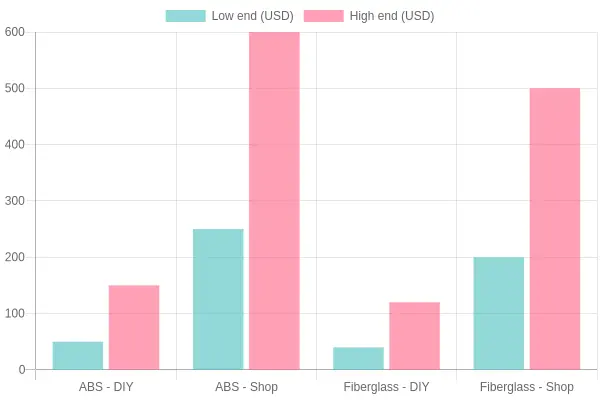
Pure DIY materials – a plastic welding kit, filler, primer, and rattle-can paint – often land in the $50-$150 range per panel, plus a healthy amount of your own time. Shop pricing for injection molded ABS fairings typically runs higher, roughly $250-$600 per panel once prep, paint, and color-matching are folded in.
Fiberglass Fairings: Friendlier to Repair
Fiberglass fairings are laid up by hand from resin and cloth, which makes them the more forgiving option after a slide. Damaged areas can be ground back, re-laminated with fresh mat and resin, then sanded and painted. Because the repair is additive, even larger gouges are often salvageable rather than replaced.
DIY resin repairs are cheap on materials – think $40-$120 per panel – though they demand patience and decent sanding skills. A shop typically charges $200-$500 per panel for fiberglass fairings, usually a touch less than ABS because bonding is more straightforward and color matching is predictable.
DIY vs Shop Pricing: The Real Gap
| Factor | DIY | Shop |
|---|---|---|
| Typical cost per panel | $40-$150 | $200-$600 |
| Time required | Several weekends | A few days |
| Risk | Visible flaws, weak paint match | Warranty and quality assurance |
| Best for | Minor scuffs and hairline cracks | Shattered or structural damage |
The gap is mostly labor. If you enjoy the work and your damage is cosmetic, DIY is genuinely viable and can cut the fairing repair cost by half or more. If panels are cracked through or mounting points are gone, paying a shop usually saves money in the long run.
Practical Takeaways
Replacement costs also matter: OEM ABS panels often run $150-$500 each, while aftermarket fiberglass sets can cost less as a bundle. Always weigh the repair against the price of replacement before committing.
Either way, a low side drop rarely means a total fairing loss – it means a decision about material, method, and how much of the job you want to tackle yourself. Match the material to your budget and skills: ABS rewards a welder’s steady hand, fiberglass rewards a patient laminator, and a good shop rewards anyone who would rather ride than sand.
Frequently Asked Questions About ABS and Fiberglass Fairings
Which fairing type cracks more easily after a low side drop?
Fiberglass fairings generally crack more easily after a low side drop because the material is rigid and brittle, so impact energy tends to produce sharp fractures and stress cracks that spread across the panel. Injection molded ABS is more flexible, which means it often flexes, scuffs, or dents on contact rather than shattering outright. That difference in fairing cracking behavior is why track riders who expect to slide frequently sometimes favor ABS for its resilience. Even so, a hard enough low side drop can still break either material.
Do injection molded ABS fairings weigh less than fiberglass fairings?
In most comparable sets, injection molded ABS fairings weigh slightly less than fiberglass fairings because the panels are thinner and the plastic has a lower density than layered resin and glass cloth. Fairing weight differences are usually small, often measured in a few pounds across a complete set, so the effect on overall handling is modest. Fiberglass can sometimes match or beat ABS when it is laid up thinly, but production fiberglass kits are typically heavier.
Which option costs less to repair?
Fiberglass usually costs less to repair because a shop can sand the damaged area, lay in new glass and resin, and refinish the panel, often reusing the original part. Injection molded ABS repairs can be more labor intensive because technicians must plastic-weld, heat, or patch the panel, and severe damage may not be economically fixable. As a result, fairing repair cost often favors fiberglass for structural damage and ABS for minor cosmetic scuffs. Replacement pricing can flip that comparison when a cheap ABS panel is available.
Can ABS fairings be repaired, or must they be replaced?
ABS fairings can often be repaired, especially for cracks, scuffs, and small holes, using plastic welding, reinforced adhesives, and filler before refinishing. However, once a panel has torn mounts, deep stress cracking, or missing sections, replacement is usually the faster and more reliable choice. A low side drop that only grinds the surface is a good candidate for repair, while a high-energy impact that distorts the panel is not.
Are fiberglass fairings easier for a repair shop to refinish?
Yes, fiberglass fairings are generally easier to refinish because the surface accepts body filler, primer, and paint much like a conventional automotive panel. Shops can feather the repair, block-sand it smooth, and blend the finish, which makes color matching and texture control straightforward. ABS requires careful surface prep and flex additives in the paint so the finish can move with the plastic without cracking. This is one reason many custom and restoration shops prefer fiberglass when appearance and long-term finish quality matter.
How do material properties affect the decision overall?
ABS offers flexibility, lower weight in most kits, and good resistance to the initial impact, while fiberglass offers easier repair and refinishing for structural damage. The right choice depends on riding style, budget, and how often a rider expects a low side drop or slide. Enthusiasts who value quick cosmetic touch-ups often lean toward fiberglass, and those who want part flexibility and consistent factory-style panels often choose injection molded ABS.
Conclusion: Matching Fairing Material to Your Priorities
After a low side drop, the choice between injection molded ABS fairings and fiberglass fairings comes down to three practical questions: how each material cracks, how much weight it adds, and how much it costs to repair. Across this guide, ABS showed a forgiving, flex-first behavior. It tends to bend and scuff before it splits, which keeps minor tip-overs cheap to live with. Fiberglass, being stiffer, tends to crack in spider-web patterns, yet those cracks are usually easy to sand and refinish at home. On weight, ABS holds the advantage: uniform, thin walls keep a complete set lighter than a typical hand-laid fiberglass kit, though the per-panel gap is small enough that most riders will not notice it in daily riding. On repair cost, the story splits again. ABS favors clean panel replacement or plastic welding, while fiberglass rewards patient DIY resin work.
Quick comparison at a glance
| Priority | Better material | Why it wins |
|---|---|---|
| Low-speed crack resistance | Injection molded ABS | Flexes and scuffs before it splits |
| Lowest total weight | Injection molded ABS | Thin, consistent walls keep a full set lighter |
| Cheapest DIY repair | Fiberglass | Sand-and-resin fixes cost little |
| Cheapest fast repair | Injection molded ABS | Swap or weld a single panel |
| OEM-style fit and finish | Injection molded ABS | Tighter panel gaps out of the box |
| Custom one-off shapes | Fiberglass | Easier to cut and reshape |
A simple recommendation framework
Work through these questions in order, and stop at the first one that matches your situation:
- If surviving everyday drops matters most, choose injection molded ABS fairings. Their flex absorbs low-speed impacts and hides small scuffs.
- If minimum weight is your goal, a thin, race-oriented fiberglass layup can be the lightest option on a track build, though typical production fiberglass kits weigh more than ABS.
- If the lowest repair bill is the priority, decide based on your skills. Fiberglass suits riders who can sand and apply resin; ABS suits riders who would rather swap a panel.
- If OEM fit and finish is essential, injection molded ABS fairings usually deliver tighter gaps straight from the box.
- If you are building a custom shape, fiberglass fairings are easier to modify for one-off designs.
When you are ready to act on that decision, the supplier matters as much as the material. The site tpbhrescue.org says it carries more than 3,000 motorcycle fairing styles across almost all models, promises an answer within six hours, and prices its panels 10-40% lower than other sites. That combination makes matching a material to your priorities faster than hunting across several vendors.
For readers who also follow broader vehicle safety and emergency-response topics, our overview of California wildfire emergency planning failures is a useful companion read.