
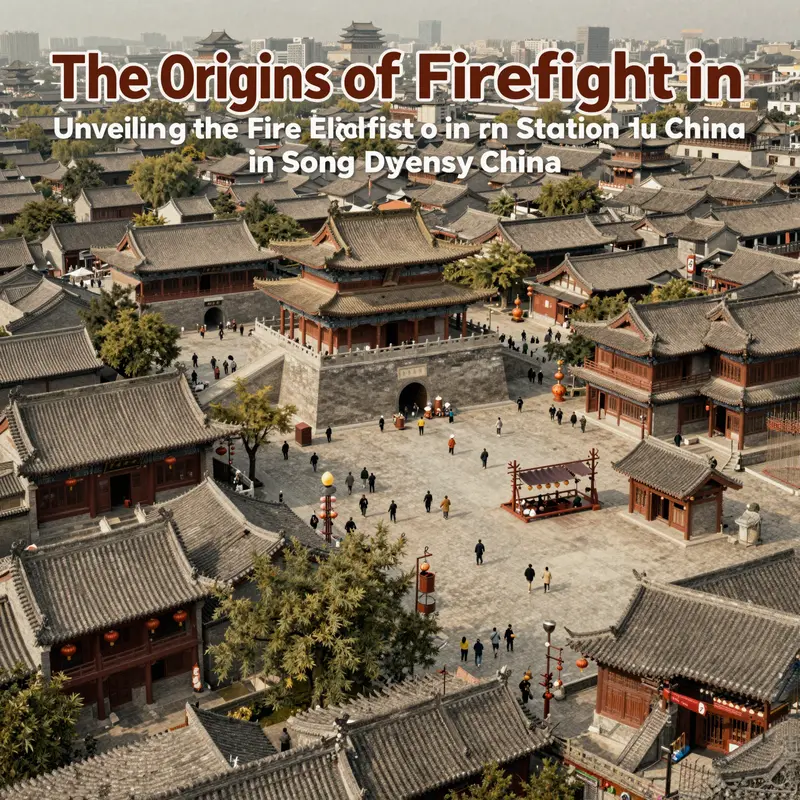
The establishment of organized fire-fighting services has been pivotal in urban safety and disaster management throughout history. Among the earliest systems was the Jūn Xún Pù, established during the Song Dynasty in China. This innovative fire station laid the groundwork for modern fire services, introducing a structured approach to fire prevention and response that significantly impacted urban development. As we delve deeper into the role of the Jūn Xún Pù, we will explore its functions and responsibilities, uncover historical firefighting techniques, compare ancient methods with contemporary practices, and assess its impact on the city of Kaifeng. Each chapter invites readers to understand the historical significance of this first fire station and its lasting influence on emergency services today.
null
null
Pioneering Flames in Dongjing: The Jūn Xún Pù and the Dawn of Urban Fire Safety
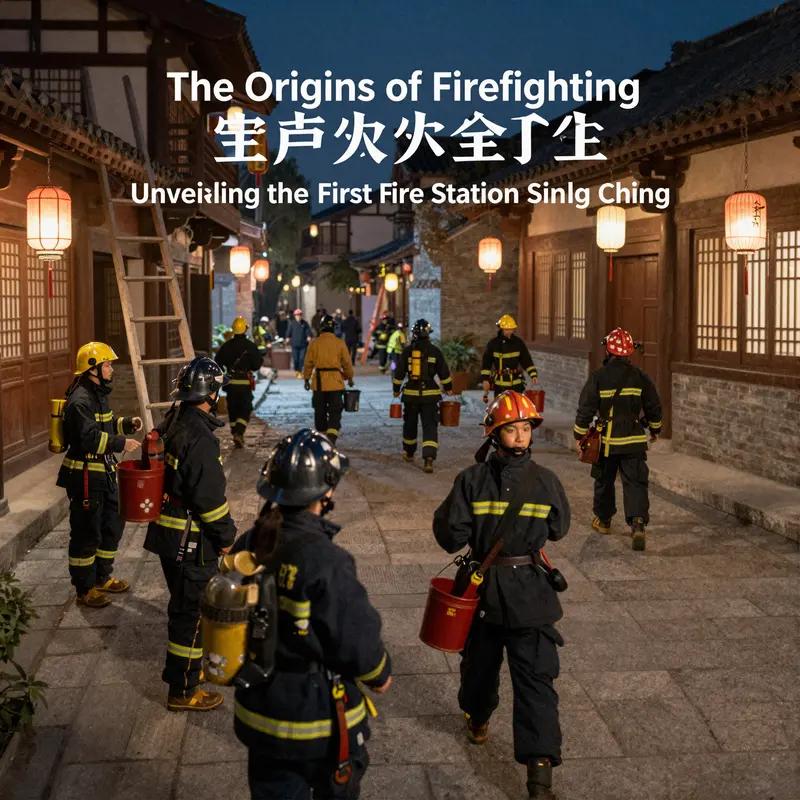
In the Song Dynasty capital of Dongjing (now Kaifeng), an urban fire protection system emerged that functioned as a proto-institutional framework for safeguarding the city from flames. The Jūn Xún Pù, or Military Patrol Posts, formed a comprehensive safety network that moved beyond ad hoc relief toward organized risk management. Patrols, alarm signals, and rapid mobilization created a discipline of vigilance and coordinated response. The aim was to compress the time between spotting danger and marshaling resources, with postkeepers responsible for detection and for coordinating a mobile response that could reallocate forces and tools as needed.
Equipment reflected forward-looking design: basic firefighting gear—buckets, ladders, and water bags—shared among posts; a pool of resources rather than private property; and horses to speed movement through crowded streets. The approach emphasized speed and community-sourced support, calling in neighbors and volunteers as the situation required.
Beyond firefighting, the Jūn Xún Pù carried crime-prevention and public-order duties. Posts acted as anti-theft outposts and centers of surveillance, illustrating how fire risk and personal risk are interwoven in the daily urban fabric. This broader remit reveals an ancient insight: public safety depends on social architecture that can deter danger and mobilize quickly when it occurs.
Modern firefighters are products of later transformations—formal training, standardized equipment, centralized administration—but the core impulse remains: reduce risk through organized action. The Song Dynasty system shows that even before a dedicated “fire station” existed, a city could organize risk around fixed points of surveillance and a plan to move from detection to intervention. The Jūn Xún Pù stands as a clear ancestor of later urban safety architectures, a living network rather than a single building.
For readers tracing origins, the Dongjing model offers a narrative of origin that challenges a simplistic view of history: a city’s safety can be built on a lattice of posts, patrols, and a shared culture of alertness and mutual aid.
From Dongjing’s Night Patrols to the Modern Fire Station: Tracing the World’s First Urban Fire Service
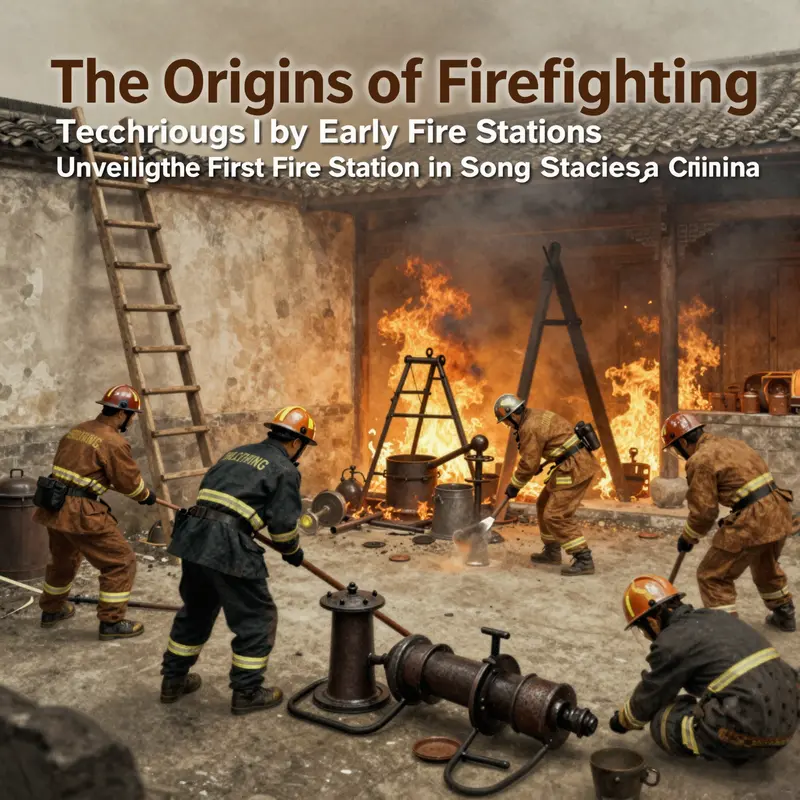
When we ask where the first fire station or rescue service was established, the answer does not lie in a modern city archive but in a centuries-ago capital surrounded by wooden structures and lamp-lit streets. In Song Dynasty China, the city of Dongjing—modern Kaifeng—held a network that scholars now point to as the world’s earliest formal urban fire service. The system, described in official chronicles and urban records of the era, operated under the banner of the Jūn Xún Pù, or Military Patrol Posts. It was not a single brick-and-mortared station with a sign above the door, but a citywide lattice of stations embedded in the fabric of civic administration. The idea was clear enough: a rapid, organized means to detect, respond to, and deter fires within a dense urban center that was rapidly growing in wealth and complexity. The Song state did not merely react to fires; it positioned itself as a steward of urban safety, a concept that would evolve and proliferate across civilizations in the centuries that followed.
The scale of this early system is striking by any standard. The capital’s streets were dotted with posts spaced about 300 paces apart—roughly one hundred meters—creating a living shield around vulnerable districts. Each post was equipped to support night patrols and swift mobilization. Five personnel at each point formed a compact unit, a small cadre trained to observe, alert, and move. The routine duties went beyond the simple act of carrying water or beating out flames; they embodied a preventive philosophy as well. Patrols watched for signs of ignition, carried out nightly curbs to minimize lamp-related hazards, and kept careful watch over the city’s most essential firefighting tools—buckets, ladders, and water bags. In a world where mechanical pumps and pressurized hoses were centuries away, such equipment represented a practical collection of capabilities designed to deploy water, leverage gravity, and coordinate a coordinated response.
The operational texture of these posts reveals a sophisticated understanding of urban risk and mobilization. Horses were employed to accelerate response times, a clear acknowledgment that speed could save lives and property in tightly packed urban settings. The patrols also functioned as a rudimentary emergency call network, where a sighting, a shout, or a quick signal could summon neighboring posts to a scene. This was not an ad hoc effort but a chain of accountability, with each unit relying on others to extend the reach of a single alarm. The organizational logic of the Jūn Xún Pù foreshadowed modern firefighting principles: continuous coverage, rapid response, and shared resources across a city’s districts. While the term “fire station” would not have been used in that era, the infrastructure and the cadence of practice carried the same essential purpose—protecting people, homes, and livelihoods from a formidable and unpredictable danger.
The historical record repeatedly emphasizes not only the mechanics of firefighting but the governance context surrounding it. City authorities implemented this system as part of a broader urban order, where fire risk intersected with traffic, lighting, housing, and public safety. To enforce nighttime curfews intended to minimize accidental ignition, the state took on the role of a guardian, an agent tasked with shaping daily life to reduce hazard. The equipment maintenance component—borrowing and repairing ladders, buckets, and water bags—reflected a public commitment to readiness, much as modern firehouses maintain engines, ladders, and rescue tools today. It is a striking reminder that the core attributes of a fire service—curb the risk, be ready to respond, and preserve essential tools—are not inventions of the industrial era but the result of a long historical process that began long before steam engines and metal engines roared to life.
Even the terminology of the time underscores a distance from our contemporary vocabulary. The term “fire station” did not exist in the Song administrative lexicon; what mattered was a networked arrangement that ensured visibility, accountability, and access to resources when danger appeared. In this sense, historians often call it the world’s first formal urban fire service, precisely because it systematized protection across a city through stationed posts, standardized duties, and a shared logistical doctrine. The overarching significance lies not in a single innovation but in the emergence of a citywide, organized public safety mechanism that treated fire risk as a factor of urban design rather than a sporadic accident. The Jūn Xún Pù stands as a precursor to later evolutions in which urban safety would be paced by standardized stations, trained responders, and an evolving lexicon of equipment and tactics.
What does this imply for our broader inquiry about the origins of organized rescue and firefighting? It establishes Dongjing as a critical historical hinge—the moment when civic institutions recognized the need for constant vigilance and readily mobilizable responders in a dense, urban environment. The system’s architecture—regular posts, professionalized personnel, defined duties, and preventive measures—demonstrates that early administrators understood risk as an infrastructural problem, one that required not just effort but a dependable framework. The five-person team per post, for instance, represents a balance between manpower and coverage that could be scaled and replicated across districts. The use of horses for mobility reveals a design choice that prioritized rapid, high-velocity advancement in a landscape where foot travel was slow and every minute counted. In short, the Song Dynasty model was an early blueprint for what would become standard practice: continuous coverage, prepared responders, and a public institution dedicated to the collective safety of the urban population.
To see the continuity between that historical experiment and later developments, one can observe how modern firefighting heritage frames its origin story. The idea of a network of outposts that prevents disaster through proximity, deterrence, and speed has endured in many cultures. Yet the Dongjing system remains unique in its explicit urban-wide reach within a walled or fortified capital, an achievement that demanded a careful balance of governance, resources, and discipline. The infrastructure might seem modest by today’s standards—water bags, simple ladders, wooden buckets—but the strategic texture was anything but. It was designed to sustain a city with tens of thousands of inhabitants and a bustling commerce that depended on the steady flow of goods by land and water. In this light, the first fire service did not merely respond to flames; it curated a civic habit of anticipation and readiness, a habit that would become a recurrent motif in the annals of public safety.
For readers who wish to glimpse a contemporary reflection on how these early institutions inform today’s understanding of firefighting history, there is a broader conversation accessible through modern exhibitions and interpretive histories. A notable example is captured in the idea of the Innovation Museum: Transforming Fire Services, which frames a lineage from ancient guard posts to today’s advanced response systems. This thread of history—the transformation from simple civic duty into a globally recognized field of public safety—helps illuminate why the question of origin matters beyond trivia. It anchors the narrative in a real place and time, showing how a capital’s careful organization began a long arc toward standardized rescue services that would eventually cross continents and cultures.
And yet there remains a clear sense that our current attention to firefighting technique often leaps ahead of the historical record. The available materials do not provide a detailed, granular account of every method and tool used at each post. What survives is a picture of structure and intent: posts dispersed across the urban fabric, a cadre of trained personnel, equipment kept in a state of readiness, and a daily rhythm of vigilance. The absence of precise apparatus details does not diminish the significance of this early system. If anything, it underscores how the most enduring innovations in public safety began with arrangements that prioritized coverage, speed, and organization before the advent of modern hydraulics and mechanization.
As the story travels forward from Song Dynasty Dongjing, it invites us to read subsequent chapters as a continuation of a century-spanning experiment in urban resilience. The questions shift from “where” to “how,” from the geographic anchor of a capital city to the evolving logic of a global service model. The Song model showed that a city could invest in a network of posts and trained personnel, a framework that later civilizations would adapt and refine. In the chapters that follow, we will trace how these early concepts matured—how different political systems, climates, and urban forms influenced the development of fire stations, rescue units, and the professional ethos that binds responders to their communities. The trajectory, while diverse in its routes, begins with a shared conviction: protecting life and property in a dense urban world requires a predictable, scalable, and accountable form of public service.
For readers curious to see how modern interpretations reconnect with this origin, consider exploring the interior narrative offered by the museum-inspired account linked above and the historical resources that point back to Dongjing’s pioneering arrangement. The lineage is not merely a line of devices but a thread of public values—proximity of protection, availability of skilled responders, and the constant calibration of urban design to reduce risk. When we finally ask where the first fire station was established, the answer is more nuanced than a single address. It is a city’s conscious choice to organize around danger, to equip its guardians, and to build a framework where safety is an everyday practice, not an occasional intervention.
External resource: https://www.mem.gov.cn/gk/zfxxgkpt/202504/t20250401_42866.html
Embers Across Time: From Dongjing’s Fire Posts to the Modern Fire Service
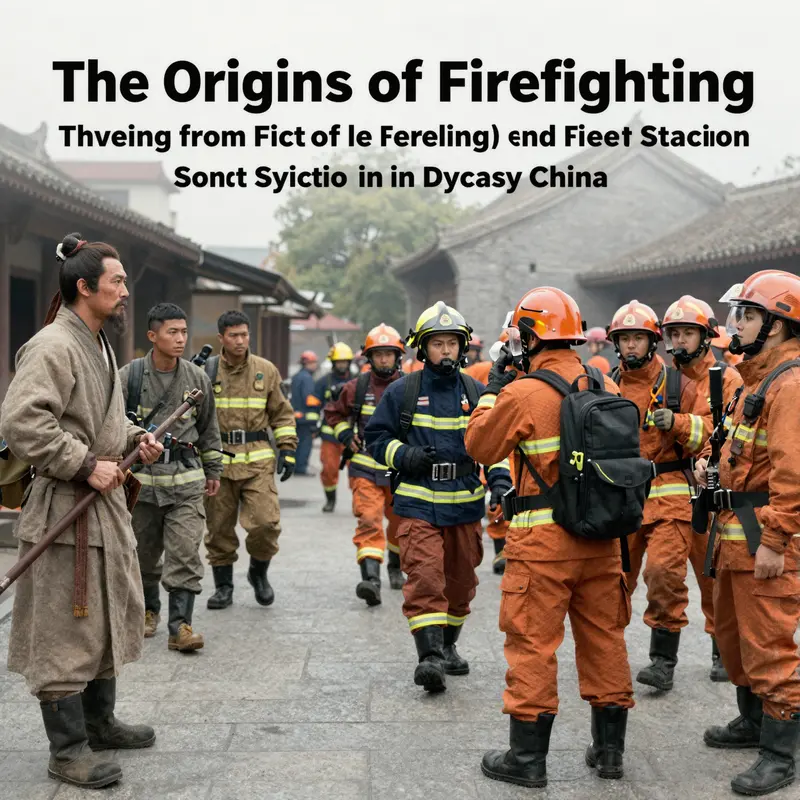
Where was the first fire station established? The answer unfolds not in a modern metropolis but in a capital of a dynasty that dared to systematize danger before danger was routinely imagined as a profession. In Song Dynasty China, the city of Dongjing—modern Kaifeng—housed a regime of organized fire protection that reads like a blueprint for contemporary urban safety. The system, known in historical records as the Jūn Xún Pù, or Military Patrol Posts, stretched through the capital and beyond, a network designed to defeat a hazard that, in those crowded streets, could erase a city in a single blaze. What makes this arrangement remarkable is not a single technological marvel but a calculated approach to proximity, staffing, and rapid response. The city was divided into a dense grid, with fire stations stationed roughly every three hundred paces, about a hundred meters apart. Each post was manned by five personnel whose duties shifted with the rhythm of night and day. They patrolled, watched for flames, and carried out the sort of rapid response that today we would recognize as the core function of a modern fire department.\n\nThe repertoire of duties at these posts went beyond merely sprinting toward embers. The patrols enforced nighttime curfews to reduce the risk of lamp and stove-caused fires, a pragmatic acknowledgment that urban life itself could become a hazard after dark. They maintained basic firefighting equipment—buckets, ladders, and water bags—and used horses to speed their approach to a blaze. The images offered by this early system resemble a well-drilled, city-wide response unit rather than a scattered collection of haphazard neighbors off to improvise a solution. It is easy to overlook the subtle but powerful implication: urban survival, in the Song capital, depended on organization as much as on courage. This is the essence of what many scholars call the world’s first formal urban fire service, a prelude to the modern idea of a station as a shared hub of readiness, equipment, and expertise.\n\nThe Song Dynasty’s model did not carry a universal label like “fire station” in the vernacular of its era, yet its infrastructure and doctrine foreshadowed a planetary shift in how cities thought about fire risk. It was a rational map drafted to minimize distance between danger and remedy, a principle that would echo through centuries as cities in every culture learned to rely on a persistent, predictable presence of trained personnel. In that sense, Dongjing’s posts were a precondition for the more expansive engineering and organizational feats that would follow. The idea of stations interconnected by patrols and rapid-response stations gave urban dwellers a tangible sense that fear could be anticipated and managed, not merely endured. This is where a narrative about ancient fire protection quietly becomes a narrative about governance: when a city commits resources to maintain constant watch, it also commits to a future in which citizens expect safety to be a standard service, rather than a rare act of luck.\n\nIf the Song Dynasty’s approach demonstrates a calculated, grid-like strategy, the story from Rome offers a contrasting dawn—the moment when an urban center first confronted the idea of a proper fire crew in a recognizable, albeit rudimentary, form. Around 60 BCE, under the early imperial reach of Augustus, Rome began to develop what historians describe as a more organized, quasi-military response to fire. The firefighters of ancient Rome, often described as closely organized cohorts, mark a transition from informal bucket brigades to a more persistent, purpose-built group with duties that looked a little more like the early modern idea of a fire brigade. Yet this Roman model did not achieve the scale, standardization, or institutional reach that the Song capital had conjured nearly seven centuries earlier. The difference is not a tale of one civilization outpacing another in cleverness but a testament to how social structures—centralized governance, urban planning, and a dedicated municipal bureaucracy—shape the quality and reach of public safety.\n\nThe difference between these two threads—Dongjing’s meticulously spaced posts and the Roman cohorts—opens a larger conversation about how fire protection evolves. Modern fire services are not just faster or more muscular; they are more professional, more integrated, and far more capable of preventing fires as well as fighting them. Today’s stations are built to an explicit standard: they serve as bases for emergency response, yes, but also as venues for public education, prevention programs, and community outreach. They operate under centralized command structures, with standardized protocols, continuous training, and career paths that nurture expertise over decades. The equipment has transformed from simple water bags and ladders to high-tech tools such as thermal imaging cameras, high-pressure pumps, aerial ladders, and a fleet of rapid-response vehicles. The difference between then and now is not merely in tools but in the scale and sophistication of organization, the reliability of communication networks, and the predictability of response times.\n\nIn reflecting on the trajectory from the first fire-station-like units to the robust modern system, one key lesson emerges from the ancient examples: institutionalization matters. The Roman model and the Dongjing grid reveal that a dedicated, trained workforce is the backbone of any effective response to urban danger. But the Song network adds an extra layer: ritual and prevention as governance. The guards’ curfews and the constant patrols transformed safety from a reactive impulse into a continuous practice. This is what modern preventive strategies seek to recapture: a structured, proactive stance that lowers the odds of a fire breaking out in the first place. Pre-industrial awareness of building safety—what Peng Zhigui and Sichuan Building Science scholars highlighted in 2015—emphasizes the value of preparedness, even when materials and technology constrain what can be achieved. The Song model, in its density and discipline, makes a compelling early case for how urban design and firefighting can be integrated into a city’s political economy.\n\nThe modern reader might wonder how a grid of posts about a century-and-a-millennium-old city can illuminate current practice. The answer lies in continuity of purpose. The Song network demonstrates a belief that safe urban life requires physical proximity to danger, disciplined staffing, and a shared sense of responsibility among those who patrol the night. It is not merely a historical curiosity but a blueprint for how to think about coverage, redundancy, and readiness in any dense urban fabric. In this sense, the Song arrangement is less a quaint antique than a living reminder that the core function of a fire service—reducing the time between detection and intervention—has always rested on a simple equation: place the fire station where danger lives, align it with trained personnel who know how to act, and supply the equipment that makes action possible.\n\nAs we trace this arc, the lineage becomes a narrative about continuous improvement rather than a string of isolated breakthroughs. The early post towers of Dongjing were followed by Roman cohorts, and then by centuries of experimentation, refinement, and expansion. Modern fire stations, with their dedicated spaces for training, prevention, and education, reflect a maturity born of this long historical dialogue between risk and social organization. The internal thread across eras is unmistakable: communities invest in the structures and people necessary to keep each other safe, and those investments multiply when knowledge travels across generations and borders. The resilience of urban life, in its most practical sense, rests on the ability to turn a network of watchful eyes, organized teams, and well-kept tools into a reliable system of response that can adapt to new threats without losing sight of the human need for reassurance.\n\nFor readers curious about the broader historical panorama of urban fire protection, a concise external resource offers a complementary portrait of how Romans approached urban danger. It provides a useful counterpoint to the Song Dynasty narrative and helps situate the Song post grid within a wider timeline of public safety innovations: https://www.history.com/topics/ancient-history/roman-fire-department. In addition, ongoing explorations of public safety innovation—such as the continued development of dedicated museums and research into fire-service history—underscore that the journey from Dongjing’s patrol posts to today’s fire stations is not a straight line but a braided path of ideas, technologies, and institutions that together safeguard cities when flames threaten to engulf them.\n\nThe story of the first fire station, then, is not merely a question of where it was established. It is a meditation on how cities learn to live with risk: through dense networks, trained hands, and a design that makes protection as much a routine habit as a last resort. The Song Dynasty’s Jūn Xún Pù shows that the impulse to protect urban life can be made visible, measurable, and defendable through careful planning and persistent practice. And in today’s world, with its rapid-fire challenges and evolving hazards, that ancient impulse remains the ember from which modern firefighting has grown.
null
null
Final thoughts
The establishment of the Jūn Xún Pù during the Song Dynasty not only marked the advent of organized fire-fighting services but also laid foundational principles that continue to guide contemporary fire safety practices. This early fire station symbolizes the importance of proactive community safety measures and has profoundly influenced urban planning and emergency response strategies. Understanding the legacy of the first fire station invites us to appreciate the evolution of fire services and their pivotal role in preserving life and property in urban settings. Reflecting on history can inspire ongoing improvements and innovations in how we approach fire safety and emergency management today.