
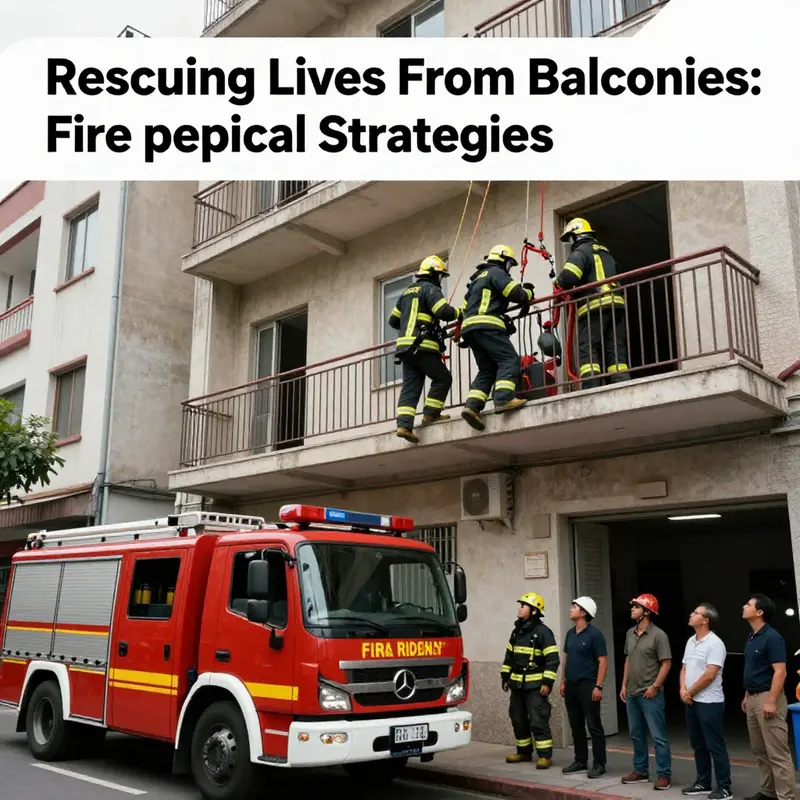
In urban environments, high-rise buildings present unique challenges concerning safety and emergency response. When emergencies occur on balconies, effective rescue operations require specialized equipment, rigorous assessment, and well-trained personnel. Fire departments play a vital role in such situations, employing aerial ladder trucks and rope rescue techniques to secure safe evacuations. This article will delve into the multifaceted approach of rescuing individuals stranded on balconies, including the use of aerial ladder trucks, innovative rope techniques, and comprehensive assessment and deployment strategies. By understanding these methods, community members, emergency responders, and educators can foster preparedness and reassurance in the face of emergencies.
Reaching the Edge: How Aerial Ladder Trucks Rescue People from Balconies in High-Rise Emergencies
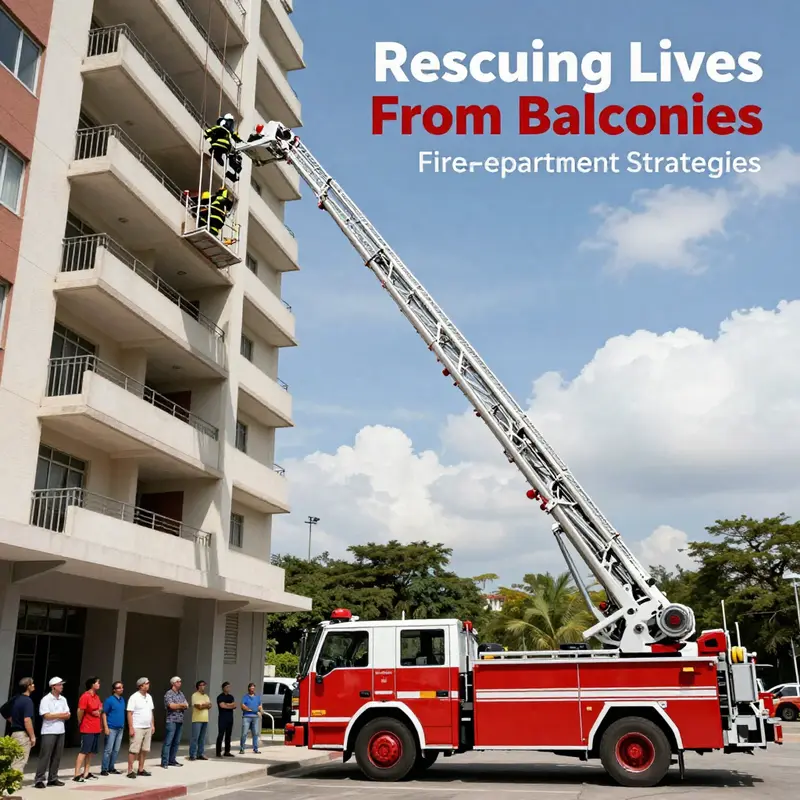
Firefighters reach people trapped on balconies using aerial ladder trucks through a series of deliberate, practiced actions. Each rescue blends vehicle positioning, mechanical reach, crew skills, and clear communication. The result is a predictable, repeatable process that prioritizes life safety while managing risks from height, fire, smoke, and weather.
At the heart of these operations is the aerial apparatus. These vehicles carry telescoping or articulated booms and a stable platform at the tip. The platform lets crews work close to building edges while staying protected. Unlike portable ladders, the aerial delivers a controlled vertical and lateral approach. For trapped occupants, that control matters. It transforms a chaotic moment into a series of measured steps.
A successful balcony rescue begins long before the boom extends. The first task at the scene is assessment. Incident commanders quickly locate the trapped person, confirm the balcony level, and identify hazards. They check for active flames, visible smoke, structural issues, and any nearby obstacles. They also note external factors that influence aerial operations: wind direction and speed, nearby overhead lines, trees, signage, and the angle of the building face. This initial assessment sets the rescue plan and determines whether the aerial will serve as the primary means of egress.
Positioning the truck is a deliberate skill. Crews must park close enough to achieve sufficient reach while avoiding hazards. Aerial vehicles require a stable footprint. Firefighters deploy outriggers or stabilizers to level and secure the apparatus. Proper leveling reduces stress on components and keeps the platform steady during operations. If the truck cannot be positioned due to obstructions, crews may pivot to alternative techniques, such as rope systems or interior evacuation via stairwells. The ability to reposition quickly, and safely, matters when time is limited.
Extending the boom is controlled and incremental. Operators raise and extend the ladder with slow, planned movements. They watch for contact with the building and for shifts in the platform caused by wind. Modern aerials offer hydraulic controls and fine movement capabilities. The operator moves in close while maintaining a safe standoff distance from the balcony railing and any exterior hazards. Crews on the platform communicate constantly with the vehicle operator. A single misstep or sudden gust can introduce sway, so the team adjusts continuously to keep the platform aligned with the balcony’s edge.
When the platform reaches the balcony, a safety check unfolds in seconds. Firefighters scan for smoke, high heat, and structural concerns. They evaluate whether it is safe for a crew to step from the platform onto the balcony. If there are flames visible or unseen risks, they may shelter occupants in place on the balcony and move them into the platform from a sheltered corner. If the balcony is structurally compromised, they will avoid stepping on weak points. Crews use thermal imaging cameras to detect hot spots on walls or floors. Their choices in these moments reflect the primary rule: do not create more victims through rescue attempts.
Rescuing the person requires a calm, clear approach. Firefighters speak reassuringly and give simple instructions. Panic can lead to sudden movements. The platform is brought as close as safely possible to the balcony railing. If the balcony door is open, firefighters may ask the occupant to back toward the door and then to step into the platform. If the person cannot stand, firefighters secure them with a harness or webbing. The harness keeps the occupant stable while the platform moves. For the injured or unconscious, teams may use a stretcher or scoop board designed for aerial operations. These devices allow firefighters to secure and support a patient while raising or lowering them.
Aerial platforms often have features tailored to rescue. Many platforms include guardrails, non-slip surfaces, and anchor points for harnesses. Some have built-in patient transfer enhancements that allow a stretcher to be rolled or slid onto the platform. Crews are trained to use these features quickly and safely. They practice transferring people in simulated conditions until the movements become instinctive.
Communication is the thread that binds each action. The platform crew, the operator, and the incident commander maintain constant updates. Radio discipline matters; concise information reduces confusion. Crews use hand signals as supplements when noise or radio interference make verbal communication difficult. This layered communication ensures the platform aligns correctly, the occupant is ready, and the descent proceeds smoothly.
The descent itself is a controlled operation. The ladder is retracted slowly, with the operator monitoring platform stability. Crews watch the path for obstructions and adjust the platform’s angle to avoid bangs or scraping. If the route to ground crosses wind-swept open spaces, the operator compensates for sway. On descent, the crew secures the occupant with harness straps to prevent jostling. Ground personnel clear a safe zone where the platform will land. That zone keeps bystanders away and allows emergency medical staff to receive the rescued person immediately.
Not every balcony rescue follows this textbook path. Building architecture, balcony depth, parapet design, and façade ornamentation can complicate access. Shallow balconies, deep recessed terraces, or balconies with high, solid parapets may block direct platform contact. Some older buildings have projections or decorative ledges that prevent the boom from getting close. External obstructions such as trees, wires, or signage also interfere. When the aerial cannot reach, crews adapt. Rope-rescue teams may rig systems from the roof, an adjacent balcony, or a nearby structural anchor. These teams use controlled rappel and belay techniques to reach the occupant from above or below. Portable ladders can work for lower levels. Interior crews might clear conditions and move occupants toward stairwells for evacuation.
Weather and wind demand special attention. Wind increases platform sway, and gusts can make precise alignment impossible. Fire departments maintain wind-tolerance charts for each aerial type. Above specified limits, they will not operate the boom. Rain, ice, or severe temperatures also affect equipment performance and human endurance. Crews dress for conditions and use protective gear. In high wind, priority often shifts to interior rescue options or to staging multiple crews to brace platforms if safe.
Teams operate within regulatory and standards frameworks that shape tactics. These standards define training requirements, equipment inspection schedules, and operational procedures. Departments perform routine checks on hydraulic systems, rotation rings, articulation points, and platform safety devices. Maintenance prevents failures during a rescue. Drills and scenario-based training keep skills sharp. Crews practice platform positioning, patient transfers, and working in tandem with interior teams. Training also emphasizes risk assessment and the authority of incident commanders to change tactics when necessary.
Coordinated interior and exterior operations multiply rescue capacity. Interior crews can prepare an occupant for transfer by opening balcony doors, moving furniture, or delivering a harness. When multiple occupants are stranded, teams may stage sequential rescues. One ladder may evacuate the most vulnerable first. Meanwhile, interior teams guide ambulatory occupants to stairwells or to safer balconies. In complex incidents, incident commanders balance aerial deployment against the risk to ladder crews and the need to keep interior paths clear for fire attack or ventilation.
The human factors in these rescues merit attention. People trapped on balconies are often frightened and disoriented. They may have been isolated by smoke or blocked exit routes. Firefighters learn to breathe calmness into the moment. They use direct language, explain what will happen, and set realistic expectations. That reassurance reduces irrational actions and helps the transfer proceed smoothly. For occupants with mobility impairments, firefighters carry out tailored plans. They bring specialized equipment and coordinate with medical staff to reduce the risk of secondary injury during transfer.
Special scenarios test departmental adaptability. For example, when a balcony faces a courtyard or is offset from the street, maneuvering an aerial truck into position can be impossible. Narrow lanes, overhangs, or adjacent buildings may block approach. Some departments use articulated aerials that can reach around corners. Others coordinate with towing resources to reposition vehicles quickly. In places with older building stock, departments may rely more on rope rescue, or on mutual aid from neighboring departments with different apparatus capabilities.
Aerial rescues also occur during non-fire emergencies. Medical calls, structural failures, or rescue from maintenance accidents can require the same reach and technique. Because aerial crews practice for many scenarios, their skills remain broadly applicable. Departments that invest in multidisciplinary training see better outcomes. Crews that work regularly with EMS partners, for instance, streamline patient handovers and reduce on-scene time.
Safety margins extend beyond hardware. Departments maintain policies that limit the number of people on the platform. They enforce weight capacities and secure points that meet the rated loads. Firefighters check harnesses for wear, secure all loose equipment, and ensure that tools are tethered. These precepts reduce the chance of a secondary incident caused by dropped gear or overloaded platforms.
Technology improves both situational awareness and rescue capability. Thermal imaging helps identify hidden fire spread. Cameras on the ladder and platform give operators an external view of contact points. Sensors track boom angle and stress. Some aerials provide stabilizer pressure readouts and leveling feedback. These systems give crews objective data to make safer choices. But technology supplements, not replaces, training. Crews still rely on practiced judgement when conditions diverge from normal parameters.
Documentation and after-action review are integral. After a rescue, teams log operational details, equipment performance, and any near-miss events. These records guide repairs, future purchasing decisions, and training priorities. Departments study incidents to find ways to shorten rescue time while maintaining safety. Continuous learning maintains high standards across the service.
The global experience confirms the aerial platform’s value. In cities worldwide, aerial rescues have saved countless lives. When a balcony evacuation is the only viable escape route, the boom provides a direct and controlled path away from danger. Even under adverse conditions, a well-executed aerial maneuver often proves decisive.
For departments facing resource constraints, flexible vehicle solutions matter. Adapting apparatus to local needs increases reach and responsiveness. Cities with narrow streets or older buildings may favor different aerial designs. When agencies evaluate new vehicles, they weigh reach, articulation, and stabilization features against budget and operating environment. For additional perspective on how adaptable truck solutions support diverse needs, see this discussion on customizable fire truck solutions for developing countries.
Real incidents illustrate practical adjustments. In one multi-story residential event, strong crosswinds forced crews to alter their plan. They combined an interior entry with a 7-story-capacity platform deployed on the building face that the wind affected less. Teams worked from both sides, moving occupants to safer zones while the aerial extracted those unable to move internally. Such hybrid responses underscore how teams tailor resources to conditions.
Ultimately, balcony rescues by aerial ladder trucks are a study in control. Crews control vehicle placement, boom movement, and patient care. They control communication and the pace of actions. That controlled approach reduces chaos and saves lives. It turns a vulnerable perch into an orderly transfer to safety.
External reference: China Fire Department – Rescue Operation Using Aerial Platform Truck (https://www.119.gov.cn/zhxx/2025-03/30/16452.html)
Balcony Rope Rescues: Principles in Modern Firefighting
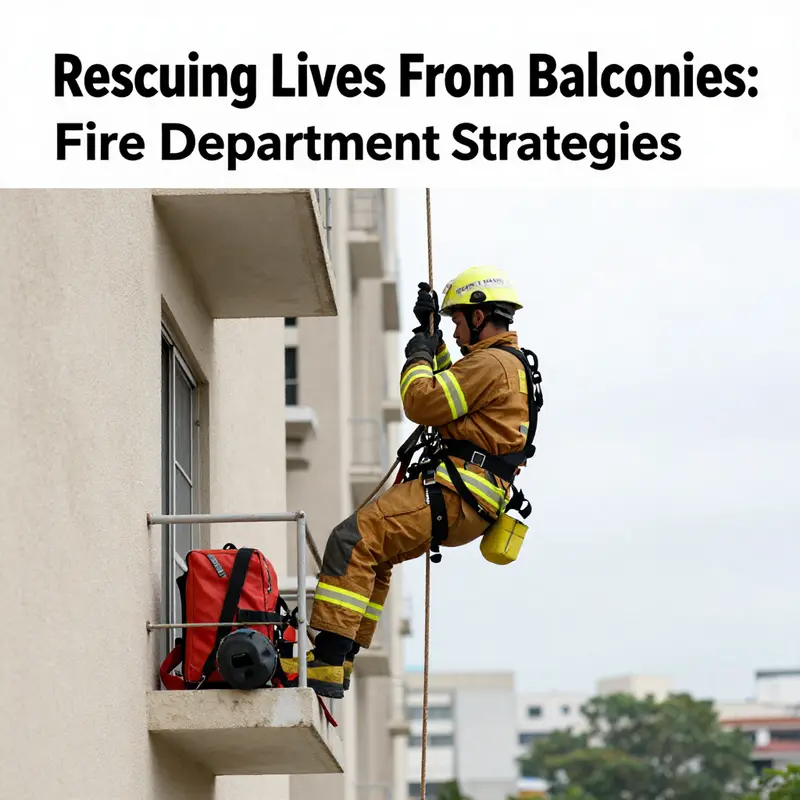
Rope rescue on balconies is a high-stakes operation that blends technical rope work with rapid risk assessment and compassionate occupant management. The goal is to move a person from a perilous perch to safety while minimizing movement and preventing secondary injury. This requires rigorous planning, redundant anchors, and disciplined teamwork. The emphasis is safety before speed, technology before equipment, and clear communication that keeps both the occupant calm and the rescuers synchronized.
Balcony rescues adapt standard rope rescue concepts to narrow ledges and limited access. Rescue teams construct robust, redundant anchors from structural points and nearby solid elements, then choreograph transitions to a controlled rope path. Different configurations—vertical, horizontal, and transitional (T-type)—provide options when direct routes are blocked or impractical. Training, drills, and after-action reviews reinforce consistency and safety across agencies.
The ethical dimension matters as much as the technique: occupants deserve dignity, calm guidance, and explanations of what will happen next. By combining international standards with local practice, fire departments keep balcony rescues predictable under chaotic conditions, reducing risk to both the person on the balcony and the responders on the ground.
Balance in Focus: An Assessment-Driven, Elevated Rescue Narrative for Balconies
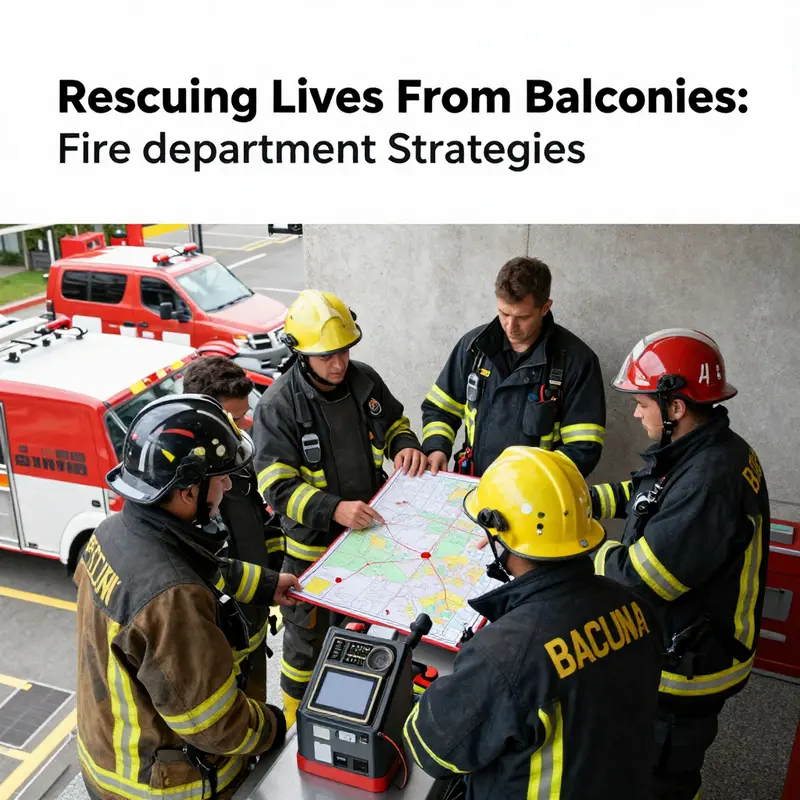
When flames threaten a building and a balcony becomes the only route to safety, fire departments move with a blend of calm assessment and precise execution. The balcony rescue is not a single act of bravery but the culmination of a carefully choreographed sequence that starts long before the sirens and continues long after the last occupant is secured on the ground. In these moments, the department’s ability to balance risk, physics, and compassion becomes as vital as the equipment itself. The chapter that follows weaves together the core elements that drive balcony rescues: rigorous assessment, strategic deployment, the use of aerial platforms, rope-based techniques when needed, and the ongoing training that keeps crews ready for the unique challenges balconies present. It is a narrative of planning meeting pressure, technique meeting humane intention, and technology meeting teamwork, all aimed at one outcome — getting people to safety from a balcony as quickly and safely as possible.
The rescue on a balcony begins with a fast but thorough intake of the scene. A rapid, almost tactile, situational awareness is formed within moments. Firefighters assess the structural integrity of the balcony itself, an often subtle but crucial factor. Balconies can be cantilevered, supported by corbels, or integrated as part of a modular façade, each presenting different load-bearing characteristics. The weight of rescuers, equipment, and a panicked occupant can push a balcony beyond its comfort zone. The assessment extends beyond the balcony to the surrounding structure: is the fire burning nearby? Is there potential for collapse or debris fallout? What is the wind doing at height, and how will that wind affect a platform’s stability or a rope system’s exposed line? Weather conditions become a live variable, not a footnote, because gusts and downdrafts at elevation can alter angles and threaten delicate maneuvers. In addition, responders quickly appraise the number of people in distress, their locations, and their capability to move. A quiet, initial medical assessment can reveal who can walk, who needs assistance, and who must be carried. Each piece of information threads into a preliminary plan that can adapt as conditions evolve.
From this moment of rapid appraisal, the deployment phase unfolds with deliberate restraint and rapid action. Aerial apparatus — the ladder trucks and platform lifts that extend toward the balcony — is the backbone of the standard approach. The location around the building is critical: crews choose positions that provide the most direct, stable access to the victim while preserving space for a safe working zone around the platform. The platform itself becomes a mobile room aloft, capable of matching the balcony height and angle, and allowing responders to enter and reemerge with the occupant in a controlled, enclosed environment. The balance here is between reach and stability. A longer ladder may seem advantageous, but if the base cannot be set with a firm bite on the ground or if nearby obstacles compromise the swing of the platform, the benefit quickly dissolves into liability.
Inside the platform, a firefighter teams up with the occupant in a way that respects both safety and dignity. The crew often uses a harness and a secure point on the balcony as a belt-line or anchor, to prevent any sudden shifts during the transfer. The actual motion from balcony to bucket is a sequence of careful, incremental steps. First, the firefighter communicates clearly with the occupant, explaining what will happen and how much assistance will be required. The person may be frightened, disoriented, or in pain; the rescuer’s voice becomes a stabilizing force as much as a technical one. The transfer into the basket is performed with attention to balance and body mechanics: the occupant is guided, not dragged, through a controlled arc that minimizes the risk of slipping or contact with railings, broken glass, or debris. As soon as the occupant is seated in the platform, the crew verifies stability, secures any harnesses, and begins the descent, always ready to halt if new hazards arise or if a recalibration is needed to maintain a safe trajectory.
Of course, not every balcony can be reached by an aerial apparatus. In urban cores or densely built neighborhoods, obstructions such as adjacent structures, narrow courtyards, or unusual balcony configurations can block a direct lift. In those instances, fire departments rely on rope rescue techniques that have matured through years of training in high-angle rescue. Rope systems enable teams to scale or descend façades with a different set of physics and a distinct set of hazards. Ropes are not a substitute for an aerial reach but a complementary tool that expands options when geometry or access compromises the platform. In practice, rope rescues involve a separate, parallel set of skills: anchor building points that can withstand load, dynamic belay systems, and a sequence of rappels or pulls that bring occupants toward a safer, lower level. The rope work is performed by the same crews who arrive with aerial gear, but the emphasis shifts from the mechanical leverage of a platform to the friction, anchor integrity, and the precise choreography of human movement on a vertical terrain. These techniques, however, are not used in isolation. They are integrated into a broader plan that respects the overall risk landscape of the incident.
The decision between aerial deployment and rope-based rescue is never binary. It is a nuanced determination based on a cascade of factors learned through training and experience. Building layout, the balcony’s construction, the number of people to evacuate, weather, and even the victims’ physical condition all feed into a dynamic decision process. The central idea is not to chase the fastest possible option but the safest one that achieves timely rescue. To support this, fire departments practice a spectrum of methods, including ground-based tactics that leverage portable ladders, harnesses, and coordinated stair-well access when the balcony’s reach is limited or when the platform cannot be positioned near the target balcony due to space constraints. The trained eye of a captain or incident commander gauges the risk-to-benefit ratio at every stage, pausing when a step would introduce disproportionate risk or when a change in conditions demands a reconfiguration of the plan.
Underlying these deployment choices is a robust framework of pre-incident planning and ongoing training. Pre-incident planning means mapping buildings, noting access points, stair configurations, elevator shafts, and likely egress routes for occupants. It also means cataloging the kinds of balconies that tend to appear in a city’s architectural vocabulary. Are there continuous balconies connected to shared corridors, or do residents access individual units through narrow projections? Each scenario requires a mental model that can be activated quickly when the alarm sounds. Regular drills ensure that the plan does not exist only on paper; it lives in the muscle memory of crews who practice high-angle rescues, platform maneuvering, and patient handling with the same seriousness given to combat drills. In many cities, simulations of balcony rescues are part of annual safety exercises. These simulations are not mere rehearsals of technique; they are opportunities to test communication lines among incident command, EMS, law enforcement, and hospital teams. Real-time communication tools suffuse the exercise with a realism that cannot be achieved in static training rooms. GPS-enabled tracking devices, scene mapping, and digital checklists transform a chaotic event into a coordinated enterprise where every member knows their role and every move is traceable and improvable.
Technology threads through the rescue in both visible and subtle ways. The aerial platform, the rope systems, the harnesses, and the patient trolleys exist within the larger technological ecosystem that supports modern firefighting. Real-time communication channels allow responders to share updates about wind shifts, platform angle changes, and the victim’s evolving medical status. GPS and on-scene mapping enable crews to verify the quickest routes to the balcony and the safest descent path to ground level. These tools do more than speed up response; they reduce risk by clarifying the geometry of the rescue. When the platform is in motion, a narrow window of time can define success or compromise. The ability to monitor platform position, victim condition, and crew integrity in real time lets commanders steer the operation with confidence rather than with uncertainty.
Coordination with other emergency services is another essential strand in balcony rescues. A high-rise incident is rarely a solo operation. Police units often secure nearby avenues of approach, crowd control, and access to utilities that might complicate a rescue. EMS teams stand ready to provide immediate medical care to people who are rescued and to prepare for the inevitable transfer to a hospital. A well-orchestrated rescue daylights the reality that balcony evacuations are not merely about physical ascent and descent; they are about preserving the dignity and comfort of the occupants. Firefighters approach this with a posture of calm communication, steady physical method, and an emphasis on minimizing further distress. The occupants’ emotional state matters as much as their physical status because fear can escalate risk, especially when a balcony is exposed to wind or smoke. In these moments, the firefighter’s voice, posture, and approach can transform a terrifying experience into a controlled, humane process.
To illuminate these principles, it helps to imagine a representative scenario. A mid-rise residential building exposes a resident on a balcony after a fire traps the interior. The ladder company arrives and introduces the platform to a balcony that is partially obstructed by a neighboring structure. The initial on-site assessment confirms the balcony’s structural integrity is marginal but still capable of supporting a slow, cautious lift if the angle can be maintained and the wind kept within manageable levels. The incident commander designates a position for the aerial apparatus that affords the platform a direct line to the balcony while preserving street access for emergency medical transport. A firefighter enters the platform, secures the occupant with a harness, and begins the deliberate transfer, the platform moving in a smooth arc toward the ground. If smoke or heat intensifies, the team is prepared to back the platform away and consider a rope-based rescue, where a belay system anchors a rescuer who lowers or raises through the balcony area while keeping the occupant protected from the exposure. The patient is then escorted through the interior of the platform to safety, with the ground team ready to take over medical care the moment the occupant clears the balcony, and the platform becomes a temporary patient cabin until the descent completes. In parallel, a rope rescue team stands ready to intervene if the balcony’s geometry or the force of the wind makes the aerial path untenable. This layered approach — aerial, rope, and ground-based tactics — exemplifies the principle that balcony rescues thrive on adaptable, multi-faceted tactics rather than a single best method.
A deeper appreciation for these procedures comes from recognizing how training and ongoing discipline support them. Regular drills reinforce a common language and a shared sense of timing across the entire response chain. The importance of pre-incident planning cannot be overstated. Building blueprints, balcony layouts, and even typical weather patterns for the city become part of the department’s autonomous knowledge. When the alarm rings, responders do not search for a plan; they implement one. The plan, however, is living and adaptable, shaped by situational cues in real time. The discipline of training ensures that the team can modify and improvise while preserving safety margins. It also builds the cultural nerve to treat balcony residents with dignity and care, acknowledging the physical vulnerability and the emotional stress inherent to emergencies on a balcony.
It is also important to consider the broader implications of balcony rescues. Communities benefit when the public understands the realities of these operations. Clear, transparent communication with residents reduces panic and helps them prepare for what a rescue might entail. For example, residents who are guided to stand still or who are asked to move to a safer portion of the balcony can significantly ease the rescue operation. Fire departments emphasize safety not only during the extraction but also in teaching people how to avoid compromising their own safety. This proactive stance, built on education and outreach, complements the on-scene techniques and reinforces a culture that values life and dignity as much as speed and effectiveness.
In practical terms, the equipment itself reflects a careful balance between reach, stability, and human factors. Aerial ladders and platform lifts provide direct access to elevated balconies, allowing responders to reach victims quickly and to transport them through a controlled space. Where a balcony cannot be reached directly, rope systems extend the department’s capability to move vertically with precision. Ground-based access, while slower to deploy, remains essential as a reliable fallback. The interplay among these tools is what makes balcony rescues possible in a range of architectural configurations. It also underscores why ongoing training and cross-disciplinary coordination matter. A rescue operation at height is not a simple exchange of good intentions; it is a complex performance that requires precise timing, deep technical knowledge, and an unwavering commitment to safety at every stage.
The chapter would be incomplete without touching on the sources of guidance that shape daily practice. National standards and training resources from established safety organizations provide the backbone for consistent, evidence-based rescue protocols. These guidelines help ensure that the actions taken in the heat of a balcony rescue align with proven methods, reduce unnecessary risk, and promote the best possible outcomes for both occupants and responders. While individual departments tailor their procedures to local needs, the shared framework offers a common language and a baseline of safety that supports coordinated action across agencies and jurisdictions. In this sense, balcony rescues reflect a broader, professional commitment to public safety that extends from the first assessment to the final handoff to medical care.
For readers who wish to explore equipment considerations and deployment principles in greater depth, a related resource explores configurable equipment options and how they influence rescue strategies in diverse environments. This resource emphasizes that equipment is not a static tool but a platform upon which rescue planning can adapt to the urban fabric, weather, and occupant needs. By studying these configurations, responders can anticipate challenges before they arise and refine their tactics accordingly. In practical terms, the knowledge supports a mindset of flexibility: the ability to shift from an aerial approach to a rope-based approach when geometry demands it, and the capacity to coordinate with EMS and police in a manner that minimizes disruption to the surrounding community. This perspective aligns with the core idea that balcony rescues are not only about technical steps but about a resilient system in which assessment, deployment, and aftercare are in constant dialogue.
In conclusion, balcony rescues hinge on a disciplined blend of assessment, deployment, and adaptation. The initial evaluation informs every decision that follows, from where to position the platform to whether a rope system should be engaged. The operation itself hinges on the portable physics of height, wind, and angle, and the people at the heart of the rescue — both those being helped and the responders who must remain calm, capable, and compassionate under pressure. The result is a coordinated, humane response that respects the dignity of every person while using technology and trained technique to bring them safely to ground level. This is the essence of balcony rescue: a concerted, professional effort built on pre-planned, practiced methods, and a continuous commitment to learning and improvement. For those seeking a practical reference to equipment configurations that can influence rescue tactics, see the related resource on customizable-fire-truck-solutions-for-developing-countries-diverse-firefighting-needs. And for official standards and training resources that guide safe operations, consult NFPA guidelines at https://www.nfpa.org/.
Final thoughts
Fire departments are equipped with specialized equipment, trained personnel, and strategic methodologies to respond efficiently to balcony emergencies. Understanding the use of aerial ladder trucks, rope rescue techniques, and assessment tactics empowers communities and individuals, reinforcing the importance of emergency preparedness and safety. In generating a supportive environment around fire departments and their essential work, we can ensure a swift response to any emergency that may arise on high-rise balconies.