
The gripping tale of Black Beauty, penned by Anna Sewell, showcases not only the plight of horses but also the profound connections between humans and animals. A pivotal moment in this narrative occurs during a catastrophic stable fire. This article delves deeply into the rescue of Black Beauty, highlighting how his groom, James, demonstrated loyalty, courage, and trust amidst chaos. We will explore the intricate dynamics of their relationship in the rescue, examine Black Beauty’s instinctual responses in the face of fear, and discuss the broader implications of this rescue scene within Sewell’s narrative framework, ultimately emphasizing the importance of kindness and loyalty in human-animal relationships.
Trust in the Fire: A Quiet Rescue
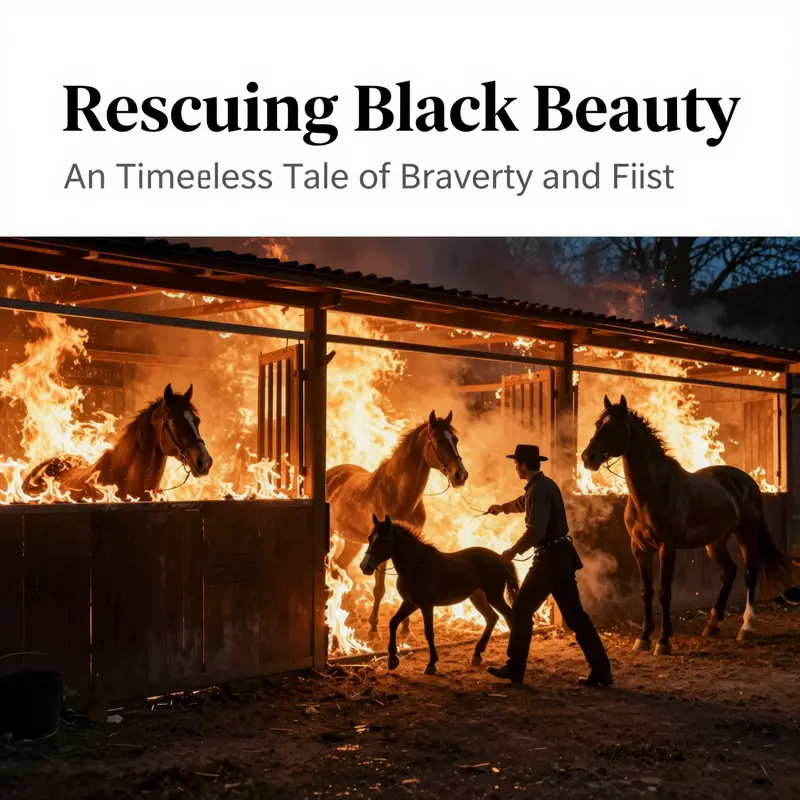
The night opens with the scent of smoke and a curtain between life and fear. In the stable where Black Beauty and Ginger share shelter and history, heat rises first in a whisper and then with a roar. The horses sense the danger even as flames lick at the rafters and the smoke thickens the air into a heavy fog that makes every movement feel like a choice between exhale and suffocation. It is a moment when character is tested not by speeches or sermons but by the simplest, stark demands of the body: to hold steady, to trust, to move when fear urges retreat. Black Beauty wakes in a smoky quiet that feels almost intimate, as if the night itself leans close to understand what is at stake. He is not a creature of panic by nature; his temperament has long been tempered by a discipline of responsiveness to the right cues from the right people. Ginger, his companion, is driven by impulses—the instinct to flee, to find the safest corner, to cling to a familiar outline of escape. The difference between their reactions is essential, because it will become the hinge upon which the rescue turns. The scene is not merely a display of physical courage but a study in crisis psychology: how trust is built, how fear is managed, and how a humane approach to animals can be a form of leadership in danger, not a mere afterthought to rescue.
The stable yard has become a stage for competing impulses. The stableman, who has worked with these horses for years, moves with the practiced urgency of someone who knows the danger is real and who also knows that time in a burning building is measured in breaths. He tries to lead the horses toward the exit, a line of light cutting through the smoke that promises safety if only the horses will choose to follow. But fear, in a stable full of voices and shadows, can become a chorus that drowns out reason. The horses rearing and shying, the clatter of hooves, the crack of timber giving way to the heat—all of it is a weather system of alarm that pushes Black Beauty toward the edges of endurance. The task is practical and brutal: coax the animals out, tug with gentle insistence when they hesitate, and hold them in a path that keeps them from injury as the flames widen their reach. Yet the moment turns not on brute strength but on the quiet force of trust earned through days of careful, consistent care. Black Beauty’s resistance to leaving Ginger behind marks a human moment in an animal world: a line drawn in affection that defines how far a creature will go for another.
Into this charged atmosphere steps James, the stable’s caretaker whose presence has always been a steadying heartbeat for the animals and for the men who work there. He does not enter with bravado or loud command. He enters with a practiced calm that seems almost ordinary but is precisely what danger requires. He speaks in a tone the horses recognize, not as a command but as invitation, a language formed by years of patient handling and mutual respect. The call to Black Beauty is simple, the kind of cadence that might be spoken in any quiet evening when the trust built over time is ready to reveal its true worth: come with me. It is not a shout but a practiced reaching of a hand, the touch of someone who understands what a horse needs to hear in a moment when instinct shouts louder than reason. The doorway to safety is not a physical corridor alone but a channel of trust that can carry a horse through smoke and heat if given a clear, trustworthy guide at the other end. James’s approach—soft speech, steady movements, and a familiar cadence of reassurance—translates into a form of rescue that transcends the immediate danger. The horses have learned not to move toward safety because danger has receded; they move toward safety because a person they know will guide them with kindness and a sure presence.
What follows is not simply a physical extraction from a burning building but a convergence of temperament, habit, and humane intent. Black Beauty refuses the initial pull of fear that would have him bolt, a reaction that would already be a victory for the flames themselves. Instead, he lingers in a poised moment, allowing the sound of James’s voice to anchor him. The fear that gripped him at the moment of awakening—the air thick with smoke, the shout of voices, the sight of the collapsing rafters—begins to loosen its grip as trust takes a firmer hold. The horse’s refusal to move under the pressure of the others becomes, paradoxically, a form of courage. It is not stubbornness but a deliberate choice to meet James in the space where rescue becomes possible: in the shared sense that Ginger’s life matters and that the bond between horse and human is not one-way. Ginger’s life is not a mere afterthought; his fate is bound into the same outcome as Black Beauty’s. James’s entry into the scene redefines the moral geometry of the moment. He embodies the humane principle that rescue is not an act of heroism performed from above but a practice enacted through intimate, respectful contact with the vulnerable being.
When Black Beauty finally responds to James’s invitation, the transformation is swift but deeply meaningful. The horse does not simply follow; he collaborates with the rescuer, moving with a measured, almost dignified pace that speaks to years of careful conditioning and mutual recognition. The two animals of the stable—Black Beauty and Ginger—emerge into the open air with a cautious alertness that belongs to survivors rather than spectators. The warmth of the flames behind them is replaced by a chill wind and the acrid tang of smoke, and yet in that breath of danger lies a sense of release. The escape is not a solitary triumph but a shared one, a moment when the boundaries between human intention and animal perception bend toward a common good. The rescue is extended beyond Black Beauty’s personal survival to include Ginger, whose life is preserved by the steering hand of James and the momentary shift in Black Beauty’s own fear toward trust. The scene, through a quiet act of care, becomes a narrative argument for humane, compassionate human–animal relations. It is not luck or fate but a demonstration of what humane attention can accomplish under pressure.
The drama of the rescue resonates beyond the burning building and into the larger arc of the novel. The bond formed in that moment of danger does not diminish either party; it deepens both. For Black Beauty, trust becomes the lens through which future encounters with strangers and caretakers are interpreted. For James, the rescue reaffirms a vocation of humane responsibility that requires more than technical skill; it demands a deep, sustained attentiveness to the emotional and physical needs of the horses in his care. The scene operates on multiple scales—a personal moment of salvation, a small ethical argument within a broader social discourse about animal welfare, and a narrative cornerstone shaping how readers perceive the relationship between humans and animals across the whole work. As readers turn away from the inferno, the lesson lingers: rescue as a practiced discipline rooted in daily care, kindness, and steady resolve. The flame is a story of destruction, but the response becomes a story of resilience, dignity, and quiet courage.
null
null
Smoke, Trust, and a Gentle Call: How Black Beauty Was Rescued from the Stable Fire
The night holds its breath as smoke slides through the crevices of the stable, a slow, acrid gray that clings to fur and breath alike. Black Beauty wakes to a rhythm of fear in the air, a tremor that travels from nostrils to spine, a primal alarm that tells him the world has changed its shape in an instant. The stable is a labyrinth of shadows and heat, each stall door a mouth from which danger could emerge, each plank murmuring with the crackle of flame. Fear swirls with the night wind as Black Beauty inhales the scent of smoke and unknown threat, while the other horses sense the same peril in the steep yaw of the cold night air and in the urgent, unfamiliar hiss that seems to rise from the heart of the fire. In such moments the animal mind does not reason so much as make a swift, unspoken choice governed by survival. The instinct to flee, to find the way to safety, to distance oneself from the furious glow, is swift and overwhelming. Yet fear, in Black Beauty, is not a solitary force. It is braided with a dawning concern for a friend who stands within the close quarters of the stable, a companion whose light and warmth have long been a part of Black Beauty’s own map of trust. Ginger, a mare who carries her own history of kindness and resilience, is inside. The night keeps her secrets close, and the smoke thickens, weaving a veil that can tempt any horse to give in to panic rather than purpose. The first attempt to move the horses is a chorus of confusion and fright, a tremor of hooves against the straw, a chorus of shuddering bodies pressed against doors that refuse to yield to fear or fate. The stableman, a steady figure in the chaos, does what he can in a voice that is both practical and earnest. He points, he pulls, he calls, and for a moment it seems that the flames will claim more than space and air; they might claim the courage that fuels a human attempt to save what is dear. In that murky moment, Black Beauty becomes a study in conflicting impulses. His body wants to bolt toward clear air, toward the gate, toward the cold, hard night beyond the blaze. Yet the fear for Ginger hums in his ears and stomach, a heat that competes with the flame, a loyalty that binds him to a friend who may be lost if he does not stay. The dialogue of fear and loyalty is not spoken aloud but lived through each tense breath and each cautious step away from the stall partition. It is a moment that reveals how fear operates in one creature and how bravery reveals itself in another. Fear is the raw energy that makes Black Beauty want to run, to escape, to vanish into the night. Bravery, when it arrives, is not loud or flashy; it is a quiet decision to stay present in the danger so that another may live. The contrast between these two forces is not a clash but an interweaving of necessity and feeling. And then, as the flames threaten to swallow not only air but memory and trust, James appears again, a figure who has stood outside the ring of danger and knows how to enter with a different kind of courage. James, a groom who has earned Black Beauty’s confidence through years of patient handling, becomes the fulcrum of the night. His presence does not merely imply protection; it embodies a practiced, intimate knowledge of how to communicate with a horse without breaking the fragile thread that binds them. When he calls out, his voice carries a calm, almost reassuring rhythm that seems to cut through the roar of the flames. There is no dramatic gesture, no shout of bravado, only a steady invitation to come along, to trust the course of action that has a chance to lead to air and dawn. The tone of his speech—neither coercive nor punitive, but confident and unhurried—gives Black Beauty a blueprint for moving forward. It is not an external rescue only; it is a rescue of trust itself. The horse, who has learned to read the subtext of human intention in a myriad of small cues, recognizes in James a figure who will not betray his own life for the sake of a command. James does not coax by fear; he does not threaten with the whip of consequence but uses the authority of care, the authority of someone who has stood at the edge of danger with him and who still remains, still speaks in a voice that has never broken the bond of friendship. The moment when Black Beauty finally decides to move with James is a silent decision rather than a spoken one. It is born from an almost instantaneous synthesis of two elements: a memory of warmth and a willingness to endure discomfort if it means reaching safety. The bond of years between horse and groom has formed a corridor of trust through which fear is softened and courage becomes possible. As Black Beauty steps, the smoke thinning before him as if the night itself is willing to open a path, there is a transformation in the animal frame. The body that had trembled begins to align with intent; the head lifts away from the ground, the ears pivot toward the direction of a safe exit, and the heartbeat steadies to a more measured rhythm. It is not a miracle in the sense of a sudden absence of fear, but a calibrated response to danger that only becomes possible because the fear is not the sole language of the moment. The horse is not a passive recipient of rescue; he contributes to the process through trust, alertness, and a resolved will to escape the burning shelter. And then the larger human figure in that scene takes on a new dimension in the narrative. James does not merely hinder the flames with a brave act; he redefines what it means to be a caretaker in a crisis. His actions are inseparable from the moral core of the tale, which treats kindness, loyalty, and patience as the true measures of character. The rescue becomes a moral event as much as a physical one. The risk he bears is real and personal, yet his conduct reframes risk as a duty to others rather than a calculation of self-preservation. In this light, the scene expands beyond a single night and a single fire. It presents a profound argument about the human-animal relationship, one that favors empathy, steadiness, and a refusal to abandon a friend in distress. The interplay of emotion is essential to the drama and the learning that arises from it. Black Beauty experiences fear with a clarity that allows the reader to sense the moment without sentimental overlays. The fear is not romanticized; it is honest and visceral. James’s bravery is not a show of strength alone but a form of moral strength that guides action when moments are most uncertain. The emotional exchange between horse and groom becomes a conduit through which the narrative speaks about resilience, about the potential of loyalty to surpass even the most immediate instinct to survive. And in the aftermath of the exit from the burning stall, there is a quiet sense of restoration that is as substantial as the smoke has been destructive. Black Beauty, once confined by fear and smoke, finds himself free in the open air, his breath clearing in the night. The horse is grateful in a way that does not rely on loud affirmations but on a shared pause after the danger, a moment in which the world seems both larger and clearer than before, as if the starry sky itself has offered a new sequence of possibilities. Ginger’s fate remains woven into the scene, a reminder of the courage required to extend rescue beyond a single life. The narrative does not claim to have saved only one soul; it declares that survival for one is always linked to survival for all who belong to a shared circle of care. The emotional architecture of the event is what makes it memorable and instructive. Fear awakens quick, instinctual actions; bravery emerges as a practiced, compassionate response. The two forces, rather than canceling each other out, sustain the moment in a way that can be learned from and remembered. The relationship between James and Black Beauty, built on repeated, kind handling, trust, and a disposition toward patient leadership, becomes a template for crisis management in human and animal communities alike. It suggests that the safest path through danger is rarely the swiftest sprint but a combination of calm direction, reliable presence, and a willingness to place another’s welfare above the recurrence of personal fear. The scene, though rooted in a single event, resonates with a broader truth: courage is not the erasure of fear but the navigation of fear toward action that preserves life and dignity. In reflecting on this moment, readers may find a quiet instruction about how to respond to crisis in their own lives. The kind of bravery that matters is the bravery that remains, that keeps faith with those who depend on us, and that trusts in a bond forged through years of mutual dependence and care. The rescue is thus a convergence of compassionate leadership and animal memory, a synthesis of human courage and animal trust that remains, even after the smoke has cleared, as a guiding story for how to respond when the fire tests the limits of loyalty and the heart calls for rescue. For a deeper encounter with the original moment as told in its historical voice, readers can consult the full text of Black Beauty, where the scene unfolds with the same gravity and tenderness that mark the best of human-animal relationships. Innovation Museum Transforming Fire Stations offers a contemporary mirror to this classic moment, reminding us that leadership in crisis can be measured by the calm, compassionate acts that save lives, both four-legged and two-legged, and that a trusted voice can be the clearest beacon when the fire is loudest. For those who wish to explore the precise narrative in its original form, the full text of the chapter is accessible through the public domain edition on Gutenberg, which preserves the cadence of the scene and the quiet power of the call that frees Black Beauty from fear. The link to the original, complete scene is provided for readers seeking the unaltered sequence and phrasing that carried this moment through time, keeping alive the memory of a horse who trusted a friend more than the flames that threatened them. https://www.gutenberg.org/files/15749/15749-h/15749-h.htm#chap20
Breath in the Dark: How a Quiet Night Rescue Shapes Black Beauty’s Trust and the Moral Heart of the Tale
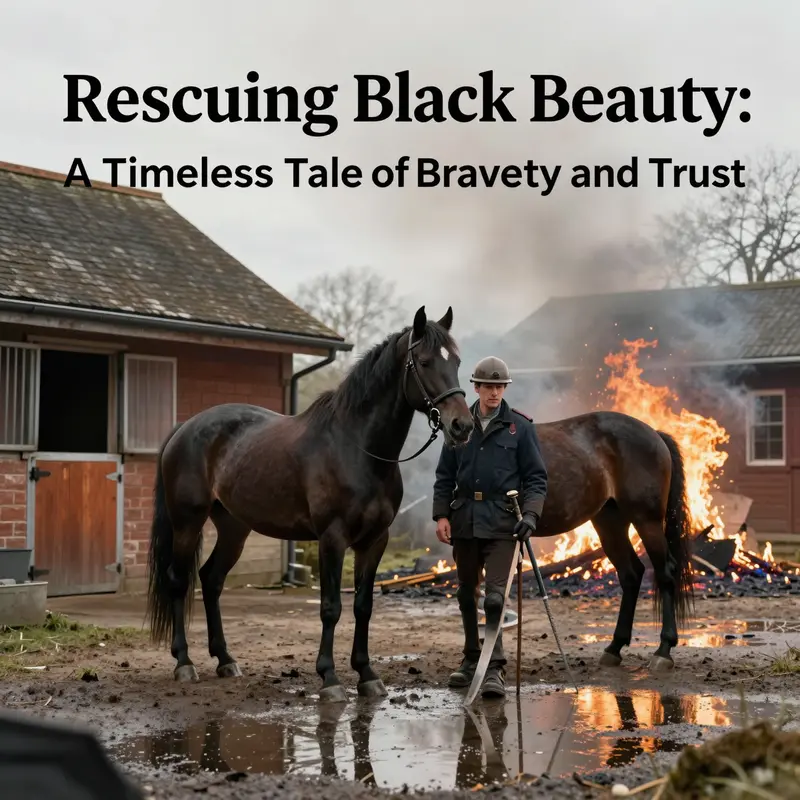
In the still hours when a stable becomes a world of its own, Black Beauty wakes to a realm of heat and ash, a world where light is swallowed by smoke and fear threads its way through every corner. The scene of that night is less a single dramatic event than a turning hinge in the novel’s moral architecture. It is here, in the choking air and the thud of hooves tremoring against timber, that the reader learns how the bonds of care between horses and people can either falter or endure under pressure. The rescue, when it comes, is not merely a technical salvation; it is a revelation of character. It reveals what compassion looks like in practice, when danger has the upper hand and the ordinary routine of daily life—the grooming, the feeding, the quiet trust built over months and seasons—suddenly seems fragile as a candle flame in a gusting wind. And because the rescue is anchored in the relationship between Black Beauty and James, it becomes a laboratory where the novel tests its central claims: that animals deserve protection, that human beings have a moral duty to act, and that trust can be the quiet engine that propels both creature and caretaker toward safety and meaning.
The opening moments of the fire scene are framed by sensory immersion. The air thickens with smoke, the lanterns throw pale halos that flicker across the stalls, and the horses stir in a chorus of nervous snorts and shifting hooves. The stable is both sanctuary and trap—the place where Black Beauty has learned to find steady, patient rhythm, and the place where, when fear erupts, courage must confront chaos. The groom’s first instinct is to lead the horses out, to replicate the routine of every other night when the doors open and two or three solid steps take them toward the yard. Yet the moment the horses refuse to move, the narrative reveals a truth more poignant than any calm instruction: fear, when it becomes collective, can bind even the strongest and most reliable beings. Ginger remains behind, a reminder that the rescue is not a solo performance but a shared, communal effort. The horse’s reluctance to abandon a friend in danger speaks to a code of loyalty that is as much a part of the animal’s temperament as it is of the social world people have built to care for them.
Into this tense tableau steps James, a figure who embodies the novel’s ideal of ethical commitment. He has been outside, perhaps checking a lantern, perhaps listening for the telltale crack of timber that signals a collapse. He returns with a voice that carries a calm confidence—“Black Beauty, come with me!”—a simple phrase, but one that carries a lifetime of trust woven into its cadence. The power of James’s utterance lies not in its command but in its tone. It is neither a shout nor a threat; it is a measured invitation extended by someone who has earned the horse’s confidence through years of consistent, humane care. It is this intimate knowledge of the animal—the way Black Beauty responds to the prompts of a soft voice, the way the horse’s muscles loosen when a trusted presence is near—that allows the moment to unfold without spectacle. The rescue does not hinge on a dramatic sprint or a heroic flourish; it hinges on a relationship built on regard and gentleness, the precise opposite of coercion and fear.
The horse’s initial hesitation—his unwillingness to move while Ginger is still inside—marks a crucial ethical pivot in the narrative. It acknowledges a truth about danger: the impulse to flee can be balanced, even outweighed, by a higher duty to others who cannot help themselves in that moment. Black Beauty’s hesitation reveals moral complexity. He is not simply a passive victim waiting for rescue; he is an agent who weighs loyalties and obligations, an animal whose sense of protection extends beyond his own narrow sense of safety. This complexity is what renders the scene so profoundly humane. The reader does not witness a mere call-and-response of rescue; they observe a moral calculation in which the well-being of another living soul takes precedence over personal survival. James’s response—grounded, patient, unfazed by the smoke and heat—transforms fear into a shared resolve. It is a testament to what can happen when care becomes a practice rather than a sentiment: a practice that steadies the trembling legs, steadies the breath, steadies the heart.
The moment of realization that Black Beauty finally trusts James enough to step into the freedom beyond the stall is a quiet triumph. It is not a dramatic, cinematic leap but a steady, almost ritual emergence into safety. The narrative emphasizes the trust that has been earned over years of grooming, of daily contact, of the quiet, unspoken rituals by which a horse and a human partner learn to read each other’s signals. In this sense, the rescue scene doubles as an origin story of the bond between man and horse in the book. It demonstrates that trust, once earned, does not vanish in a crisis; it becomes the lever by which a life can be saved. The horse’s decision to move at James’s call also serves as a subtle critique of the impulse to equate rescue with brute strength. When strength is aligned with empathy, it becomes something gentler and more lasting—a force that preserves the dignity of the animal while ensuring its safety. The emotional weight of the scene is therefore not just the fear of flames or the physical risk of entrapment; it is the moral weight of choosing to act when action could cost a person dearly or require a quiet, unheralded sacrifice.
In the broader arc of the novel, this rescue scene catches the reader at a moment of heightened awareness about vulnerability and care. The fire exposes the precariousness of safety for horses when the human world around them is imperfect or distant. It is not simply a test of physical endurance; it is a test of moral imagination. The people who tend to Black Beauty—grooms, stablehands, owners—are entrusted with more than security. They bear responsibility for the animal’s dignity, for the quiet, daily rituals that make a creature’s life worth living, and for the ethical courage to step toward danger when the moment calls. James’s bravery is not a one-off act of ingenuity; it is a consistent manifestation of the novel’s insistence that kindness is a form of practical wisdom. He embodies a model of care that extends beyond the confines of Birtwick Park and into the wider world—the world of farms and fields where animals live under imperfect, often unforgiving conditions. The fire scene, in this sense, redefines rescue as a moral obligation, not a dramatic flourish.
The atmosphere surrounding the fire is not merely a backdrop but a dramaturgical device that intensifies the meaning of the act. The sensory details—heat pooling at the throat, the acrid sting of smoke, the echo of splintering wood, the claustrophobic press of the stable walls—create a sense of life-or-death immediacy. Yet Sewell’s prose keeps a humanistic focus. We are guided to observe how fear can be transformed by patient, compassionate leadership. James does not rush Black Beauty; he approaches with a steady, reassuring cadence, choosing clarity and gentleness over panic. The reader is invited to notice the subtler cues: the way Black Beauty’s hackles settle, the easing of the horse’s jaw against the bit, the almost inaudible nod that signals a readiness to trust again. The transformation is not instantaneous but earned in a quiet, stubborn way, the way trust is earned in every long night of leading a horse through a world where danger lurks in the periphery. The scene thus becomes a study in the ethics of care, a reminder that rescue is as much about listening and attending as it is about speed and risk.
Crucially, the rescue also reframes the concept of safety. Safety, as the book presents it, is not an absolute state but a fragile balance maintained by vigilance, compassion, and moral responsibility. The stable, a place of shelter, is juxtaposed with the world beyond its doors where threats can materialize without warning. In that contrast lies a gentle critique of human institutions that promise security but sometimes fail to deliver it. The horse’s sense of vulnerability outside the sanctuary of a well-tured home is a moral cautionary tale: animals endure a world where their welfare remains contingent on human choice, on the willingness to intervene when it is hardest to do so. The rescue scene insists that such intervention is not optional but essential. It asserts that the right act in a crisis is not merely an urgent one; it is an act that preserves life, dignity, and the possibility of trust between species in a world that often tests that trust to the limit.
From a narrative standpoint, the fire rescue functions as a hinge that deepens the reader’s emotional and ethical investment in Black Beauty’s journey. It binds the fates of horse and human in a shared moment of peril and relief, transforming a terrifying episode into a vivid pedagogy about responsibility. The episode invites readers to consider questions they might not dwell on during calmer chapters: What does it mean to protect those who cannot advocate for themselves? How does one balance personal safety with the obligation to rescue a fellow creature who trusts you? And perhaps most subtly, how does a moment of rescue ripple outward, altering the characters’ internal landscapes and shaping future choices? The answers the novel offers are not sensational or self-congratulatory. They are quiet, durable, and practical—less a sermon than a lived ethic that can guide real lives across generations. The fire scene thus becomes not only a dramatic high point but a distilled expression of the book’s enduring moral project: that compassion, when enacted as a disciplined form of care, is the surest path to safety and to the renewal of trust between human beings and the animals they depend on.
The resonance of this rescue lingers in the memory of the reader, not as a solitary moment of courage but as a formative example of how an act of rescue can become a turning point in a life. Black Beauty’s subsequent conduct—more pliant in the presence of steady care, more contemplative about the risk of leaving a friend behind—echoes the scene’s implicit lesson: that rescue is less about escaping danger than about preserving a network of relationships that gives meaning to life. In the larger framework of the novel, the fire becomes a symbol not of destruction alone but of the possibility of renewal through acts of mercy. The bond between James and Black Beauty gleams with renewed intensity after the flames die down, not because danger has vanished but because courage has been demonstrated in a way that elevates both horse and groom. This transformation—a quiet, steadfast faith in each other—becomes the core of the narrative’s argument: that the welfare of animals should rest on the hands of those who know them, who treat them with reverence, and who are willing to risk themselves to save them.
As readers close the chapter on that night, they carry with them a sense that the rescue is less about the instant of escape and more about the ongoing ethics of care it embodies. The scene invites reflection on how stories of animals and humans can model responsible action in the real world. It aligns the fictional rescue with a broader moral vocabulary: that humans are accountable not merely for managing beasts but for dignifying their lives. In this sense, the fire scene remains a living, breathing part of Black Beauty’s pedagogy—an invitation to readers to consider, in their own lives, what it means to act with restraint, bravery, and unwavering kindness when danger presses in from every side. The narrative thus instructs through sympathy, guiding readers toward a posture of vigilant care in which rescue becomes a routine of daily ethics rather than a once-in-a-lifetime event.
For readers drawn to the mechanics of storytelling and the ethics of animal welfare, the rescue scene offers a compact case study in how literature can translate abstract ideals into concrete, memorable actions. It shows that the most enduring heroism in Black Beauty is not the flash of flames or the speed of a calculated escape, but the patient, steadfast commitment of a caretaker who chooses to act when it would be easier to walk away. It is this choice, repeated in countless small ways across the course of the novel, that underwrites the integrity of Black Beauty’s world and gives the story its enduring moral weight. In the quiet aftermath, when the smoke clears and the horses stand a little steadier in their sheds, the reader is reminded that the true rescue is not about saving a life from a blaze alone. It is about preserving a way of living—the intimate, reciprocal relationship between horse and human that makes life worth living for both parties—and about recognizing that in every act of care lies the possibility of a more compassionate, more responsible world.
External reading for further reflection on literary devices and the narrative weight of this scene can be found at LitCharts: https://www.litcharts.com/literature/black-beauty/summary-and-analysis.
Internal note for readers exploring the connection between narrative crisis and real-world care: in contemporary discussions of emergency management, the gaps that appear in practice often resemble the vulnerabilities the stable scene exposes. See the discussion on emergency preparedness gaps in California wildfires for a modern perspective on how communities can translate moral obligation into policy and action. emergency-preparedness-gaps-california-wildfires.
Final thoughts
The rescue of Black Beauty from the fire stands as a powerful example of bravery, loyalty, and the strong bond between humans and horses. James’s unwavering commitment to Black Beauty not only saved his life but also emphasized the crucial theme of trust found throughout Sewell’s narrative. This moment serves as a reminder that in times of crisis, the relationships we forge can lead to acts of heroism and hope. As we reflect on this story, let it inspire us to foster kindness and loyalty, both in our lives and our interactions with all beings.