
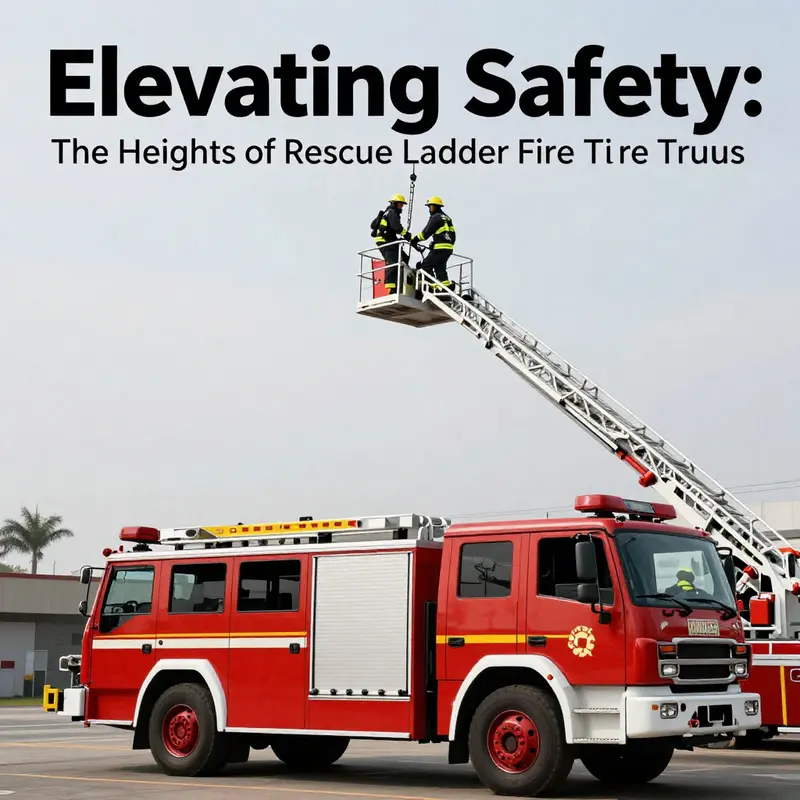
In modern firefighting, the ability to access elevated structures is crucial for saving lives and protecting property. Fire rescue ladder trucks play an indispensable role in this regard, showcasing remarkable advancements in technology and engineering that allow them to reach impressive heights. This article explores the maximum capabilities of rescue ladder fire trucks, detailing cutting-edge models capable of reaching up to 112 meters, as well as the operational limits these vehicles face under various conditions. Additionally, we delve into how structural features and environmental factors impact the effective reach of these ladders, ensuring that communities understand both the strengths and limitations of such vital emergency apparatus.
Reaching Skyward: Engineering Feats, Practical Limits, and the Real-World Reach of Rescue Ladder Fire Trucks
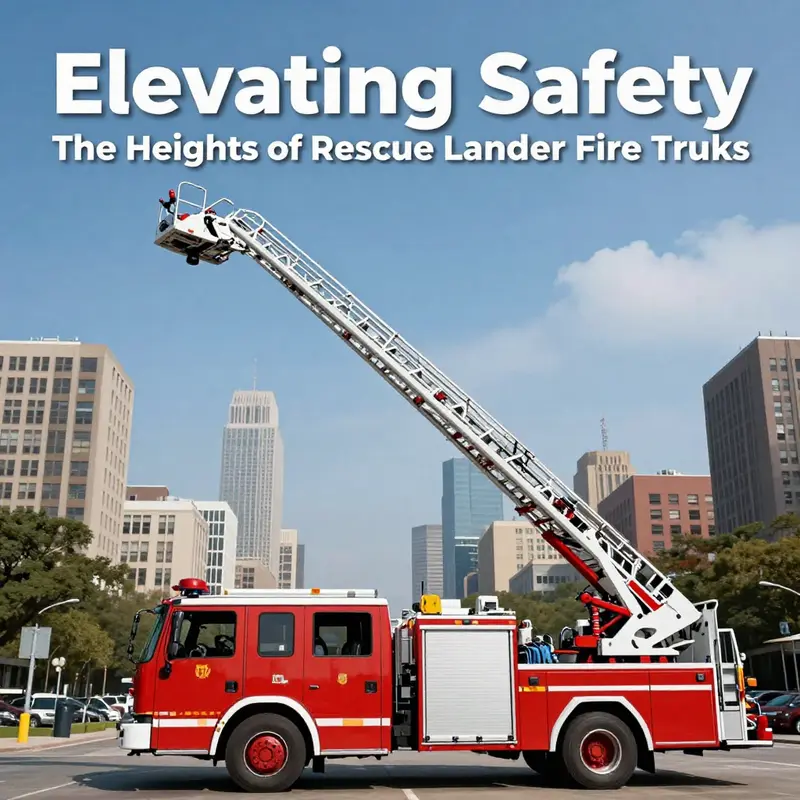
In the modern cityscape, where glass towers rise like glassy cliffs and streets compress into narrow canyons, the height a rescue ladder can reach is more than a feat of engineering. It is a measure of how quickly a firefighting operation can transition from ground level to the zone where smoke begins to corral itself around upper floors, where heat radiates and visibility collapses, and where every decision can determine whether a life is saved or lost. The pursuit of greater reach is not merely about extending a metal arm; it is about balancing speed, stability, safety, and payload. In practical terms, the height a rescue ladder fire truck can reach defines its ability to respond to high-rise emergencies in dense urban cores and to give responders a stable platform in which to work, even when the environment itself is hostile—wind gusts, shifting loads, and the structural realities of a building that is itself under threat.
From the earliest aerial devices to the most advanced platforms on the road today, the arc from ground to upper floors has grown in fitful, incremental steps. The record for working height stands at an exceptional mark, a figure that signals both capability and the limitations that come with it. The highest reported working height is around 112 meters, a scale that translates to roughly 40 stories in many urban environments. This extreme is not a general-issue tool for everyday incidents; it is a specialist asset, deployed when fires or rescues reach into the upper reaches of very tall structures or when access points at lower levels are obstructed or unsafe. Such heights embody a synthesis of advanced hydraulics, multi-section telescoping booms, robust chassis, and control systems designed to keep the platform steady enough to perform delicate tasks at great elevation. They also underscore a truth that every fire department and public-safety agency understands implicitly: with height comes risk, and the deeper the reach, the more demanding the choreography needed to keep a rescue operation safe and effective.
In a broader sense, height is a spectrum rather than a fixed ceiling. The next rung on that spectrum is the realm of approximately 101 meters, a level that has become the standard for a class of domestically produced high-reach platforms in some large urban centers. Reaching 101 meters does not just extend the vertical envelope; it multiplies the geographic and architectural flexibility available to responders. A 101-meter machine can address a sizeable portion of tall buildings that define the urban skylines in many parts of the world, particularly where new construction continues to push the boundaries of height. Yet even this impressive capability has to be weighed against the realities of operation. Platforms in this class arrive with substantial platform load capacities, typically designed to support a crew of four plus their equipment, a critical factor when firefighters must maneuver hoses, tools, thermal imaging devices, and rescue gear while perched high above ground. The platform must not only reach the target height but also sustain a working environment that remains controllable and safe under challenging conditions.
The practical realities of using a rescue ladder at extreme heights demand attention to a constellation of technical disciplines. Hydraulics drive the telescoping action that extends the arm, while the vehicle’s chassis provides the counterweight and structural integrity that keeps it stable on city streets, even when the outriggers are deployed and the surface beneath is uneven or soft. The boom’s joints must resist bending moments created by wind and by the dynamic loads of personnel moving within the platform. Control systems—ranging from hydraulic pressure regulation to sophisticated sway reduction technologies—are essential to limit lateral movement so that precise operations—such as cutting through building exteriors, probing for victims, or delivering air supplies—remain feasible rather than precarious. In this context, the operational envelope is defined not by the maximum reach alone but by a balance of reach, load, stability, and the time it takes to deploy and retract the apparatus safely.
A crucial distinction in discussing reach is the difference between theoretical extension and practical working height. Theoretical extension describes how far the arm can extend in a free, unobstructed environment. Practical working height, by contrast, takes into account wind conditions, surface constraints, traffic, and the need to move the vehicle and operator into position without compromising safety. Even when a platform can reach an astonishing vertical extension, wind can render a rescue operation impractical. A level of wind that might seem modest on the ground can translate into dangerous sway at the extreme ends of a long, high-velocity boom. The sway is not merely an annoyance; it constrains the operator’s ability to perform precise tasks, limits the safe working envelope, and imposes stricter gust- and drift-related safety margins. Consequently, while a platform may be capable of reaching beyond the 100-meter mark, real-world operations typically occur within more conservative ranges, especially during emergency conditions when visibility is limited, temperatures rise, and the building’s own structural integrity is compromised by heat and fire.
The story of reach is also a story of materials and manufacturing discipline. High-strength steel alloys and advanced composites reduce weight while preserving stiffness. This lightweight but strong approach improves the platform’s load-to-height ratio, enabling greater vertical extension without sacrificing stability. Yet lighter materials introduce their own challenges: the precision of manufacturing tolerances, long-term fatigue under cyclic loads, and the need for meticulous maintenance to ensure that each joint and hydraulic cylinder operates within its expected life cycle. The structural design must accommodate not only the explosive demand of a sudden elevation but the daily wear of routine training, inspection, and occasional testing. In practice, this translates into a maintenance culture that treats every bolt, hose, and valve as a critical link in a chain that begins with a design drawing and ends with a firefighting crew being able to function at height when every other option has failed.
For the crews who depend on these platforms, the operational philosophy emphasizes predictability and control. Operators train to read the environment quickly: the direction and speed of the wind, the way smoke and heat distort light, and how a building facade might react to the fire’s heat. They learn to position the truck with careful attention to ground conditions, street width, and weight distribution. The process emphasizes smooth, measured movements rather than the rapid, aggressive actions that might seem intuitive on the ground. The difference between a successful high-rise rescue and a failed attempt often hinges on the crew’s ability to translate the plan from a drawn diagram into a sequence of precise mechanical actions at altitude. It is in this translation—where hydraulic power becomes synchronized with operator judgment and environmental variables—that the real artistry of these machines reveals itself.
In some high-level demonstrations and real-world deployments, teams have shown that operation at extreme heights is not only about raw capability but about the strategic use of technology to create a viable working envelope. A platform with a high reach must also deliver a stable work surface—a platform that can hold up to several hundred kilograms while resisting the sway caused by wind and by the movement of occupants. In these scenarios, the chassis design, outriggers, and ballast arrangements are co-optimized with the hydraulic system. The objective is to ensure that when firefighters assume positions on the platform, their movements do not translate into dangerous instabilities that could jeopardize the operation. The result is a system that appears almost surgical: precise, deliberate, and reliable enough to support critical tasks such as rescue through windows, rope-assisted evacuations, or the delivery of life-sustaining air and equipment to victims trapped within high floors.
The development arc of high-rise rescue platforms is deeply influenced by urban growth patterns and the evolving demands of city planning. In cities where new towers rise at a pace that outstrips traditional firefighting apparatus, the impetus to push reach higher becomes both a practical necessity and a public safety imperative. When a city adds dozens of new high-rise structures to its skyline, the ability to access upper floors from a safe distance changes from a luxury to a core capability. In response, domestic manufacturers in densely urbanized regions have pursued significant improvements, often drawing on international designs as a template while committing to local adaptation. This approach—often described in industry circles as importing, digesting, absorbing, and innovating—helps cultivate a domestic capability that reduces dependence on foreign equipment for high-stakes emergencies. The same path helps ensure that these advanced vehicles can be supported by local supply chains for maintenance, repair, and upgrades, which in turn sustains a city’s readiness over the long term. It is a practical acknowledgment that high-rise firefighting is not only about the hardware that carries people to height but also about the ecosystem that keeps that hardware ready to perform when called upon.
The numbers tell a story of both aspiration and constraint. The leading high-reach platforms now operate in a band that begins around 60 meters for routine operations—covering the vast majority of mid-rise incidents—and extends well beyond 100 meters for specialized scenarios. The jump from a practical 60-meter class to a 100-meter-plus platform is not merely a matter of adding more metal; it requires a rethinking of stability, hydraulics, load management, and the demands placed on the driver and operator. Some configurations feature multi-section arms that fold and unfold with impressive smoothness, while others rely on a telescoping approach that can deploy quickly to engage a target, then hold a position for complex tasks. Each design choice carries implications for the vehicle’s center of gravity, its ability to counterbalance with ballast and outriggers, and the inertia that must be managed during deployment and retraction.
What does all this mean for the everyday reality of firefighting in a high-rise environment? It means that the typical ladder, which serves most buildings up to a certain height, remains essential for the majority of incidents. Forty to sixty meters is a common operating range in many urban fire departments, providing rapid access to a wide range of floors and enabling firefighters to work efficiently on balconies, windows, and stairwells. The higher platforms fill a critical niche when firefighters need to reach higher-than-usual floors, insert long tools through windows, or rescue occupants with limited escape routes. In other words, the ladder’s height is not a single metric but part of an integrated toolkit—the ladder, the ladder’s reach, the vehicle’s mobility, and the crew’s training—each piece reinforcing the others to expand the overall capability of the department.
The story also circles back to the human element. A machine can be capable of extraordinary height, but without well-trained operators, protective protocols, and resilient safety margins, the operation can still fail under pressure. A platform that reaches a record height must be matched by a crew that understands how to set up the vehicle quickly, how to manage line-of-sight constraints, how to work within effective wind limits, and how to coordinate movements with other units on the scene. The best-case scenario is a synchronized effort in which engine, ladder, and command center operate in concert, allowing four or more firefighters to work on a high-altitude task while remaining within the platform’s safe working envelope. The complexity of such operations underscores why ongoing training, regular maintenance, and careful risk assessment remain central to the use of high-reach platforms in emergency response.
To situate these considerations in a concrete sense, consider the practical implications of a 101-meter platform when deployed in a city with a dense vertical mix of structures. The platform’s reach covers a large slice of the skyline but still leaves deep pockets where access remains challenging due to architectural features, prevailing winds, or surrounding obstacles. In those cases, the ladder becomes part of a strategic approach that includes rapid vertical reconnaissance, the use of ground-based tools to manipulate fire behavior, and careful planning for interventions that minimize exposure to heat and smoke for responders. The platform’s load capacity becomes especially important when four firefighters and their gear must operate in a constrained space at height, coordinating with venting operations, the placement of rescue devices, and the safe injection of air or other lifesaving supplies to victims. This complexity is why a high-reach platform is not merely a larger ladder but a sophisticated system that must be understood, operated, and maintained with rigor.
This nuanced picture of reach—where the upper limits exist but are tempered by wind, stability, and operating safety—helps explain the evolution of high-rise firefighting equipment. It also frames the role of domestic innovation in settings where urban populations are growing rapidly and where the architectural landscape is continually being redefined. In these environments, the ability to acquire, assimilate, and improve upon foreign designs has become a central theme. The core idea is to build a capability that does not rely on a single engineering feat but rather on a portfolio of technologies and practices that collectively extend the practical reach and reliability of rescue platforms. This includes not only the boom itself but the chassis, the counterweights, the hydraulic distribution, the operator consoles, the imaging and navigation aids, and the procedural discipline that governs deployment under fire and smoke.
Readers curious about the broader context of these advances may find additional reflections in the public discourse surrounding high-rise firefighting, including ongoing discussions about best practices, training, and equipment lifecycle. For a concise primer that touches on similar themes while offering a window into the broader culture of early-stage experimentation and public safety, consider a brief exploration available online at Hello World. It serves as a reminder that in many technical domains, the journey from concept to operational reality is a long, collaborative process that blends engineering rigor with on-the-ground experience. Hello World.
As these platforms push upward, the future of high-rise firefighting will likely continue to hinge on a loop of innovation. New materials may unlock lighter, stronger booms; control algorithms may better damp sway; and integration with other technologies—thermal cameras, drone-assisted reconnaissance, or exterior stabilization systems—could further expand the practical envelope of operating at height. The central lesson remains consistent: reach matters, but only when coupled with stability, safety, and the capacity to execute critical tasks under duress. In dense urban cores, where every floor can hold a different hazard profile and every window can conceal a life-or-death moment, the interplay between height, technique, and timing defines the boundary between triumph and tragedy. The highest platforms represent the edge of what is technically possible today; the true measure of their value lies in how effectively they empower rescuers to reach, assist, and protect people when visibility is low, the clock is ticking, and the city’s vertical expanse demands courage and precision.
External considerations also shape how these remarkable machines are designed and deployed. The global landscape of high-rise rescue capabilities reflects divergent priorities: some regions emphasize extreme reach to serve the tallest megastructures, while others prioritize rapid deployment, maneuverability through congested streets, and the capacity to operate within a broader fleet of standard-height units. In either case, the central challenge remains consistent: how to translate a remarkable technical achievement into a reliable, safe, and timely intervention for those in danger high above the ground. Because the ultimate purpose of a rescue ladder is not to showcase a number on a gauge, but to make a difference when every second counts. The conversation about reach, therefore, intertwines engineering ambition with public safety realities, urban growth, and the sustained dedication of crews who train to turn potential into practical rescue when flames threaten the upper floors of urban life.
For readers seeking a broader look at how such capabilities are evolving in different contexts, external reporting highlights ongoing developments in high-rise firefighting across major urban centers. These narratives underscore the pace at which cities are embracing higher cores of verticality, while reminding us that the most decisive advancements occur when engineering breakthroughs are matched with disciplined operation, maintenance, and continual learning from each critical incident. In this light, height is not merely a metric; it is a marker of a community’s readiness to protect its people as buildings grow taller and the spaces between street and sky become more consequential in emergencies. The journey toward greater reach continues, guided by the same principles that have always governed firefighting: courage, craft, and a relentless commitment to safeguarding life.
External resource: https://www.sohu.com/a/765432109_121439
Beyond the Ladder: Reaching New Heights and Reimagining Rescue Platforms in Firefighting
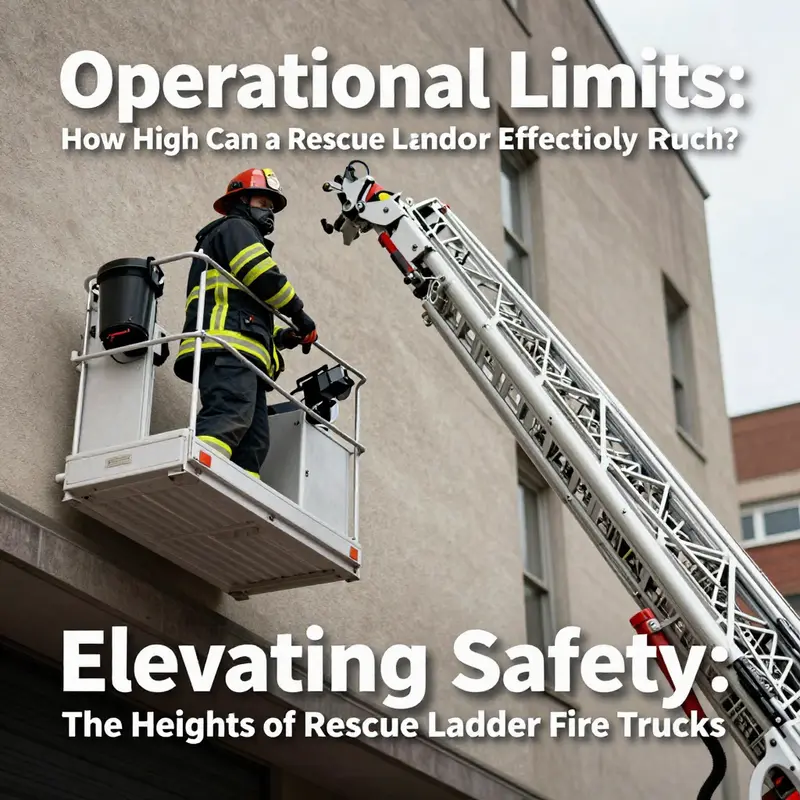
When people ask how high a rescue ladder fire truck can reach, they are really asking about the boundary between traditional access and the evolving toolkit of modern firefighting. The short answer is practical and varies by context. In most cities, a standard aerial platform offers a working reach around 50 meters, which aligns with the needs of mid-rise structures and many urban precincts. This range has long defined routine operations: it is tall enough to reach the upper floors of many apartment blocks and offices, while still providing the stability and control responders rely on in the heat and chaos of a live incident. Yet the skyline keeps changing, and so do the instruments we deploy to meet its demands. The tallest reported working height in the contemporary era sits well above that threshold, with records pointing to a 112-meter aerial platform developed by a European manufacturer. That figure, while remarkable, does not represent a universal capability or a one-size-fits-all solution; it stands as a benchmark for what is technically possible and a reminder that height alone does not equate to effectiveness on the ground.
To situate these numbers within real-world practice, it helps to consider the broader spectrum of platforms in operation today. Across markets, there are high-reach systems that eclipse the 100-meter mark, but these are not ubiquitous in urban fleets. In some regions, domestically produced high-reach platforms claim heights around 101 meters, enabling rescue and firefighting capabilities on buildings that tower well beyond the mid-rise category. At the same time, the majority of fire departments rely on platforms in the 40- to 60-meter range for day-to-day emergencies and for the bulk of high-rise responses. Within that band, several intermediate configurations have become common in dense urban cores, providing a balance of reach, maneuverability, and cost. A 72-meter class unit, for instance, represents a practical leap beyond conventional ladders while still maintaining the control and stability required for near-vertical operations in complex urban environments. A 42-meter platform is frequently cited as a workhorse for mid-rise rescues, offering enough elevation to address many common high-rise scenarios while keeping the apparatus within the traditional handling envelope of fire engines.
But height is only one dimension of capability. The modern reality is that a rescue platform operates as part of a broader ecosystem of access, water delivery, and rescue—an ecosystem that increasingly relies on intelligent, adaptive systems to extend reach in meaningful, life-saving ways. The challenges posed by super high-rise buildings are not merely about getting firefighters to the uppermost floors; they involve delivering water or foam to the point of need, maintaining stability on windy days, and coordinating with personnel inside the building who are navigating stairwells and elevators under duress. In tall structures, winds aloft can generate sway and unpredictable load dynamics. The platform must not only extend vertically but remain controllable and safe under shifting gusts and changing wind shear as the chassis and the arm interact with the air. The most capable platforms factor these realities into their design: multi-section arms that can articulate with precision, counterbalance systems that absorb dynamic loads, and operator interfaces that translate complex movement into intuitive control. Even with advanced hydraulics and robust materials, the practical ceiling of a rescue platform is often the weather outside. A platform stretched to its maximum can become a liability if wind conditions exceed safe operating thresholds. This delicate balance between height and stability explains why even at the high end of the spectrum, rescue crews approach extreme heights with a disciplined calculus that weighs time, access, rescue probability, and structural integrity of the target building.
The push toward greater reach edges into what might be described as a new frontier of firefighting technology. As height scales up, responders and engineers alike are rethinking the means of achieving access and administering suppression. One of the most consequential shifts is the emergence of intelligent firefighting systems designed to compensate for the gaps left by traditional ladders. In recent demonstrations, researchers and rescue teams in Asia have tested systems that move water not by a conventional hose line from a truck, but through a network of climber-equipped devices that can ascend a building’s exterior and still deliver water with precision. Reported capabilities include vertical water transport to as much as 200 meters, an order of magnitude beyond what a ladder can achieve in most urban settings. These systems deploy compact robotic modules that attach to or ride along a vertical conduit and position water cannons—sometimes with adjustable spray patterns and rates—to saturate the target area. The water flow rate in these tests is around 5 liters per second, a rate that may seem modest in isolation but becomes significant when scaled against the time required to reach and flood hot zones on the upper floors of a high-rise. The reach of spray in these configurations roughly matches the four-to-five-decade range of a mid- to high-rise floor, while the water’s vertical ascent bypasses the need to physically maneuver a large payload to the topmost levels. In practice, this technology does not replace ladders but augments them, broadening the window for timely life-safety interventions when traditional access is impractical or impossible.
The implications of such advancements are profound for urban safety planning. Cities are densifying, and tall buildings are a defining feature of the modern cityscape. The math of rescue becomes a blend of geometry, fluid dynamics, and human factors. A longer ladder can close the distance to a fire and provide a means of direct rescue and interior venting, but it cannot stand alone when faced with structural combustion, smoke movement, and the need to stabilize occupants in lofty apartments and offices. The intelligent systems, by contrast, can deliver water and foam into zones that are hydraulically shielded from a conventional platform, laying down a defensive line in the upper echelons of a structure while crews reposition for interior access or create a ventilated corridor for evacuation. They introduce an alternative modality of intervention that acknowledges the limits imposed by wind and structural integrity at extreme heights. Yet these systems come with their own sets of constraints: energy requirements, energy management within a hazardous environment, and the need for robust control interfaces that ensure operators can respond quickly to evolving fire dynamics without becoming overwhelmed by the complexity of the apparatus.
As the landscape of capabilities expands, the dialogue around height tends to center on three interlocking themes. First, reach remains a critical but not sole determinant of effectiveness. A platform that can extend to a building’s top floor but cannot maintain stability or provide reliable dewatering and water supply is not inherently more effective in an emergency. Second, the integration of new technologies—whether robotic climbers with water cannons or hybrid systems that couple aerial access with ground-based water distribution—offers new tools for mitigating risk and extending the tactical options available to responders. Third, and perhaps most important, the value of height is bounded by the demands of the building, the stage of the fire, and the needs of occupants. For example, a late-stage interior fire in a tightly compartmentalized high-rise may benefit more from rapid internal access and aggressive interior suppression than from a maximal exterior reach. Conversely, a rapidly spreading exterior fire on a tall structure may necessitate both an elevated platform and a supplemental vertical water delivery system to create defensible space and protect stairwells and elevators for evacuations.
The practical takeaway is nuanced: the height of a rescue platform is a key capability, but its true worth emerges only when it aligns with the building’s geometry, the fire’s progress, and the available human and mechanical resources. In many urban settings, a ladder in the 40- to 60-meter range offers an efficient compromise that supports routine rescues and rapid vertical egress for occupants while preserving the vehicle’s stability and speed. For emergencies that push beyond those limits, departments increasingly rely on a layered approach. A combination of higher-reaching platforms, portable lift devices, and intelligent water-delivery solutions can converge to deliver a holistic response. The challenge is to implement these technologies in a way that integrates smoothly with existing command structures, training regimens, and maintenance schedules. It is not enough to own a device capable of extraordinary height; it must be deployable within the constraints of urban traffic, station logistics, water supply, and the safety protocols that govern high-risk operations.
This broader perspective on reach also invites policymakers and city planners to reconsider how they view high-rise safety infrastructure. If the tallest platforms can reach beyond the top floors, there is a case for designing building interfaces that facilitate rapid external access or alternative water delivery paths during emergencies. This could involve standardized anchor points, dedicated fire-rescue shafts, or exterior facades engineered to accommodate climbing robots without compromising daily integrity. At the same time, the integration of intelligent systems into the firefighting repertoire highlights the importance of interoperability across agencies, manufacturer ecosystems, and training programs. Operators must understand not only how to control the machinery but how to interpret sensor feedback, coordinate with interior crews, and adapt to the unique thermal and structural signatures of each incident.
In closing, the question of how high a rescue ladder fire truck can reach serves as a focal point for the evolving architecture of modern firefighting. It invites us to recognize both the limits of existing ladders and the potential of emergent technologies to fill those gaps. The leading-edge heights—whether in the 100-meter neighborhood or beyond—demonstrate that height, while impressive, is not the sole measure of capability. The real metric is the ability to secure lives, protect property, and maintain safety for responders in the face of the unpredictable dynamics of fire and collapse. For readers seeking deeper engagement with these developments, a comprehensive resource explores the broader landscape of adaptable, customizable fire-truck solutions designed for diverse rescue needs in developing contexts. Comprehensive Customized Fire-Truck Solutions for Developing Countries. The discussion continues to evolve as intelligent firefighting equipment and climbing-robot systems advance, offering a glimpse of a future where reach is augmented not just by extended booms but by coordinated, multi-modal intervention strategies. For a thorough examination of recent tests and demonstrations of these intelligent firefighting capabilities, including vertical water transport and climbing robots, see the external resource linked in the accompanying notes. External resource: https://news.cgtn.com/news/2024-11-15/Chinese-fire-and-rescue-team-tests-intelligent-firefighting-equipment-1jL3Y8RZ9kA/index.html.
Reaching the Sky: How Structure, Wind, and Urban Design Define the Reach of Rescue Ladders
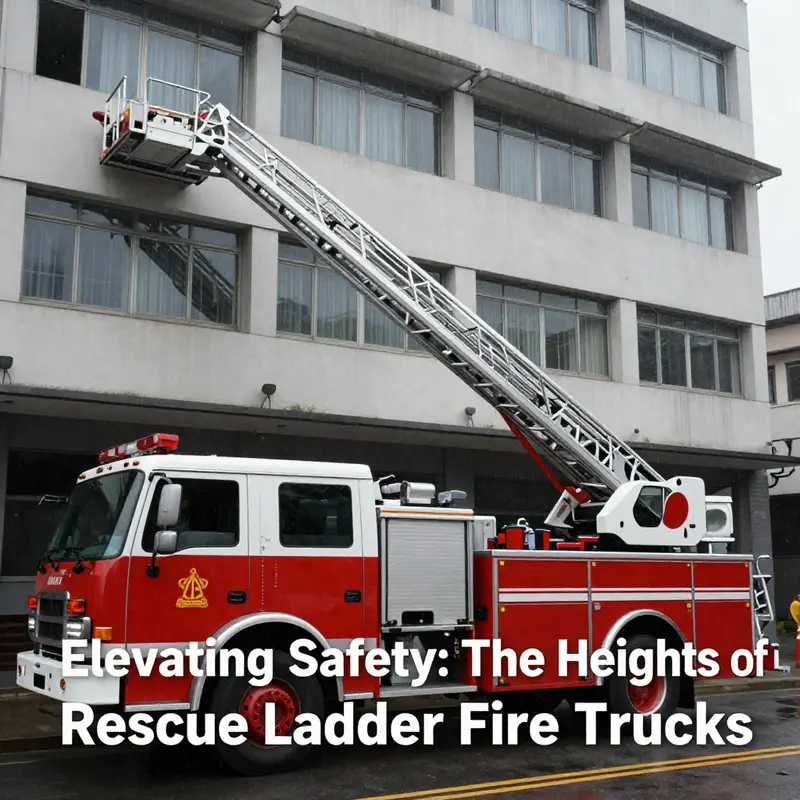
Every question about how high a rescue ladder fire truck can reach hides a more complex truth: reach is not a single measurement but a conditional capability shaped by structure, weather, and the science of stabilization. The public image of a ladder blooming from a truck and stretching into the upper floors of a building is compelling, but the practical, safe reach of an aerial platform rests on a confluence of factors that must be understood in tandem. As the latest evidence in the field shows, the theoretical maximum height of modern aerial systems can exceed seventy meters, and in some configurations even cross into the triple digits. Yet the practical ceiling is rarely the same, because every scene presents a unique set of obstacles. The highest heights are rarely, if ever, exercised in routine operations. More commonly, firefighters work within a more modest envelope that still demands precision, balance, and rapid decision making under pressure. The story of reach, then, is a story of balance between ambition and discipline, where the design of the vehicle, the geometry of the building, and the environment converge to create a dynamic limit that operators must respect in real time.
Structural design of buildings sets the stage for how an aerial ladder can engage a rescue scenario. In architectural terms, tall façades have grown increasingly complex. Modern high-rises can feature recessed windows, cantilevered balconies, glass curtain walls, and irregular contours that deflect the ladder away from a straight ascent. These features are not mere aesthetics; they can obstruct the ladder’s path, complicating alignment and reducing the usable angle at which the platform can function. When a façade introduces overhangs or sculpted projections, the ladder may have to navigate around corners, potentially forcing firefighters to abandon a direct vertical approach in favor of a more constrained, angled reach. The structural integrity of the building during a fire compounds this complexity. If heat exposure has weakened supporting elements or if the core is compromised, the risk of sudden instability increases. Under such circumstances, incident commanders cannot permit the ladder to extend to its maximum possible height without ratcheting back to a safer working range. The ladder becomes less of a tool for direct vertical access and more of a controlled platform for situational assessment, rescue of occupants within a safer arc, and protection of firefighters working nearby. This is not just a theoretical constraint; it is a practical reality observed across urban centers where the geometry of the built environment collides with the physics of elevated platforms.
Beyond the geometry of the structure, the accessibility infrastructure surrounding a building—what urban planners and fire engineers call firefighting access surfaces—plays a decisive role in determining how effectively an aerial apparatus can reach residents. In dense urban blocks, the turning radii required by large vehicles, the proximity of other streetscape elements, and the availability of level, non-slip landing zones all influence the operator’s options. A lack of dedicated firefighting surfaces can force crews to contend with precarious positioning, reduced ladder angle, or even the need to reposition the vehicle repeatedly, all of which slow operations and can compromise safety. A 2025 analysis of a dense urban fire event in a major Asian city highlighted how inadequate access routes and poorly maintained firefighting surfaces within tightly packed blocks significantly hampered response time and reach. When streets are narrow, when parking is constrained by curbside restrictions, or when loading bays fall short of the required dimensions, the operational envelope of the aerial platform shrinks further. A truck may be technically capable of reaching a certain height in the abstract, but the actual working height—defined by the need to maneuver the ladder without destabilizing the vehicle, while keeping the operator within a safe range of motion and visibility—becomes a function of the surrounding space. In turn, this elevates the importance of pre-incident planning, building code integration, and ongoing collaboration between fire services and urban designers to ensure that future developments include firefighting access provisions that align with the capabilities of high-reach platforms.
The environment, a constant variable in every incident, adds another layer of constraint. Wind is the most pernicious factor when a ladder extends high above the street. Crosswinds can push the platform laterally, threatening stability and complicating the operator’s control of both the vehicle and the ladder head. Fire departments commonly apply wind thresholds to aerial operations, typically limiting activity when sustained winds surpass a moderate speed range. The precise numbers vary by jurisdiction and the specific configuration of the ladder, but the principle remains: the higher the ladder, the more sensitive the system becomes to wind. Temperature and atmospheric conditions exert their influence as well. Extreme heat can affect hydraulic performance and material strength, while very cold conditions can alter fluid viscosity, affect battery performance in electric components, and change the operator’s tactile feedback through the controls. Visibility is another ally of danger; smoke, fog, or precipitation can obscure distance judgments, angles, and the alignment between the ladder and a target window or ledge. In smoke-filled conditions, even a well-calibrated system may require more conservative operating parameters, slower extension, and closer on-ground supervision to maintain safety margins.
Technology and control systems have evolved to counterbalance these environmental and structural challenges. Modern aerial platforms come equipped with automatic leveling systems that rapidly stabilize the chassis on uneven ground or sloped terrain, bringing the vehicle into a stable stance in seconds. Integrated sensors monitor wind speed, platform tilt, load, and hydraulic pressures, feeding a real-time data stream to the operator and to on-board control software that can compute safe operating envelopes. This smart software translates raw measurements into actionable guidance: it can limit the ladder’s maximum extension, adjust the permissible working angle, or prompt the operator to reposition for better stability or safer access. These technologies do not remove risk; they reduce it. They provide a framework for safe decision-making that supports, rather than replaces, the judgment of skilled firefighters who must interpret the incident environment, the building’s behavior in fire, and the ladder’s capabilities.
Yet even with stabilization and sensors, the human factor remains central. The operator’s experience with height, angle, and load behavior is crucial. The scene dynamics evolve quickly as smoke expands, temperatures rise, and occupants move. The ladder’s harness of safe operating parameters becomes a guide rather than a guarantee. This is why pre-incident planning—drills, familiarization with local building stock, and the integration of aerial ladder considerations into city-wide emergency planning—matters as much as the hardware itself. Aerial reach is not the primary determinant of success; it is one of several critical enablers that must work in concert with crew proficiency, incident command decisions, and the broader tactical plan. Indeed, the most effective response often hinges on a blended approach: a platform that can reach higher floors when conditions permit, paired with ground operations, rope systems, and rapid exit strategies for occupants who cannot be reached from above. In the calculus of high-rise rescue, reach is a variable that interacts with many others, including entry points, stairwell access, elevator operations during a blackout, and the availability of dedicated firefighting surfaces on the building’s exterior.
In practice, the typical working reach that urban fire departments rely on for day-to-day rescues commonly falls in the neighborhood of forty to sixty meters. This range is well suited for mid-rise structures where stairwells, balconies, and accessible window openings provide reliable access points. It accommodates the majority of standard urban building configurations while preserving a margin of safety, especially when winds are unsettled or when the structure shows signs of thermal weakening. For specialized operations—where high-energy fires drive rapid vertical escalation, or where occupants are stranded on higher floors—the ladder may extend further, sometimes beyond the seventy-meter class, but only under carefully controlled conditions and with additional safety measures in place. The existence of taller configurations, including those that can exceed one hundred meters, speaks to a capability that exists on the envelope of performance rather than as a routinely exercised constraint. These extreme configurations are context-dependent, brought into play when incidents demand access to upper floors of super-tall buildings or when the interior egress routes are compromised and exterior access becomes essential. The practical takeaway is that reach is a capability with a spectrum: while the device can physically extend to remarkable heights, the operating window narrows with height, and the safety calculus becomes increasingly intricate as more variables come into play.
The interplay of structure and environment also intersects with urban planning and policy. As modern cities grow vertical, the alignment between building codes, street design, and firefighting infrastructure becomes more important. Fire service access surfaces must accommodate the turning radii and workspace required by aerial platforms, including the clearance around the ladder head and the space needed for safe deployment of the platform while maintaining the stability of the vehicle. The 2025 Hong Kong Tai Po incident emphasizes this point: dense urban blocks with poorly designed or maintained access routes frustrate the most capable apparatus, forcing crews to compromise on reach and often lengthening response times. The implication for planners is not to add more height for its own sake but to ensure that high-reach capabilities have a clear, reliable, and safe operating corridor. It is not merely about stockpiling height; it is about integrating high-reach rescue into the city’s operational narrative—where streets are wide enough to accommodate the ladder’s footprint, where building gaps align with platform reach, and where contingency plans for wind and weather are embedded in the day-to-day readiness of first responders.
In this light, a widely cited takeaway emerges: although modern aerial platforms can be described in terms of their maximum potential extension, the actual, usable reach on any given incident is bounded by a matrix of structural and environmental constraints. The theoretical maximum is a compass bearing, not a guarantee. The practical reach is the path that emerges when the street, the façade, the weather, and the crew’s competence align to create a safe and effective operating envelope. It follows that maximizing rescue outcomes requires more than escalating the height ceiling of the ladder. It requires a holistic approach—one that considers building design, urban firefighting surfaces, weather forecasting, and the training and preparedness of the responders who must translate potential into performance at the exact moment of need.
To illustrate the integrative nature of this challenge, consider how a single piece of infrastructure—the firefighting access surface—interfaces with the vehicle’s capabilities. A well-designed access surface reduces the need to tilt or angle the ladder excessively to achieve a safe stance, thereby preserving more of the ladder’s usable height. Conversely, when access surfaces are ill-suited to the size of modern platforms, the operator must compensate with shorter working angles, which reduces reach and increases the risk of misalignment. This relationship underscores why some cities invest in urban reconstruction programs that include dedicated firefighting corridors, standardized turning radii, and clear zones around affected buildings during emergencies. These measures do not just expedite response; they extend the practical reach of aerial equipment by maintaining the operator’s ability to deploy at a favorable angle and height.
The evolution of aerial ladder technology, with its automatic leveling, real-time sensors, and smart control algorithms, adds a new layer of resilience to the reach equation. These advancements help systems cope with wind, tilt, and load variations during operation. They do not erase physical limits, but they do expand the margin within which firefighters can work safely. In the hands of experienced operators, these tools translate into more precise positioning, better assessment of the structural condition, and more reliable engagement with victims on higher floors. Still, the ultimate limit remains a balancing act: height, stability, human judgment, and the safety of those in and around the building must all be weighed in real time. It is this balance that defines the professional art of aerial rescue and the science that supports it.
In conclusion, the reach of a rescue ladder fire truck is not a single distance etched in steel. It is a dynamic attribute shaped by the geometry of the target building, the configuration of surrounding urban space, the environmental conditions on the scene, and the sophistication of stabilization and control technologies. The practical use of reach emphasizes the need for comprehensive urban planning and incident planning that acknowledge these constraints. It calls for a thoughtful integration of high-reach capabilities into emergency response strategies, ensuring that a city’s tallest, most complex buildings can be approached safely when every other option may be compromised. As the research indicates, the highest possible heights exist, but their safe and effective use is contingent on a confluence of structure, environment, and skilled human judgment. When aligned, these elements empower responders to extend the reach of rescue ladders in a way that saves lives without sacrificing safety. In that sense, reach is less about how tall a ladder can stretch and more about how well a city can prepare for the moments when height becomes a matter of life and death. For readers seeking to explore connected discussions on the practical design and deployment of high-reach fire apparatus in a world of diverse urban forms, a comprehensive resource on customizable fire truck solutions offers practical insights into aligning equipment capabilities with local needs and constraints, including how planners and responders collaborate to extend the effectiveness of aerial systems in developing and challenging urban environments.
Internal link reference: To explore how adaptable fire truck configurations can support diverse urban needs and improve operational readiness, see Customizable fire truck solutions for developing countries. https://tpbhrescue.org/customizable-fire-truck-solutions-for-developing-countries-diverse-firefighting-needs/
External resource for further reading: For standards and safety guidance related to aerial apparatus operation and stability, consult established industry guidelines and professional standards organizations. https://www.nfpa.org
Final thoughts
In conclusion, the reach of rescue ladder fire trucks is a testament to both engineering excellence and the necessity for effective emergency response. As we’ve seen, while some models boast heights exceeding 100 meters, the operational effectiveness of these vehicles is influenced by multiple factors, including wind conditions, structural integrity, and on-site challenges faced by firefighters. Understanding these nuances enhances community awareness and trust in firefighting capabilities, emphasizing the continuous advancements in rescue technologies as they adapt to urban landscapes and emergency scenarios.